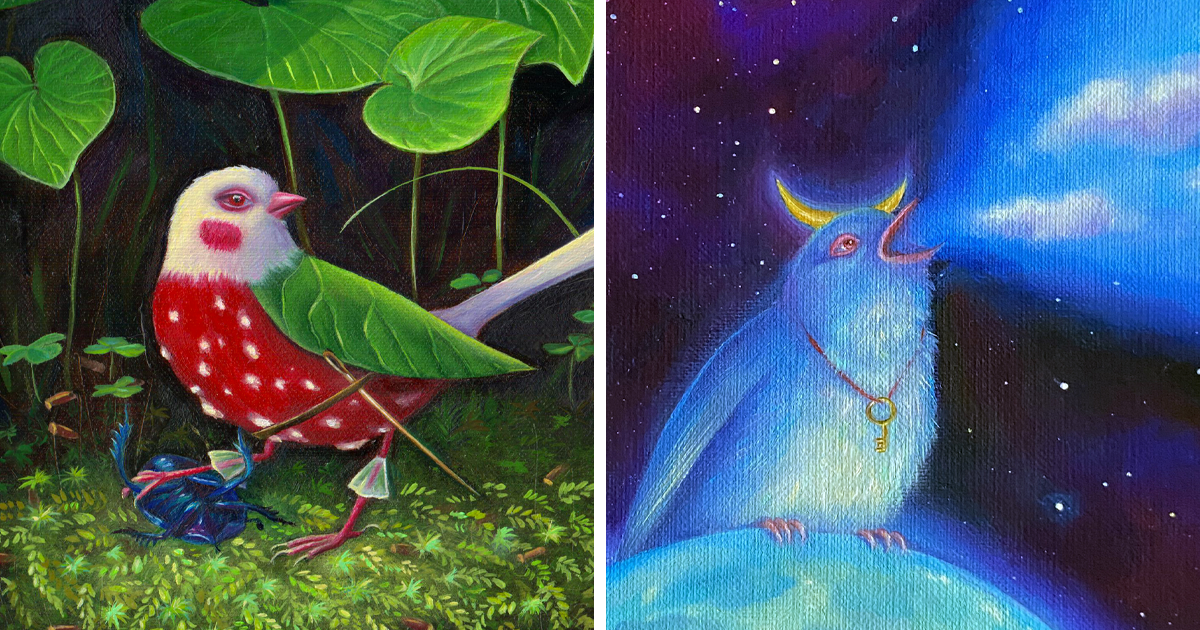
Some paintings give you a hug. Some paintings give you a side-eye. And some of the most memorable ones do both at the exact same time. That strange emotional collision is the whole point of the work in this series. I want the viewer to feel calm enough to linger, but uneasy enough to keep looking. Not panic, not chaos, not a haunted-house soundtrack with budget fog machinesjust that delicious, hard-to-name tension where beauty and dread sit at the same table and pretend they are not related.
Across art history, that blend has always had a pulse. Quiet rooms can feel loaded. Soft light can feel suspicious. A familiar street, doorway, chair, or empty bed can suddenly behave like a psychological trapdoor. That is why peaceful yet anxious art is so powerful: it sneaks into the nervous system dressed as serenity. One moment the viewer is admiring the color harmony, and the next they are wondering why an ordinary hallway feels like it knows their secrets.
These paintings lean into that contradiction on purpose. The surfaces are gentle. The compositions are controlled. The colors often whisper instead of shout. But inside the stillness, something is always slightly off: a doorway opens into too much darkness, a figure stands with impossible patience, a landscape looks restful until the sky starts acting suspicious. The result is a body of conflicted feelings paintings that aim to hold peace and anxiety in the same frame without forcing either one to win.
Why Peaceful Paintings Can Feel So Unsettling
The short answer is that the human brain does not love unresolved tension nearly as much as art does. When a painting gives us enough information to feel grounded but not enough to feel fully safe, our attention sharpens. We lean in. We scan the edges. We start building theories. Ambiguity becomes a magnet. That is why unsettling paintings often work best when they are not loud. A scream is obvious. A whisper from the next room is much more effective.
That emotional friction gets stronger when an image takes something familiar and nudges it into the uncanny. A room is still a room, but it feels too empty. A face is still a face, but the expression refuses to settle. A quiet street is still a quiet street, but the silence becomes so complete that it starts sounding suspicious. In atmospheric paintings like these, calm is not the opposite of tension. Calm is the delivery system.
I also think peaceful and anxious art works because it mirrors real life more honestly than either pure bliss or pure terror. Most people do not move through the world in one clean emotional lane. We feel relief mixed with uncertainty, nostalgia mixed with grief, hope mixed with caution. That emotional overlap is not a flaw; it is the weather report. Good emotional artwork reflects that complexity instead of flattening it into a poster slogan and a decorative beige rectangle.
The Visual Ingredients Behind the Mood
To create liminal art that feels balanced and unstable at once, I rely on a few recurring tools. The first is restrained color. Soft greens, dusty blues, pale creams, muted pinks, and dim golds can lull the eye into comfort. Then I interrupt them with a wrong-note color: a bruise-purple shadow, a toxic orange glow, a patch of sickly yellow near a window. Suddenly the painting still looks beautiful, but it no longer feels innocent.
The second tool is stillness. Stillness in art can be gorgeous, but too much of it becomes tense. A room with no movement, no clutter, and no obvious story can feel meditative for one viewer and ominous for another. That is exactly the sweet spot. The third tool is distance. A figure seen from behind, a doorway viewed from across the room, a shoreline observed from far awaythese compositions keep the viewer close enough to care and far enough to feel slightly locked out. And honestly, nothing says “please overthink me” quite like a painting that refuses to fully explain itself.
The 16 Paintings in This Series
1. The Hallway With the Friendly Light
This painting looks welcoming at first: warm lamplight, pale walls, polished floorboards, the visual equivalent of a polite hello. But the hallway stretches a little too long, and the light fades before the final doorway. The peace comes from order and softness. The anxiety comes from the sense that the house continues farther than it should.
2. Window at 5:12 A.M.
A pale blue morning washes over a nearly empty room. The scene feels clean, quiet, and almost holy. Then the viewer notices that the window reflects more darkness than daylight should allow. It becomes one of those surreal paintings where the hour feels ordinary, but the logic does not.
3. Pink Room, Closed Door
This work borrows the sweetness of domestic colorrose walls, creamy trim, soft upholsterybut uses enclosure as pressure. The room seems safe until the repeated patterns start boxing the eye in. It is a painting about comfort becoming claustrophobic, like being wrapped in a blanket that slowly remembers it was once a net.
4. The Pond That Refused to Blink
Water usually calms people down. This pond almost does. The surface is glassy, the reeds are still, and the sky is a gorgeous washed-out silver. But because there are no ripples, birds, insects, or wind, the calm becomes uncanny. It feels less like nature and more like nature holding its breath.
5. Figure by the Stairs
A lone figure stands at the bottom of a staircase, turned away from the viewer. Nothing dramatic happens. No one runs. No one screams. Yet the composition makes the body feel paused between decision and dread. That is the power of anxious art: it does not need a disaster, only a hesitation.
6. After the Guests Left
A dining table remains set under soft yellow light. The glasses catch beautiful reflections. The chairs are neatly arranged. Everything says the evening is over, except for one chair angled just enough to suggest someone stood up in a hurry. It is peace with a residue. Hospitality with a paper cut.
7. Small Chapel, Heavy Sky
This painting balances spiritual quiet with atmospheric threat. The architecture is simple and centered, giving the image a grounded, almost prayerful calm. But the sky presses down in layered gray-blue sheets, as if weather itself is leaning on the building. The painting asks whether shelter can feel safe when the world around it is listening.
8. Landscape With a Wrong Horizon
From a distance, it reads like a serene landscape painting: a field, a distant tree line, a broad sky. Up close, the horizon tilts just enough to make the body feel off-balance. It is subtle, but subtle is where the trouble lives. A peaceful view becomes a visual rumor that something is not standing straight.
9. Blue Bed, No Sleeper
An empty bed can be one of the most emotionally loaded objects in painting. Here the blanket is neatly folded, the pillow carries a soft indentation, and the cool blue palette suggests rest. But absence becomes the subject. The viewer is left not with a bedroom, but with the outline of a person who should be there and is not.
10. Balcony in Rainlight
This piece is almost romantic: wet railings, diffused city glow, reflective surfaces, and that dreamy weather people claim to love until they actually have to walk through it. The anxiety comes from isolation. The balcony hangs over a city that seems both near and unreachable, making the scene feel suspended between intimacy and exposure.
11. Orchard With a Dark Center
Fruit trees and soft afternoon light create a nearly pastoral peace. Then the eye lands on the center of the composition, where the branches knit into a dense, unreadable darkness. This painting explores how beauty can frame uncertainty rather than erase it. The lovely parts are not a distraction; they are the bait.
12. Child’s Chair Under Museum Light
A single small chair sits in a large room under clinical illumination. The scale difference creates instant emotional friction. The object is ordinary, almost tender, yet the emptiness around it exaggerates its loneliness. Viewers often describe this kind of image as both beautiful and creepy, which is exactly the sort of mixed reaction I am after.
13. The House Across the Water
This painting is built on distance and longing. Across a still body of water sits a house washed in pale light. It looks reachable, but the composition keeps the viewer stranded on the near shore. The anxiety is not violent; it is emotional. The house becomes a symbol of calm that can be seen but not entered.
14. Noon Shadow, Empty Street
Bright light is supposed to reassure us. In this work, it does the opposite. The street is sunlit, the geometry crisp, the shadows sharp as cut paper. Yet the absence of people turns the clarity into exposure. There is nowhere for the eye to hide, which makes the scene feel more tense than a dark alley ever could.
15. Sea Wall in Fog
A soft fog can be comforting, almost cinematic. But when it erases depth, it also erases certainty. This painting uses a low horizon, diffused grays, and a cool reflective surface to create a meditative mood that slowly becomes disorienting. You are not sure whether you are looking at safety, silence, or the edge of disappearance.
16. Last Room Before Evening
The final painting in the series is the quietest and, for that reason, maybe the most anxious. A nearly bare room catches the last warm light of day. The composition is balanced, the brushwork controlled, the atmosphere gentle. But because the light is fading and the room offers no narrative closure, the viewer is left with the emotional equivalent of an unanswered text from the universe.
What These Paintings Are Really Trying to Do
At the center of this series is a simple idea: peace is more convincing when it has something to push against. If every painting felt obviously soothing, the work would become decorative. If every painting felt aggressively alarming, the work would become exhausting. The tension between those poles creates staying power. It makes the viewer feel rather than merely recognize.
That is also why these conflicted feelings paintings avoid easy symbolism. There are no cartoon storm clouds floating above every chair of sorrow. No theatrical ravens perched on every poetic railing. The mood has to emerge from composition, scale, color, silence, and what remains unsaid. Viewers tend to trust emotion more when the painting does not shove them into it with both hands.
In practical terms, this means I paint ordinary spaces as emotional containers. Bedrooms, sidewalks, windows, staircases, orchards, waterlines, and empty rooms all become stages for psychological weather. I am less interested in telling one fixed story than in creating the conditions for many possible stories. The viewer arrives with memory, expectation, and mood; the painting meets them halfway. That shared uncertainty is where the art starts breathing.
Why Viewers Keep Responding to Peaceful Yet Anxious Art
People often remember artwork that leaves a little static in the body. A painting that is merely pretty may be admired and forgotten. A painting that is only disturbing may be impressive and quickly abandoned. But an image that feels soothing and unnerving at once tends to stay lodged in memory. It keeps asking questions after the viewer has already walked away.
There is also something deeply human about wanting a safe place to examine unsafe feelings. Paintings can offer that. They let viewers encounter vulnerability, isolation, anticipation, or dread inside a controlled visual experience. The frame says, “You can stand here and look.” That permission matters. It turns unease into reflection rather than overwhelm.
And yes, there is a tiny bit of mischief in it too. I enjoy making work that behaves politely from across the room and strangely up close. It feels honest. Life rarely announces its emotional complexity with fireworks and a subtitle. More often it arrives as a beautiful afternoon that feels just a little wrong. Those are the moments these paintings are trying to catch.
Additional Reflections and Experiences Behind This Series
Making this body of work taught me that peace is not always soft, and anxiety is not always loud. Sometimes they arrive wearing each other’s clothes. I would begin a painting thinking I was chasing stillness, only to realize that the stillness I loved was already carrying tension inside it. A blank hallway, a clean bed, a silent shoreline, a neat row of treesnone of these things are frightening on paper. But in paint, once light, scale, and distance begin interacting, they start revealing emotional undertones that ordinary seeing often misses.
One of the most interesting experiences came from painting interiors. Rooms are never just rooms. They store routine, memory, absence, and habit. When I painted a lamp glowing in an otherwise empty space, viewers did not simply comment on the color or composition. They began telling stories. Someone said it looked like waiting for a loved one to come home. Someone else said it felt like returning to a childhood house after years away. Another person said, very casually and with incredible accuracy, “This looks restful, but I don’t think I’d want to be alone in it.” That was the reaction I was after.
Landscapes produced a different kind of response. People usually expect nature in painting to deliver comfort, maybe awe, maybe a nice little mental vacation with zero mosquitoes. But when I removed movement from the water, pushed the sky too low, or let fog swallow the edges of a scene, the mood changed fast. Viewers still called the paintings beautiful, yet they also described them as eerie, suspended, or emotionally distant. It reminded me that anxiety in art does not need monsters. Sometimes all it needs is too much quiet.
The hardest part of creating peaceful and anxious art is restraint. It is tempting to over-explain the feeling with dramatic symbols, exaggerated darkness, or obvious narrative clues. But once the painting starts shouting, the mystery evaporates. I had to learn to stop earlierto let a threshold remain a threshold, to let a shadow remain merely a shadow, and to trust that viewers would sense the friction without being pushed into it. Painting, in that way, became an exercise in leaving doors half open.
I also noticed that my own emotional state changed while making these works. The process was oddly calming, even when the finished image carried tension. Repeating brushstrokes, adjusting values, building thin layers of color, and slowly tuning the atmosphere of a painting created a rhythm that felt grounding. That contrast fascinated me: the act of painting often settled my mind, while the result on the canvas invited a more restless kind of looking. It was as if the studio gave me peace, and the painting gave the viewer the question mark.
In the end, this series became less about contradiction and more about coexistence. Peace and anxiety are not enemies in these works; they are roommates. They share the same light, the same walls, the same horizon line. That is what makes the images feel alive to me. They do not offer a neat emotional conclusion. They offer a place to pause inside complexity, which might be the most honest gift a painting can give.
Conclusion
I Create Paintings That Cause Conflicted Feelings Of Peace And Anxiety (16 Pics) is really a study in emotional double exposure. These atmospheric paintings use calm color, careful composition, liminal space, and strategic ambiguity to create an experience that feels both intimate and unsettled. They invite viewers to stay longer than they planned, look harder than they expected, and feel more than one thing at oncewhich, frankly, is rude behavior for a rectangle on a wall, but very effective.
If the paintings work, they do not merely show anxiety or illustrate peace. They create the conflicted emotional space where both can exist at the same time. That is where the tension lives. That is where the viewer starts participating. And that is where art becomes less like decoration and more like a beautifully lit question with suspiciously excellent brushwork.