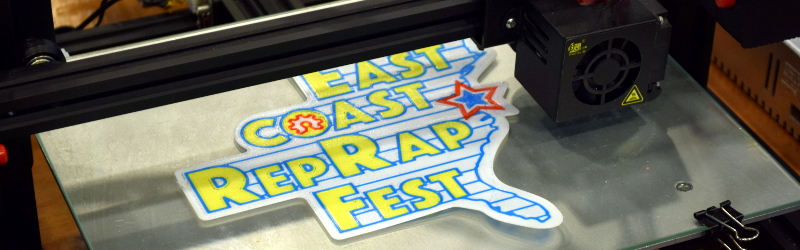
If you know, you know: some weekends are for mowing the lawn, answering emails, and pretending that PLA scraps are “organized.” Other weekends are for wandering into a giant hall full of 3D printers, custom builds, community projects, weirdly brilliant inventions, and the kind of joyful nerd energy that makes you want to go home and redesign everything you own. That spirit is exactly why the East Coast RepRap Festival, better known as ERRF, became such a beloved event in the desktop 3D printing world.
The headline “East Coast RepRap Festival Returns This Weekend” first captured the excitement around the event’s big comeback, but the bigger story is how ERRF grew from a promising regional gathering into one of the most recognizable maker events on the East Coast. It started as a celebration of open-source 3D printing, community-built machines, and hands-on experimentation. Then it evolved into something larger: part expo, part reunion, part live demo lab, and part unofficial convention for people who think a printer’s motion system is perfectly reasonable dinner conversation.
Today, the festival’s legacy continues under the 3DPrintopia name, but the DNA is still unmistakably RepRap. The event remains rooted in the same culture that made it special in the first place: accessible technology, creative problem-solving, and a strong belief that the best ideas often start on somebody’s workbench before they end up in a polished product launch.
What Made ERRF Matter in the First Place?
The East Coast RepRap Festival stood out because it never felt like a stiff trade show wearing a polo shirt and pretending to have fun. It felt alive. Inspired by the Midwest RepRap Festival, ERRF gave East Coast makers, hobbyists, startups, educators, tinkerers, and serious printer obsessives a place to gather without needing a plane ticket and an expense account. That mattered. A lot.
At a time when desktop 3D printing was growing fast, ERRF gave the community a physical home. You could see polished commercial machines sitting only a few aisles away from wild garage-built creations that looked like they had been assembled by a genius raccoon with access to aluminum extrusion. Somehow, both belonged there. That was the magic.
The festival also helped bridge multiple corners of the 3D printing ecosystem. One booth might feature a company showing off new filament or hot-end technology. The next might showcase a community builder with a modified Voron, a belt printer, a tool changer, or a completely bonkers machine that exists only because someone said, “I wonder what happens if we try this?” Usually, the answer was either innovation or a light electrical smell. Sometimes both.
The Return Weekend Was Bigger Than a Calendar Date
When people talked about the East Coast RepRap Festival returning, they were not just talking about an event opening its doors again. They were talking about a community getting its in-person heartbeat back. During the pandemic years, maker culture did what maker culture always does: it adapted. People streamed, posted build logs, joined Discord servers, and kept printing from home. But 3D printing is a deeply tactile hobby. You want to see surface finish up close. You want to hear the machine. You want to ask someone why they mounted an extruder like that. You want to hold the print that looked impossible on camera.
That is why the comeback weekend carried real emotional weight. The return of ERRF signaled that the collaborative, in-person side of the hobby was alive and healthy again. It meant builders could once again compare designs face to face, companies could launch products in front of a genuinely engaged crowd, and longtime community members could reconnect without a webcam square between them.
In practical terms, the return also restored everything that made the festival fun for newcomers. Talks, exhibits, live demonstrations, community competitions, and exhibitor showcases all gave visitors an easy on-ramp into the world of 3D printing. Whether someone could explain kinematics in their sleep or still thought a slicer was a kitchen tool, the event had room for them.
More Than Booths: The Real Personality of the Festival
What separated ERRF from a generic tech event was personality. This was not just a place to collect brochures and stress-eat convention pretzels. It was a place where the culture of open-source 3D printing was visible everywhere. The machines on display reflected years of shared ideas, published modifications, collaborative engineering, and friendly one-upmanship.
That openness showed up in the variety of attractions. The festival featured presentation stages, racing events, maker showcases, and crowd-friendly demos that turned 3D printing from an abstract technology into something immediate and entertaining. A 3D Printed Derby, for example, is exactly the kind of idea that sounds slightly ridiculous until you see it in action and suddenly realize it is perfect. It is educational, competitive, creative, and just enough chaotic to keep everyone smiling.
There was also room for cosplay, design, art, accessibility projects, and experimental builds. That matters because 3D printing is not one industry with one audience. It is a toolset used by hobbyists, engineers, artists, teachers, students, repair-minded tinkerers, and entrepreneurs. A good festival reflects that diversity instead of flattening it. ERRF did.
How the Festival Grew Up Without Growing Boring
One of the most impressive things about ERRF is that it managed to scale while still feeling like a community event. That is not easy. Many gatherings start with grassroots charm and end with the personality of an airport terminal. ERRF largely avoided that trap by keeping the maker community front and center even as attendance and exhibitor interest grew.
The event’s growth made sense. By the early 2020s, desktop 3D printing had become more mature, more capable, and more visible to mainstream consumers. Printers got faster. Multi-color and multi-material options improved. Interfaces became friendlier. At the same time, the enthusiast crowd never stopped pushing the boundaries. Festivals like ERRF became the rare place where both stories could be seen at once: consumer-ready polish and wild experimentation sharing the same floor.
That balance is part of why the event earned such loyalty. Companies could show their newest hardware, materials, and accessories. Community builders could bring customized machines or niche projects that would never appear in a glossy marketing campaign. Visitors got the full picture of where 3D printing was heading, not just the sanitized version.
Why the Best Stories Often Came From the Show Floor
Some of the most interesting coverage of the festival focused less on corporate announcements and more on what people actually brought to the event. That is telling. A festival like this thrives on surprises: a battery-powered printer rolling around the floor, a foldable machine that makes you question your own life choices, restored retro printers that remind everyone how far the hobby has come, or accessibility projects that prove additive manufacturing can solve real human problems.
Those examples reveal the festival’s deeper value. It was never just about buying another spool of filament you absolutely do not need but will definitely justify later. It was about seeing what happens when tools become truly personal. People shape them for travel, for speed, for education, for art, for adaptive devices, for business, or just for the pure joy of making a machine do something delightfully unnecessary.
From ERRF to 3DPrintopia: Same Spirit, Bigger Stage
The move from the East Coast RepRap Festival name to 3DPrintopia is more than a branding tweak. It reflects the reality that the event outgrew its original identity without abandoning its roots. The RepRap movement remains part of the festival’s foundation, but the audience now includes a broader range of attendees who may be interested in commercial printers, software, materials, design applications, or creative production rather than purely self-replicating machine culture.
That evolution is healthy. A great event should grow with its community. The current version of the festival keeps the maker-first attitude while expanding the scale, visibility, and opportunity around it. That includes a larger venue, more room for exhibitors, more polished programming, and more chances for first-time visitors to discover that 3D printing is much more than a bench toy for people who enjoy arguing about nozzle diameters on the internet. Though, to be fair, some of those people are delightful.
The announced move to Philadelphia also says something important: the festival is no longer merely surviving. It is positioning itself for the next phase. More space means more exhibitors, more foot traffic, more ambitious displays, and more room for the kinds of large-format or unusual installations that make these events memorable.
Why This Festival Still Matters to the 3D Printing Industry
In an era when product launches can happen on YouTube and communities can organize instantly online, a physical festival still offers something digital platforms cannot fully replace. Context. At an event like ERRF, you do not just hear about trends in desktop 3D printing; you see how they land with real people.
If a new material matters, users will gather around it. If a printer design is clever, people will crowd the booth, ask sharp questions, and inspect the output with the seriousness of museum curators evaluating a marble statue. If an idea is hype without substance, it tends to wilt under that level of scrutiny. That kind of environment is useful for the entire industry.
Events like this also strengthen the social infrastructure of innovation. Collaborations happen in the aisles. Future products start as show-floor conversations. Educators discover classroom applications. Nonprofits find tools for adaptive design. Hobbyists turn side projects into businesses. Experienced builders mentor newcomers. A teenager sees a custom machine for the first time and suddenly knows what they want to learn next. That ripple effect is hard to measure, but it is very real.
Who Should Pay Attention to the Return of ERRF?
The obvious answer is 3D printing enthusiasts, but that undersells it. This kind of festival matters to anyone interested in maker culture, product design, STEM education, rapid prototyping, open-source hardware, creative entrepreneurship, and community-driven innovation. If you teach, design, build, prototype, repair, customize, invent, or simply enjoy seeing clever people make improbable things from melted plastic, this is your scene.
It is also a smart event for brands and startups. The audience is informed, opinionated, and unusually engaged. In other words, terrifying in the best possible way. If your product solves a real problem, you will know quickly because people will tell you. If it does not, you will also know quickly, probably while someone politely points at the flaw and then explains a better approach they already posted on GitHub.
That feedback loop is part of what gives the festival long-term value. It is not just a showcase. It is a live testing ground for ideas, designs, messaging, and community trust.
What the Weekend Experience Feels Like
Walk into a festival like this and the first thing you notice is not one giant headline attraction. It is the density of curiosity. Everywhere you look, something is moving, printing, spinning, glowing, racing, folding, or being examined from three angles by someone with the delighted expression of a person who has just found their people.
You hear technical conversations that somehow sound both serious and cheerful. One table is discussing firmware. Another is showing off a gorgeous cosplay prop. A few steps later, someone is explaining why a machine’s toolhead redesign shaved precious seconds off a print. Then a kid runs by, excited about a derby car, and suddenly you remember this technology is not just about engineering elegance. It is about wonder.
That is why the East Coast RepRap Festival’s return resonated so strongly. It was not merely a return to scheduled programming. It was a return to shared enthusiasm, spontaneous learning, and the wonderful spectacle of people gathering in one place to celebrate what they can build.
500 More Words of Real-World Experience: Why a Weekend Like This Sticks With You
There is a very specific feeling that comes from spending a weekend around people who are all obsessed with making things better, faster, stranger, prettier, or more useful. At first, the festival can feel like sensory overload in the best possible way. There are printers humming in every direction, tables packed with parts and prototypes, and conversations happening at the speed of thought. You are not just attending an event. You are stepping into a temporary city built out of curiosity.
For first-time visitors, the experience often starts with a simple reaction: “I had no idea 3D printing could do all this.” That is one of the festival’s greatest strengths. A person might arrive thinking 3D printing is mostly about figurines, replacement knobs, or the occasional phone stand. Then they see educational tools, wearable art, accessibility devices, custom robots, racing machines, production-ready parts, and experimental printers that look like they were designed during a caffeine storm. Suddenly the technology feels much larger and far more personal.
For longtime makers, the experience is different but just as powerful. There is validation in seeing other people who care about details that most of the outside world would never notice. You can spend ten minutes discussing layer consistency, motion systems, hot-end upgrades, or belt tensioning, and nobody looks at you like you accidentally wandered out of a science fiction convention. In fact, they usually lean in closer. That sense of belonging matters more than people often admit.
Another unforgettable part of the weekend is how approachable the community tends to be. Festivals like ERRF are filled with talented people, but the atmosphere is not only about showing off. It is about sharing. Someone explains how they solved a failed print problem. Someone else walks a newcomer through the difference between printer styles. A company rep answers technical questions without corporate fog. A builder proudly points out the ugly early version of a design because it helps tell the story of how the final version came together. That openness is part of what makes the experience feel generous instead of intimidating.
Then there is the emotional side of it. Yes, this is a 3D printing festival, but it is also a gathering shaped by memory, friendships, and shared history. Returning to an event after years of disruption carries extra meaning. People are not just excited to see machines. They are excited to see each other. They are excited to continue traditions, revive inside jokes, revisit favorite booths, and meet the people whose projects they followed online. For many attendees, the weekend becomes part technical conference, part family reunion, and part creative reset button.
By the time it is over, most visitors leave with more than a few photos and a dangerous temptation to upgrade their printer. They leave with ideas. They leave with inspiration. They leave with a renewed sense that making things still matters, that community still matters, and that innovation does not always begin in giant labs or glossy launch videos. Sometimes it begins at a folding table, next to a modified printer, while two strangers geek out over a clever design and accidentally become collaborators.
Conclusion
The East Coast RepRap Festival did more than return for a weekend. It proved that the open-source 3D printing community still knows how to gather, grow, and evolve without losing its soul. From its early days in Bel Air to its larger future as 3DPrintopia, the event has remained a showcase for creativity, experimentation, and real human connection. In a world full of polished marketing, that kind of authenticity is refreshing. Also, let us be honest, it is much more fun.