Note: This article was written from standard geometry, navigation, Earth-science, and atmospheric-refraction references, then fully rewritten in original American English for web publication.
Ever stood on a beach, squinted dramatically at the ocean, and wondered, “How far away is that clean blue line where the sky seems to shake hands with the water?” Good news: you do not need a pirate map, a ship’s wheel, or a suspiciously confident uncle with binoculars. You can calculate the distance to the horizon with a few easy formulas, a square root, and your height above the surface.
The main idea is simple: the higher your eyes are, the farther you can see. A person sitting in the sand sees a closer horizon than a person standing on a pier. A lighthouse keeper sees farther than both of them. A pilot sees so far that the beach people become philosophical dots.
In this guide, we will break down the distance to the horizon formula, explain why it works, show easy examples in feet, miles, meters, kilometers, and nautical miles, and cover real-world factors like atmospheric refraction, waves, hills, and visible objects. By the end, you will be able to calculate the horizon distance quicklyand possibly become the most interesting person on the next road trip, which is a heavy responsibility.
What Is the Horizon?
The horizon is the visible boundary where Earth’s surface appears to meet the sky. On a beach, it looks like a perfect line. In a city, it may be blocked by buildings. In the mountains, it may be replaced by ridges, trees, and the occasional hiker pretending not to be tired.
For calculating distance, we usually mean the geometric horizon: the farthest point on a smooth, spherical Earth that your eyes could theoretically see if nothing blocked your view. This is not always the same as the horizon you experience in real life. Weather, terrain, ocean waves, haze, and light bending through the atmosphere can all change what you actually see.
The Easy Distance to the Horizon Formula
The most useful quick formula depends on your preferred units. If your eye height is measured in feet and you want the answer in miles, use this:
Formula for Miles
Distance to horizon in miles ≈ 1.22 × √height in feet
Example: If your eyes are about 5 feet above sea level:
Distance ≈ 1.22 × √5
Distance ≈ 1.22 × 2.24 = 2.73 miles
So, for an average adult standing at the beach, the horizon is roughly 2.7 to 3 miles away. It feels farther because the ocean is very good at looking dramatic.
Formula for Kilometers
If your height is in meters and you want the distance in kilometers, use:
Distance to horizon in kilometers ≈ 3.57 × √height in meters
Example: If your eye height is 1.7 meters:
Distance ≈ 3.57 × √1.7
Distance ≈ 3.57 × 1.30 = 4.64 kilometers
That means a person standing at sea level with eyes about 1.7 meters above the water sees a geometric horizon around 4.6 kilometers away.
Formula for Nautical Miles
Boaters, sailors, navigators, and people who own suspiciously many waterproof notebooks often use nautical miles:
Distance to horizon in nautical miles ≈ 1.17 × √height in feet
Example: If your height of eye is 9 feet above the water:
Distance ≈ 1.17 × √9
Distance ≈ 1.17 × 3 = 3.51 nautical miles
This formula is especially useful for estimating how far you can see from a boat, dock, bridge, or ship deck.
The More Exact Formula
The simple formulas above are excellent for everyday use, but they are approximations. The more exact geometric formula is:
d = √(2Rh + h²)
Where:
- d = distance to the horizon
- R = radius of Earth
- h = height of the observer above the surface
The key rule is that R and h must use the same units. If Earth’s radius is in kilometers, your height must also be converted to kilometers. If Earth’s radius is in miles, your height must be in miles. Mixing units is how math turns into soup.
Earth’s average radius is about 6,371 kilometers, or about 3,959 miles. Since a person’s height is tiny compared with Earth’s radius, the h² part is usually so small that we can ignore it for normal heights. That gives the simplified version:
d ≈ √(2Rh)
This is the reason the quick formulas work so well. They are just the exact geometry formula with the Earth’s radius and unit conversions already baked in.
Why the Formula Works
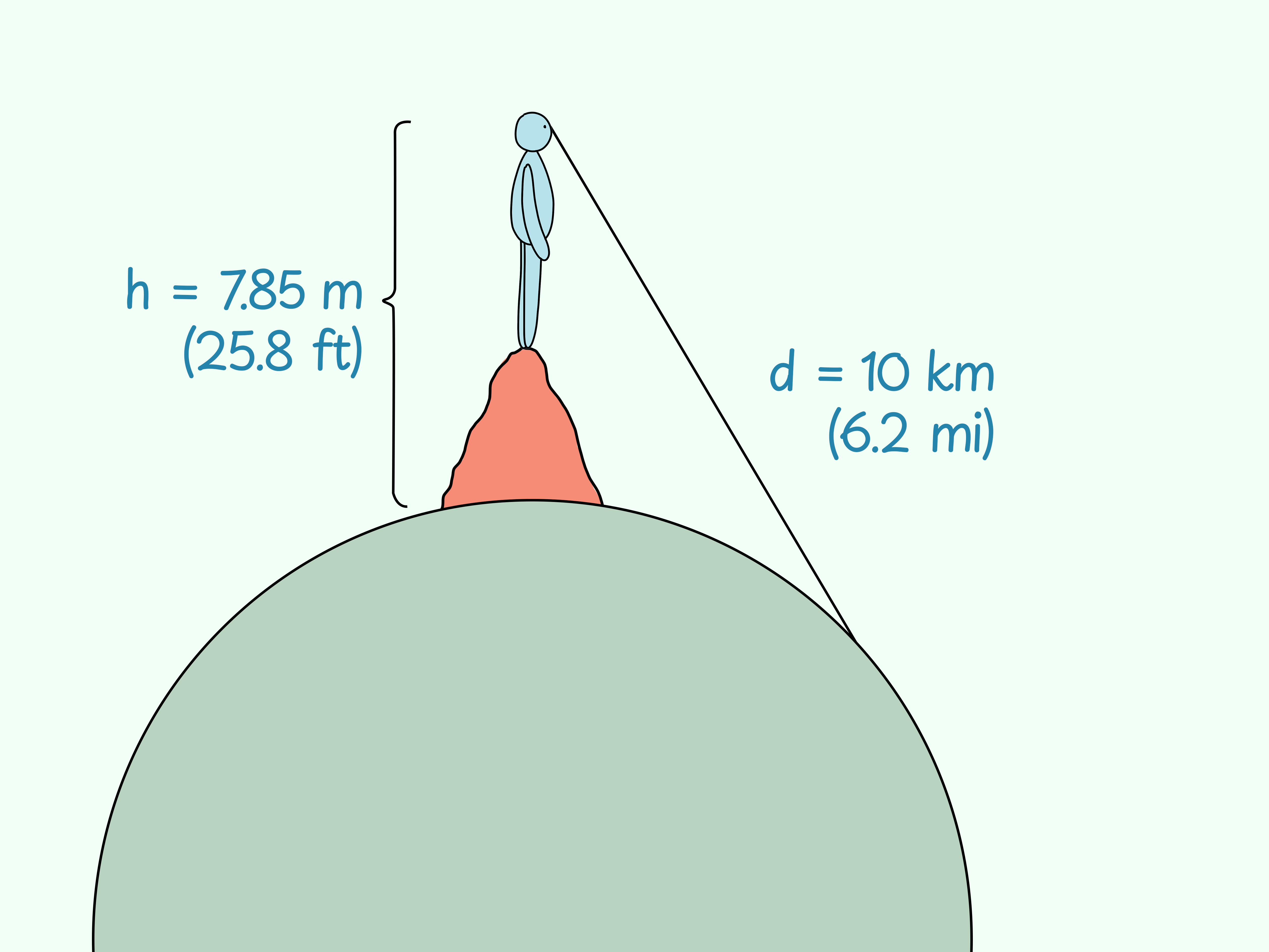
The distance to the horizon is a classic right-triangle problem. Imagine a line from the center of Earth to your feet. Now imagine another line from the center of Earth to the horizon point. Finally, imagine your line of sight from your eyes to the horizon.
Your line of sight touches Earth at a tangent. A tangent line meets a circle at a right angle to the radius at that point. That creates a right triangle, which means the Pythagorean theorem gets to walk into the room wearing sunglasses.
The triangle looks like this:
- One side is Earth’s radius: R
- The hypotenuse is Earth’s radius plus your height: R + h
- The third side is the distance from your eyes to the horizon: d
Using the Pythagorean theorem:
(R + h)² = R² + d²
Solving for d gives:
d = √(2Rh + h²)
That is the entire magic trick. The horizon is not hiding. It is just geometry with a good publicist.
Quick Horizon Distance Examples
Here are practical examples using the common mile formula:
| Observer Height | Approximate Horizon Distance | Example Situation |
|---|---|---|
| 3 feet | 2.1 miles | Child standing near sea level |
| 5 feet | 2.7 miles | Adult standing on a beach |
| 10 feet | 3.9 miles | Small boat deck |
| 25 feet | 6.1 miles | Raised pier or fishing tower |
| 100 feet | 12.2 miles | Cliff, tower, or tall lighthouse base |
| 1,000 feet | 38.6 miles | Mountain viewpoint |
| 10,000 feet | 122 miles | Small aircraft altitude |
Notice that doubling your height does not double your horizon distance. Because the formula uses a square root, the distance grows more slowly. To see much farther, you need to get much higher. This is why climbing onto one extra beach chair does not suddenly let you see Europe.
How to Calculate How Far You Can See an Object
Calculating the horizon distance from your own eye height is useful, but what if you are trying to see a tall object, such as a lighthouse, ship, mountain, or building?
In that case, calculate the horizon distance for your eye height, then calculate the horizon distance for the object’s height, then add the two together.
Object Visibility Formula
Maximum visibility distance ≈ your horizon distance + object’s horizon distance
Example: Suppose your eyes are 9 feet above the water on a boat, and a lighthouse light is 100 feet above sea level.
Your horizon distance in nautical miles:
1.17 × √9 = 3.51 nautical miles
Lighthouse horizon distance:
1.17 × √100 = 11.7 nautical miles
Total possible sighting distance:
3.51 + 11.7 = 15.21 nautical miles
So, in clear conditions, the lighthouse could theoretically become visible from a little over 15 nautical miles away. Real-world visibility may be lower if haze, rain, glare, darkness, or waves get involved. Nature loves fine print.
Does Atmospheric Refraction Change the Horizon Distance?
Yes. Atmospheric refraction bends light as it passes through air layers of different density. Near the horizon, this bending can make objects appear slightly higher than they actually are. As a result, the visible horizon may seem a little farther away than the purely geometric horizon.
A common practical adjustment is to use a slightly larger effective Earth radius. In everyday terms, this means the horizon might appear roughly 8% farther away under standard atmospheric conditions. That is why some refraction-adjusted formulas use values such as:
Distance in miles ≈ 1.32 × √height in feet
or:
Distance in kilometers ≈ 3.86 × √height in meters
However, refraction is not perfectly predictable. Temperature gradients, humidity, pressure, and surface conditions can change how light bends. Sometimes refraction lets you see objects that should be hidden. Sometimes haze ruins everything and you can barely see the end of the pier. For simple planning, use the geometric formula. For navigation, treat the result as an estimate, not a pinky promise from the universe.
Common Mistakes When Calculating Horizon Distance
Using Your Full Height Instead of Eye Height
The formula needs the height of your eyes above the surface, not the top of your head. Unless you see through your hair, use eye height.
Mixing Units
If you use Earth’s radius in kilometers, convert your height to kilometers. If you use feet, use a formula designed for feet. A formula is like a recipe: swapping teaspoons for gallons creates drama.
Forgetting About Obstacles
The geometric horizon assumes a smooth surface. Trees, buildings, dunes, hills, ship rails, waves, and your friend’s enormous beach umbrella can all block the view.
Expecting Perfect Accuracy
The distance to the horizon formula is a model. It is very useful, but Earth is not a polished billiard ball. It is slightly flattened, lumpy, mountainous, ocean-covered, and wrapped in a complicated atmosphere. Still charming, though.
How Far Is the Ocean Horizon?
For most adults standing at sea level, the ocean horizon is about 3 miles away, or roughly 5 kilometers. If you sit down, it gets closer. If you climb a dune, pier, balcony, or lighthouse, it gets farther away.
This surprises many people because the horizon looks distant and grand. But the basic geometry of Earth’s curvature means that the visible sea-level horizon is much closer than our instincts suggest. The ocean is basically saying, “I contain mysteries,” while the math whispers, “It is three miles, calm down.”
How Far Can You See From an Airplane?
At high altitude, the horizon expands dramatically. At 30,000 feet, use the simple miles formula:
Distance ≈ 1.22 × √30,000
Distance ≈ 1.22 × 173.2 = 211 miles
So, from a cruising aircraft, the geometric horizon may be over 200 miles away. With refraction, it may appear slightly farther. This is one reason the sky from an airplane looks so vast: your viewing height has changed from “standing with coffee” to “tiny metal city in the upper air.”
How Far Can You See From a Mountain?
Mountains are excellent horizon extenders. If you stand at a viewpoint 5,000 feet above the surrounding surface:
Distance ≈ 1.22 × √5,000
Distance ≈ 1.22 × 70.7 = 86 miles
That does not mean every object within 86 miles will be visible. Terrain may block the view, and air clarity matters. But it explains why mountain views can feel enormous. Your eyes are sitting on top of a very large geometry problem.
Distance to Horizon Calculator: Step-by-Step
You can calculate the distance to the horizon manually in less than a minute:
- Measure or estimate your eye height above the surface.
- Choose the correct formula for your units.
- Take the square root of your height.
- Multiply by the formula constant.
- Adjust expectations for weather, terrain, and refraction.
For example, if you are standing on a balcony with your eyes 50 feet above sea level:
√50 = 7.07
1.22 × 7.07 = 8.63 miles
Your geometric horizon is about 8.6 miles away.
Practical Uses for Horizon Distance
Knowing how to calculate the distance to the horizon is not just a fun fact for people who enjoy ambushing dinner guests with math. It has real uses.
Boating and Sailing
Mariners use horizon distance to estimate when lighthouses, ships, buoys, and coastlines may become visible. It helps with navigation, safety, and understanding why a light may not appear even when the chart says it exists.
Photography
Landscape photographers use horizon awareness when planning ocean shots, mountain views, skyline images, and long-lens photos across water. The curvature of Earth can hide lower parts of distant objects.
Hiking and Travel
At scenic overlooks, the formula helps explain why you can see so far from high elevations. It also helps travelers understand why “I can see forever” usually means “I can see until Earth politely curves away.”
Aviation
Pilots and aviation enthusiasts use horizon distance to understand line of sight, visibility, and how altitude changes what can be seen from the cockpit.
Radio and Communications
Line-of-sight radio signals are affected by Earth’s curvature. While radio waves can behave differently from visible light, horizon distance is still a helpful starting point for understanding signal range.
Experience-Based Notes: What Calculating the Horizon Feels Like in Real Life
The first time you calculate the distance to the horizon, the result may feel wrong. Standing on a beach, the horizon looks enormous, ancient, and almost unreachable. Then the formula says it is only about three miles away, and suddenly the ocean feels like it has been overselling the mystery. But that is part of the fun. The horizon is not far because it is distant in a straight-line sense; it feels far because it marks the edge of what your eyes can access from your current height.
One useful experience is to compare different viewing heights in the same place. Stand near the waterline and estimate your eye height. Then climb a dune, walk onto a pier, or go up to a hotel balcony and run the formula again. The change is immediate. From eye level near the beach, your horizon might be around 3 miles away. From 25 or 30 feet up, it may be around 6 or 7 miles away. The view feels wider because it truly is wider. You have not improved your eyesight; you have improved your geometry.
On boats, the formula becomes even more practical. If you are in a small boat with your eyes 6 or 7 feet above the water, the horizon is only a few nautical miles away. That explains why distant boats seem to appear top-first or why a low object can disappear behind the curve even on a clear day. Move to a higher deck, and the visible distance increases. This is why lookouts historically climbed masts and why modern ship bridges are built high above the water. Height buys distance.
The formula also changes the way you look at lighthouses. A lighthouse is not visible simply because it is bright. Its height matters enormously. A light mounted 100 feet above sea level can be seen from much farther away than a light mounted 10 feet above sea level, assuming the same weather and brightness. When you add your own horizon distance to the lighthouse’s horizon distance, you get a better estimate of when the light might first appear. It is a small calculation, but it makes navigation feel less like guessing and more like reading the planet’s operating manual.
Mountain viewpoints offer the most dramatic lesson. At higher elevations, the horizon leaps outward. A viewpoint thousands of feet above the surrounding land can produce a horizon dozens of miles away. But real life adds complications: ridges block valleys, haze softens distant shapes, and clouds can erase half the view. The formula tells you the theoretical limit, not the guaranteed Instagram caption. Still, it helps you understand why a clear day from a mountain can feel almost unreal.
Another interesting experience is noticing how weather changes perception. On some days, the horizon is sharp enough to look drawn with a ruler. On humid or hazy days, it fades into a pale blur. The math may say the horizon is a certain distance away, but visibility can shorten the useful view. Atmospheric refraction can also stretch the view slightly, sometimes making distant objects appear higher than expected. This is why the horizon is both a geometry problem and a weather mood ring.
For everyday use, the best approach is simple: calculate the geometric distance first, then treat it as a smart estimate. If you are standing at the shore, use about 3 miles. If you are on a high deck, cliff, tower, or aircraft, use the square-root formula. The calculation takes seconds, but it gives you a surprisingly rich understanding of what you are seeing. The horizon stops being just a pretty line and becomes a visible measurement of Earth’s curvature.
Conclusion
Calculating the distance to the horizon is easier than it looks. The quick formulas are simple: use 1.22 × √height in feet for miles, 3.57 × √height in meters for kilometers, or 1.17 × √height in feet for nautical miles. These formulas come from the geometry of a tangent line touching a curved Earth.
For most people standing at the beach, the horizon is only about 3 miles away. From a boat deck, cliff, lighthouse, mountain, or airplane, it can be much farther. Add the horizon distance of a tall object to your own horizon distance, and you can estimate when that object may become visible. Just remember that weather, terrain, waves, haze, and atmospheric refraction can all affect the real-world result.
The next time you stare at the horizon, you will know what you are seeing: not just a beautiful line, but a perfect little reminder that Earth is curved, math is useful, and your eyes are doing their best from wherever you happen to be standing.