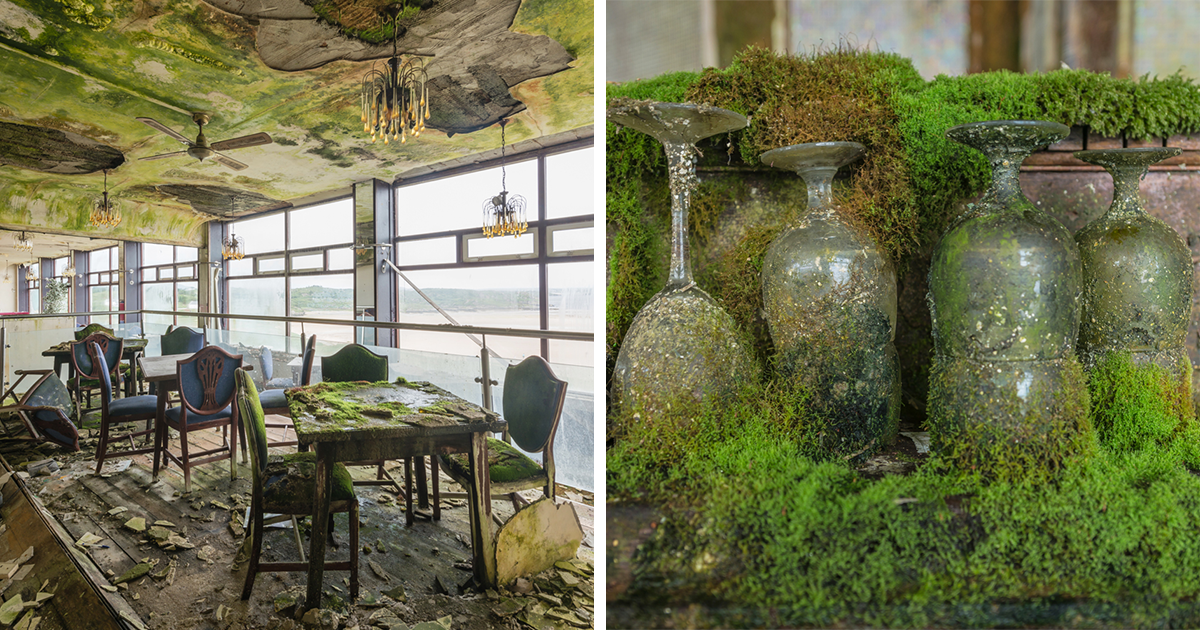
There is a very particular silence inside an abandoned hotel. It is not the peaceful quiet of a library or the sleepy hush of a country inn after breakfast. It is heavier than that. It hangs in the hallways, curls around the stair rails, and waits behind half-open doors like it paid for a late checkout and never left.
When I visited an abandoned hotel in Ireland with many objects left untouched, I expected peeling wallpaper, broken glass, and maybe a dramatic crow perched somewhere for cinematic effect. What I found was stranger and far more human: chairs still gathered around tables, old televisions facing empty beds, glasses waiting for guests who would never return, books softened by damp air, phones that looked ready to ring, and hair dryers mounted in bathrooms as if someone had stepped out for tea and simply forgotten to come back for a decade.
The hotel, located near the Irish coast, had clearly battled the elements. Wind had bullied its way through cracked windows. Rain had entered rooms with the confidence of a long-term tenant. Moss, mold, and ivy were quietly negotiating ownership of the property. Yet the most haunting part was not the decay. It was the order. So many things remained in place that the building felt less abandoned than paused.
This is the strange magnetism of abandoned places in Ireland. The country is famous for lively pubs, warm hospitality, ancient castles, green landscapes, and hotels where the breakfast alone can make you question every life choice that led you away from Irish butter. But tucked between the polished manor houses and postcard-perfect villages are forgotten buildings that tell a quieter story. They reveal what happens when tourism shifts, money dries up, storms move in, and time starts redecorating without asking permission.
The First Look: A Hotel Frozen Between Welcome and Warning
I will not share the exact location of the hotel. Responsible urban exploration depends on restraint, and abandoned buildings are vulnerable to theft, vandalism, and dangerous curiosity. I visited with permission, kept to safe areas, moved nothing, took nothing, and left the place exactly as I found it. In other words, I behaved like a polite ghost with a camera.
From the outside, the hotel looked tired but dignified. Its coastal setting was beautiful in the moody way Ireland does so well: gray sky, wet stone, restless wind, and grass so green it looked like it had a motivational coach. The building had once been designed to welcome travelers. You could see that in its wide entrance, the generous windows, and the kind of layout meant for laughter, luggage, weddings, Sunday lunches, and guests asking reception where the nearest pub was even though the nearest pub was probably everywhere.
But nature had changed the mood. Salt air had gnawed at metal fittings. Window frames had swollen. Paint flaked from walls in long curls. The front door no longer said “welcome.” It said, “Please reconsider your footwear.”
Inside the Lobby: Where Hospitality Became History
The lobby was the first emotional punch. Hotels are built around arrivals. They are places of keys, greetings, maps, reservations, and mild panic from people who cannot find their confirmation email. In this abandoned Irish hotel, the reception area still carried the shape of that old routine.
There were desks, chairs, shelves, and fragments of paperwork. An old phone sat near the counter, useless but oddly dignified, like a retired employee who still shows up because nobody told him to stop. The carpet had darkened with moisture. The ceiling showed water damage. But the bones of the room were intact enough to imagine the former rhythm: guests dragging suitcases, staff answering questions, someone laughing too loudly near the entrance, someone else complaining about the weather because tradition must be honored.
What makes abandoned hotels different from abandoned factories or houses is their public memory. A hotel belongs to thousands of temporary lives. Most guests only stay one night or one week, but together they leave a residue of movement. Even empty, the lobby felt crowded with almost-stories.
Objects Left Untouched: The Most Surreal Discoveries
The untouched objects were what made the visit unforgettable. In many abandoned buildings, valuable or portable items disappear quickly. Here, so much remained that the hotel felt like a museum curated by accident.
Phones, Tables, and Chairs
The old phones were among the strangest things to see. A phone in an abandoned room has a special kind of creepiness. It suggests communication, but there is no one left to call. I found myself imagining the last ring, the last reservation, the last complaint about towels. The tables and chairs still seemed arranged for guests, though dust had replaced conversation and dampness had replaced dinner.
Books, Paintings, and Forgotten Decor
Books sat in corners and on shelves, their pages warped by the coastal air. Old paintings still clung to walls, some tilted, some stained, some looking more offended than damaged. Hotel art often gets mocked for being bland, but here it became oddly touching. These paintings had not been chosen for a gallery. They had been chosen to make rooms feel comfortable. Their survival made the silence feel personal.
Glasses, TVs, and Hair Dryers
Glasses remained in places where glasses should not logically remain after years of abandonment. Televisions sat in rooms like square-faced time capsules. Hair dryers still hung in bathrooms, which somehow felt more intimate than grand furniture. A hair dryer is not dramatic. It is practical, ordinary, almost silly. But that is why it stayed with me. History is not only chandeliers and documents. Sometimes it is a wall-mounted appliance waiting for someone with wet hair and breakfast plans.
The Guest Rooms: Ordinary Spaces Made Eerie
The guest rooms were the most cinematic part of the hotel. Beds, bedside tables, old fixtures, and faded curtains created the feeling of a place interrupted mid-sentence. Some rooms had been damaged by water. Others were surprisingly intact. In a few, the remaining furniture made it easy to imagine how the space once looked when fresh sheets were tucked in, lamps were working, and guests were deciding whether to go downstairs for one more drink.
Abandoned hotel rooms are unsettling because they are designed for comfort. A hotel room is supposed to be safe, private, and temporary. When that comfort decays, the contrast becomes powerful. The room still says “rest,” while the ceiling says “absolutely not.”
I noticed how quickly nature finds weaknesses. A cracked pane becomes a doorway for rain. A small leak becomes a stain. A stain becomes rot. A carpet becomes a sponge. A room that once smelled of soap and linen begins to smell of damp wood, dust, and the outdoors. Time does not rush in abandoned buildings. It seeps.
Why Abandoned Hotels in Ireland Feel So Different
Ireland has a deep relationship with hospitality. From family-run guesthouses to grand castle hotels, the Irish welcome is not just a marketing phrase; it is part of the travel experience. Visitors come for landscapes, ruins, music, literature, food, and history, but many leave talking about the people. That is why an abandoned hotel in Ireland feels especially poignant. It is a place built for welcome that no longer welcomes anyone.
There is also Ireland’s complicated architectural legacy. Across the country, historic houses, old estates, former institutions, and rural hotels carry layers of social, economic, and political history. Some have been restored into luxury properties. Others remain derelict, caught between heritage value and the brutal cost of repair. Moisture, storms, insurance, ownership disputes, and changing tourism patterns all play their part. Buildings do not become abandoned because one dramatic villain twirled a mustache and locked the door. Usually, it is messier: finances, maintenance, inheritance, recession, regulations, location, and time.
In coastal areas, the weather is not a background detail. It is a character. Irish coastal wind has opinions. Rain arrives sideways. Salt air works patiently on metal, paint, and wood. Once a building is no longer heated, repaired, and watched, the climate begins taking it apart one quiet inch at a time.
The Beauty of Decay, Without Romanticizing the Damage
It is easy to romanticize abandoned places. The light through broken windows, the moss on staircases, the dramatic peeling wallpaperit all photographs beautifully. But beauty should not make us careless. Abandoned buildings are not theme parks for people with cameras and questionable shoes. They can be structurally dangerous, legally protected, privately owned, contaminated by mold or asbestos, and emotionally significant to local communities.
That is why ethical exploration matters. The rule is simple: take only photographs, leave only footprints, and sometimes leave even fewer footprints if the floor looks suspicious. Do not break in. Do not steal souvenirs. Do not spray paint your name like a raccoon with a marker. Do not publish exact locations if doing so could invite damage. And most importantly, do not confuse abandonment with ownership. Just because a place looks forgotten does not mean it belongs to whoever finds it.
During my visit, the untouched objects made this rule feel even more important. A glass on a table, a book on a shelf, a painting on a wallthese things are fragile records. Remove them, and the story changes. Damage them, and the story shrinks. Leave them, and the room keeps speaking.
What the Hotel Revealed About Time
The most powerful part of the experience was not fear. It was tenderness. I expected the hotel to feel spooky, and yes, some hallways had the atmosphere of a horror movie location scout’s dream vacation. But mostly, it felt sad and strangely respectful.
Hotels are full of routines. Keys handed over. Breakfasts served. Beds made. Bills paid. Staff schedules written. Guests checked in and checked out. When a hotel closes, those routines vanish, but the objects remain as evidence that ordinary life once happened there. A chair is not just a chair. It is where someone waited. A phone is not just a phone. It is where someone answered. A hair dryer is not just a hair dryer. It is proof that someone once cared whether guests left with presentable hair in a country where the weather immediately had other plans.
Walking through the building made me think about how quickly the present becomes the past. One year, a hotel is taking bookings. Years later, strangers walk through its rooms whispering, “Can you believe they left this?” The line between normal and forgotten is thinner than we like to admit.
Photography in an Abandoned Irish Hotel
Photographing the hotel was a lesson in patience. The best images were not the most dramatic ones. They were the quiet details: a chair angled toward a window, a lampshade softened by dust, a hallway where the carpet seemed to fade into shadow, a guest room where the television still faced the bed with loyal uselessness.
Natural light did most of the work. Abandoned interiors often reward restraint. Flash can flatten the atmosphere and make a room look like evidence. Soft window light, especially in Ireland’s cloudy weather, gives everything a muted, painterly quality. The greens outside the windows made the interior decay feel even more intense, as if nature were pressing its face against the glass saying, “My turn?”
I avoided staging objects. It is tempting to move a book, straighten a chair, or place a glass where it looks more poetic. But the truth of the place matters more than the perfect shot. The hotel was already composed by time, weather, and chance. My job was simply to notice.
Why We Are Drawn to Abandoned Places
People are fascinated by abandoned places because they reveal a future we rarely want to think about. They show what happens when human plans stop being maintained. A hotel is especially powerful because it was built around comfort and service. Seeing it empty reminds us that every polished space depends on constant care.
There is also a storytelling instinct at work. We see objects left behind and immediately ask questions. Who used this room? Why did the hotel close? Was there a final guest? Did the staff know it was the end? Why was so much left behind? The building becomes a mystery, even when the real answer is probably less dramatic than we imagine. Financial trouble is less exciting than ghosts, but it is usually more accurate.
Still, mystery has value. It encourages attention. It asks us to look closely at ordinary things. In the abandoned hotel, I found myself noticing details I would ignore in an active hotel: the shape of a chair, the pattern of wallpaper, the position of a phone, the sound of wind moving through a corridor. Abandonment turns background into subject.
Lessons From a Place Left Behind
The abandoned hotel in Ireland taught me that decay is not the opposite of history. It is part of history. Restored buildings show us what people choose to preserve. Abandoned buildings show us what happens when preservation fails, pauses, or becomes too expensive to continue.
That does not mean every derelict building should remain untouched forever. Some should be restored. Some should be documented before they disappear. Some may be too dangerous to save. But all deserve to be treated with seriousness. They are not empty. They are full of evidence.
As I left the hotel, I looked back at the windows. Some were broken. Some were dark. Some reflected the gray Irish sky. The building no longer functioned as a hotel, but it still held the shape of welcome. That was the detail I could not shake. Even abandoned, it seemed to remember what it had been built to do.
Extended Experience: What It Felt Like After Leaving the Hotel
The strangest part of visiting an abandoned hotel is that the experience follows you out. Once I stepped back into the open air, the world seemed too bright, too loud, and frankly a little rude for continuing as usual. Cars passed on the road. Birds moved through the grass. Somewhere nearby, life was making tea, checking phones, and worrying about normal things like dinner plans and whether the laundry had been moved to the dryer. Meanwhile, my mind was still inside that hotel, standing in front of a dusty reception desk and waiting for a phone that would never ring.
For the rest of the day, ordinary hotels looked different to me. A clean lobby felt temporary. A neatly made bed felt like a small miracle of maintenance. Even the hum of a working vending machine seemed heroic. We rarely think about how much effort it takes to keep a building alive. Someone must repair leaks, polish floors, replace bulbs, answer emails, clean windows, pay insurance, manage staff, and make sure breakfast does not descend into toast-based anarchy. Without that constant care, even the grandest hotel begins to slip.
That realization made the abandoned Irish hotel feel less like a ruin and more like a warning. Buildings do not preserve themselves. Communities, owners, local authorities, historians, travelers, and investors all play roles in deciding what survives. Ireland has many examples of historic properties that have been beautifully restored into hotels, museums, guesthouses, or cultural spaces. Those success stories can make preservation look romantic, but restoration is usually expensive, complicated, and full of unglamorous problems. Behind every elegant staircase saved from decay is someone dealing with plumbing, planning rules, budgets, and probably at least one very dramatic roof.
I also kept thinking about the objects left inside. They were not rare treasures in the traditional sense. No golden crown, no secret manuscript, no ancient sword conveniently labeled “ancient sword.” Instead, the emotional power came from common things: chairs, glasses, books, televisions, phones, hair dryers. These objects were valuable because they were ordinary. They made the past feel close enough to touch, though touching was exactly what I tried not to do.
That is the lesson I would pass on to anyone interested in abandoned places: go for the history, not the thrill. Go with permission. Go carefully. Go with respect. Do not force entry, do not take souvenirs, and do not treat someone else’s loss as your personal adventure playground. The best explorers are not conquerors. They are witnesses.
By evening, the hotel had settled into my memory like a half-remembered dream. I could still picture the rooms, the damp wallpaper, the furniture waiting in silence, the Irish weather pressing against the windows like an impatient editor. I had gone there expecting eeriness, and I found it. But I also found humor, sadness, beauty, and a surprisingly deep appreciation for functioning roofs. Above all, I found a reminder that places hold stories even after people leave. Sometimes, the quietest buildings have the most to say.
Conclusion
Visiting an abandoned hotel in Ireland with many objects left untouched was not just an urban exploration experience. It was a walk through hospitality after the guests were gone, a study of decay, and a reminder that ordinary objects can become powerful when time changes the room around them. The phones, chairs, books, glasses, TVs, paintings, and hair dryers were not props. They were fragments of a working hotel that once welcomed real people.
The building was eerie, yes, but it was also deeply human. Its silence carried traces of staff, travelers, weather, economics, and memory. Ireland’s abandoned places are compelling because they sit at the intersection of beauty and loss. They show how quickly nature returns, how fragile buildings become without care, and how important it is to document forgotten spaces responsibly.
If there is one thing this abandoned Irish hotel made clear, it is that history does not always announce itself with monuments. Sometimes it waits in a damp hallway, beside an old phone, under a crooked painting, in a room where everything has been left untouched.
SEO Tags
Note: This article is written as an original narrative-style feature based on real information about abandoned places, Irish hospitality, coastal decay, heritage preservation, and responsible urban exploration. Always seek permission before entering abandoned or derelict property, and never remove or damage objects left behind.