Note: This article is provided as body-only HTML for easy web publishing.
Square root problems have a funny way of looking scarier than they really are. The radical symbol can make a simple problem seem like it arrived wearing a cape and dramatic background music. But once you understand what a square root actually means, most of these problems become much more manageable. In fact, square root questions usually follow a handful of patterns, and once you recognize them, you can solve them with more confidence and fewer calculator panic attacks.
This guide breaks down how to solve square root problems step by step. You’ll learn what square roots mean, how to simplify radicals, how to solve equations that contain square roots, and how to avoid the most common mistakes. Along the way, you’ll see tips, tricks, and examples that make the topic feel a lot less mysterious and a lot more doable.
What a Square Root Really Means
A square root answers this question: what number multiplied by itself gives the original number? For example, the square root of 25 is 5 because 5 × 5 = 25.
That sounds simple enough, but here’s the detail that trips up many students: every positive number actually has two square roots. For 25, both 5 and -5 work because:
- 5 × 5 = 25
- -5 × -5 = 25
However, the symbol √25 means the principal square root, which is the nonnegative one. So:
- √25 = 5
- The solutions to x² = 25 are x = ±5
That tiny distinction matters a lot. If you mix up √25 with the solutions to x² = 25, math will quietly let you walk off a cliff.
Types of Square Root Problems You’ll Usually See
Most square root problems fall into one of these categories:
- Evaluating square roots: Find √49 or √144
- Simplifying radicals: Rewrite √72 in simplest form
- Estimating square roots: Approximate √30 without a calculator
- Solving radical equations: Solve √(x + 5) = 7
- Solving quadratic equations using square roots: Solve x² = 81 or (x – 3)² = 20
Once you identify the type of problem, the method becomes much easier to choose.
Tip #1: Memorize Your Perfect Squares
If you want to solve square root problems faster, memorize the perfect squares from 1 through at least 15. It saves time, reduces mistakes, and makes estimation much easier.
- 1² = 1
- 2² = 4
- 3² = 9
- 4² = 16
- 5² = 25
- 6² = 36
- 7² = 49
- 8² = 64
- 9² = 81
- 10² = 100
- 11² = 121
- 12² = 144
- 13² = 169
- 14² = 196
- 15² = 225
These numbers are the cheat codes of square root work. The more familiar they feel, the faster your brain will spot shortcuts.
Tip #2: Simplify Before You Panic
When a square root is not a perfect square, don’t assume the problem is impossible. Many radicals can be simplified by pulling out perfect-square factors.
Example: Simplify √72
Start by factoring 72 into a perfect square times something else:
√72 = √(36 × 2)
= √36 × √2
= 6√2
That’s the simplest form: 6√2.
Another Example: Simplify √48
√48 = √(16 × 3)
= √16 × √3
= 4√3
The trick is to look for the largest perfect square factor. If you only notice 4 × 12, that still works, but it creates extra steps. Bigger perfect square, fewer headaches.
Tip #3: Use Nearby Perfect Squares to Estimate
Sometimes you need to estimate a square root without simplifying it exactly. This is where nearby perfect squares come in handy.
Example: Estimate √30
Find the perfect squares around 30:
- 25 = 5²
- 36 = 6²
Since 30 is between 25 and 36, √30 must be between 5 and 6.
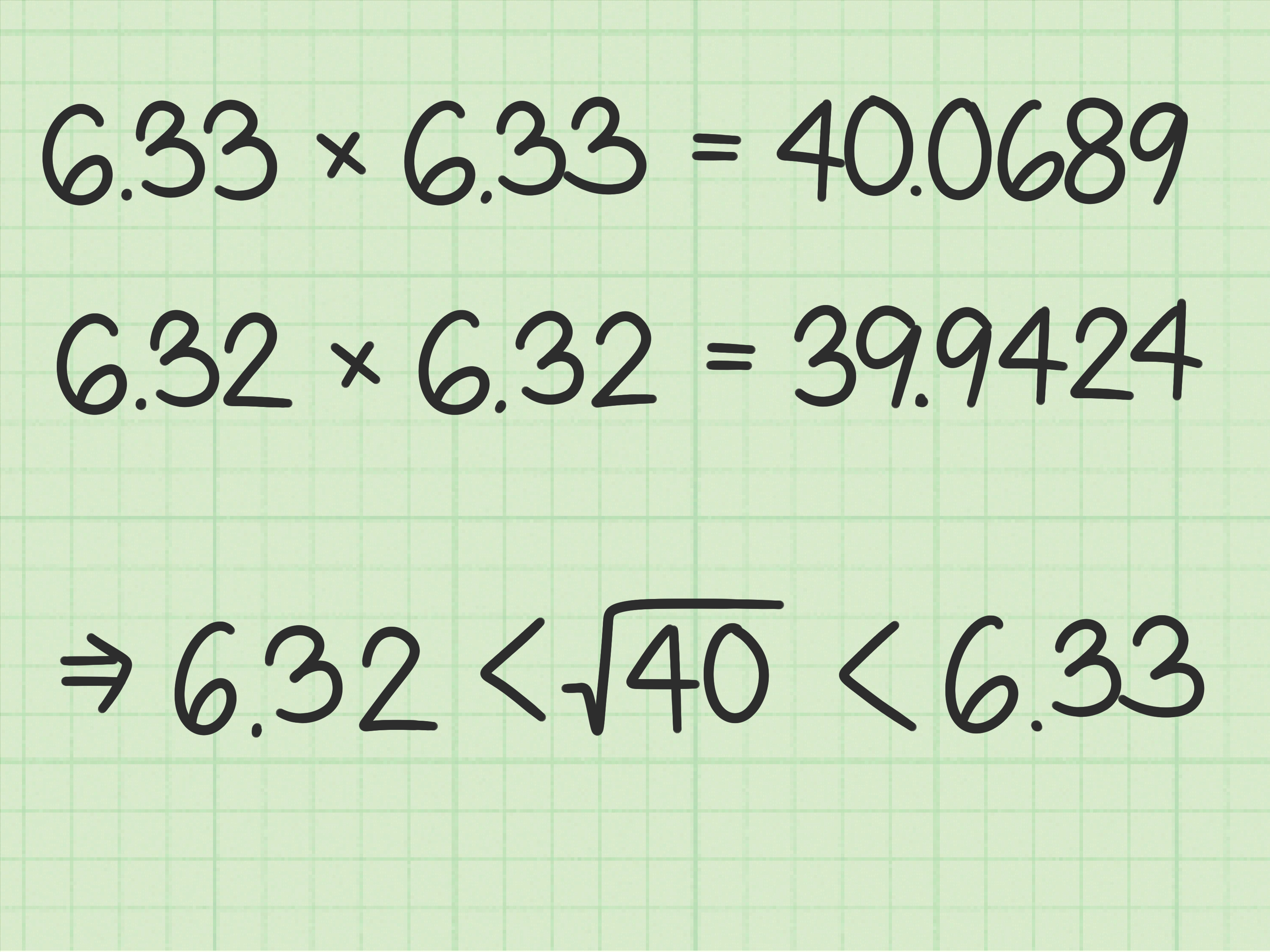
Because 30 is closer to 25 than to 36, √30 is a little closer to 5 than to 6. A reasonable estimate is:
√30 ≈ 5.48
This method is especially useful in tests where calculators are not allowed or when you just want a quick sense of whether an answer is reasonable.
How to Solve Simple Square Root Equations
When the square root is already isolated, these are some of the easiest square root problems to solve.
Example: Solve √x = 9
Square both sides:
(√x)² = 9²
x = 81
Now check:
√81 = 9 ✔
So the solution is x = 81.
Example: Solve √(x + 4) = 6
Square both sides:
(√(x + 4))² = 6²
x + 4 = 36
x = 32
Check the solution:
√(32 + 4) = √36 = 6 ✔
So the answer is x = 32.
Tip #4: Isolate the Radical Before Squaring
This is one of the most important square root tricks in algebra. If there are extra terms hanging around next to the radical, move them first. Do not square too early unless you enjoy creating unnecessary algebra drama.
Example: Solve √(2x + 3) + 1 = 6
Step 1: Isolate the square root
√(2x + 3) = 5
Step 2: Square both sides
2x + 3 = 25
Step 3: Solve
2x = 22
x = 11
Step 4: Check
√(2·11 + 3) + 1 = √25 + 1 = 5 + 1 = 6 ✔
The solution is x = 11.
If you had squared both sides before isolating the radical, the algebra would have grown into a small monster. Always isolate first when possible.
Tip #5: Always Check for Extraneous Solutions
When you square both sides of an equation, you can create answers that look legal but do not actually work in the original problem. These are called extraneous solutions.
Example: Solve √(x + 1) = x – 1
Step 1: Square both sides
x + 1 = (x – 1)²
Step 2: Expand
x + 1 = x² – 2x + 1
Step 3: Rearrange
0 = x² – 3x
0 = x(x – 3)
Possible solutions:
- x = 0
- x = 3
Step 4: Check both answers
For x = 0:
√(0 + 1) = 0 – 1
1 = -1 ✘
For x = 3:
√(3 + 1) = 3 – 1
2 = 2 ✔
So the only valid solution is x = 3.
This is why checking is not optional. In square root equations, checking is part of the job, not extra credit.
How to Solve Quadratic Equations by Taking Square Roots
Some square root problems start with a squared expression instead of a radical. In that case, your goal is usually to isolate the squared part and then take the square root of both sides.
Example: Solve x² = 49
Take the square root of both sides:
x = ±√49
x = ±7
So the solutions are x = 7 and x = -7.
Example: Solve (x – 2)² = 16
Take the square root of both sides:
x – 2 = ±4
Now solve both cases:
- x – 2 = 4 → x = 6
- x – 2 = -4 → x = -2
Final answer: x = 6 or x = -2.
Example: Solve (x + 1)² = 10
Take square roots:
x + 1 = ±√10
Subtract 1:
x = -1 + √10 or x = -1 – √10
This is a great example of when radicals remain in the final answer, and that is perfectly okay. Not every problem wants a neat little integer wearing a bow tie.
Common Mistakes in Square Root Problems
1. Forgetting the ± sign
If you solve x² = 36 and write x = 6, you only found half the answer. The correct result is x = ±6.
2. Adding terms inside a radical incorrectly
√(9 + 16) = √25 = 5, but √9 + √16 = 3 + 4 = 7. These are not the same. In general, you cannot split a square root over addition.
3. Forgetting to check answers after squaring
Extraneous solutions are common in radical equations. Always plug your answer back into the original equation.
4. Ignoring domain issues
In real numbers, the expression inside a square root must be zero or positive. If x – 5 is inside a square root, then x must be at least 5.
5. Stopping before simplifying
√50 is not usually the final answer. It simplifies to 5√2.
Quick Square Root Tricks That Actually Help
- Look for perfect squares first. This helps with both simplification and estimation.
- Isolate the radical before squaring. It keeps the algebra cleaner.
- Use parentheses carefully. Especially when squaring binomials like (x – 3)².
- Check every answer in the original equation. No exceptions.
- Know when the radical sign means only the positive root. This prevents sign mistakes.
- Leave exact answers as radicals when needed. Don’t force decimals unless the problem asks for an approximation.
Worked Practice Examples
Example 1: Simplify √98
√98 = √(49 × 2) = 7√2
Answer: 7√2
Example 2: Estimate √50
49 < 50 < 64, so 7 < √50 < 8. Since 50 is just above 49, √50 is about 7.07.
Answer: √50 ≈ 7.07
Example 3: Solve √(3x – 1) = 8
Square both sides: 3x – 1 = 64
3x = 65
x = 65/3
Check: √(3·65/3 – 1) = √64 = 8 ✔
Answer: x = 65/3
Example 4: Solve x² = 18
x = ±√18 = ±3√2
Answer: x = ±3√2
Example 5: Solve (x – 5)² = 27
x – 5 = ±√27 = ±3√3
x = 5 ± 3√3
Answer: x = 5 ± 3√3
Final Thoughts
Square root problems become much easier once you stop seeing them as one giant topic and start seeing them as a few repeatable patterns. First identify what kind of problem you have. Then use the matching strategy: simplify the radical, estimate with nearby perfect squares, isolate and square, or solve a squared equation with the ± rule. Most errors come from rushing, not from the math being impossible.
So the next time a square root appears on the page looking all dramatic, remember this: it is usually asking for one of a few predictable moves. Learn those moves, practice them with intention, and soon enough you’ll handle square root problems with less fear and a lot more accuracy.
Experiences Students Commonly Have When Learning Square Root Problems
One of the most common experiences students report is that square root problems seem confusing at first because the notation feels unfamiliar, not because the ideas are impossible. A lot of learners are comfortable with multiplication and squaring, but the moment the radical symbol shows up, their confidence drops. That reaction is normal. The good news is that square roots become much easier once students connect them to something they already know: squaring and perfect squares. The biggest breakthrough often happens when a student realizes that square roots are not a brand-new topic but rather the reverse of squaring.
Another common experience is frustration with sign errors. Many students solve x² = 64 and write x = 8, then wonder why the teacher marked it wrong. This usually is not a deep misunderstanding of algebra. It is more often a habit problem. Students get used to the fact that √64 = 8, then forget that solving x² = 64 is different because both 8 and -8 square to 64. Once this distinction is practiced enough times, it becomes second nature. Until then, the plus-or-minus sign tends to play hide-and-seek.
Students also often struggle with radical equations because they square too early. For example, if they see √(x + 3) + 2 = 7, they may immediately square everything before isolating the radical. That usually creates a bigger algebra mess and more opportunities for mistakes. Over time, though, many learners describe a moment when the process finally clicks: move everything except the radical to the other side, then square, then solve, then check. Once that routine becomes familiar, square root equations stop feeling chaotic and start feeling procedural.
Estimation is another area where student experience improves dramatically with practice. At first, estimating √45 or √70 without a calculator can feel like guessing in formal clothes. But after students memorize a short list of perfect squares, they begin to estimate much more confidently. They recognize that √45 must be a little more than 6 because 36 and 49 are nearby. That kind of number sense helps not only in algebra but also in testing situations where checking whether an answer is reasonable matters almost as much as getting it exactly right.
Perhaps the most encouraging experience is the moment students realize square root problems reward patience. These are not usually problems you solve by speed alone. They reward careful setup, organized steps, and checking your answer. Many students who once thought they were “bad at radicals” improve simply by slowing down and following a clear method. In that sense, square root problems teach more than algebra. They teach discipline, precision, and the useful life lesson that panicking at a symbol has never once improved a solution.