One week, your chin is perfectly peaceful. The next, two deep pimples move in, ignore the eviction notice, and invite several frior simply your pores choosing chaos?
The honest answer is that acne rarely fits into one tidy box. What people commonly call “bacterial acne” and hormonal acne are not completely separate conditions. Nearly all acne develops through some combination of excess oil, sticky dead skin cells, clogged hair follicles, inflammation, and activity from Cutibacterium acnes, a bacterium that normally lives on human skin. Hormones can increase oil production and create the conditions in which clogged, inflamed pores flourish. at means the real question is not whether hormones or bacteria are present. Both may be involved. The goal is to identify which factors appear to be driving your breakouts so you can choose a treatment strategy that makes sense.
What Is Hormonal Acne?
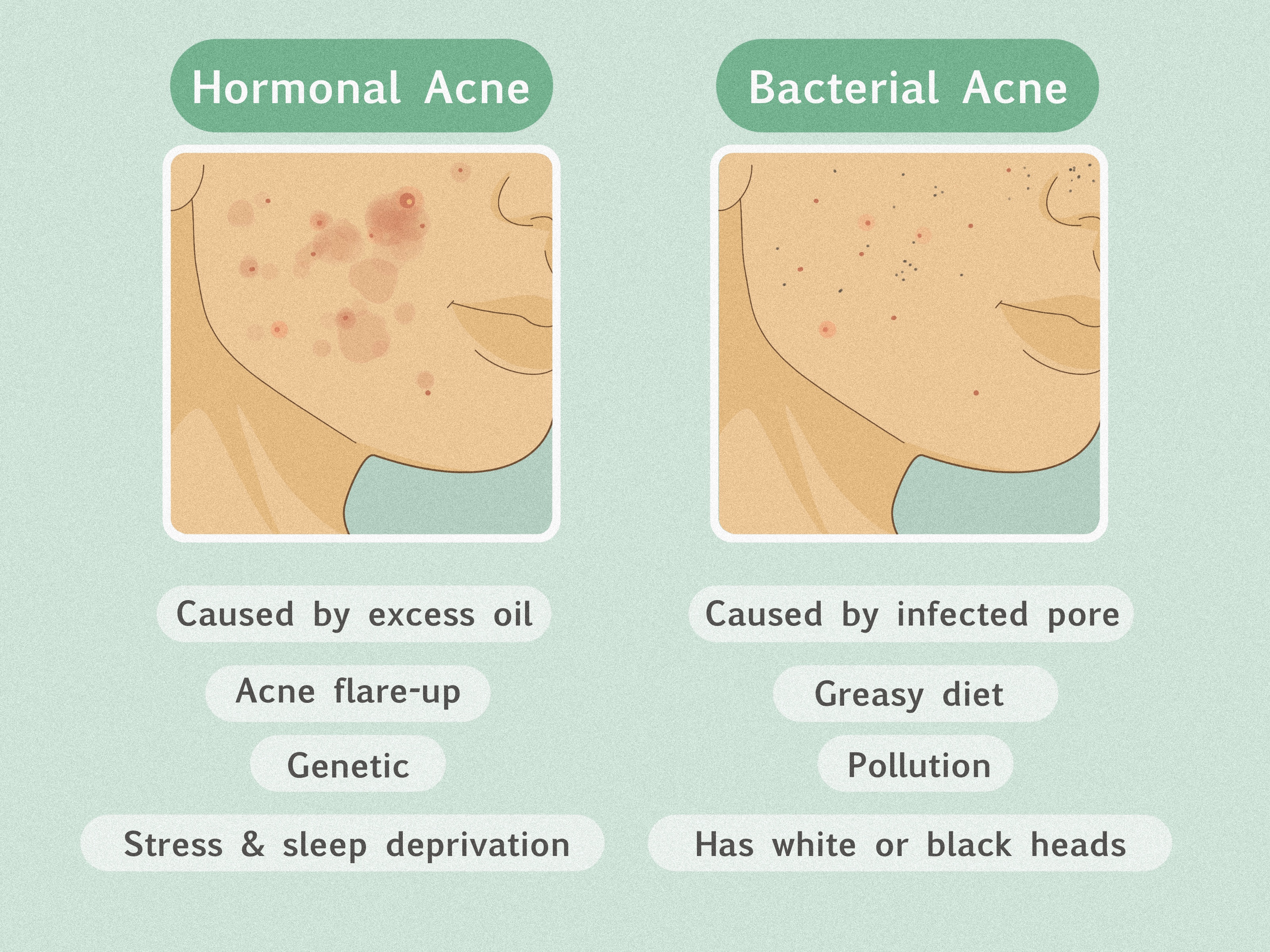
Hormonal acne is acne that is strongly influenced by fluctuations in androgen hormones, including testosterone. Everyone produces androgens, although levels and skin sensitivity vary. These hormones stimulate the sebaceous glands, encouraging them to produce more sebum. When extra oil mixes with dead skin cells inside a follicle, a clog can form. Inflammation and changes in the follicle’s microbiome may then turn that clog into a red, tender pimple.
Hormonal acne is especially common during puberty, but it can also appear or return during adulthood. Menstrual cycles, pregnancy, perimenopause, menopause, stress, certain medications, testosterone therapy, and endocrine conditions such as polycystic ovary syndrome, or PCOS, may influence breakouts. ommon signs of a hormonal pattern
No single symptom proves that acne is hormonal, but the following pattern raises suspicion:
- Breakouts repeatedly appear before or during menstruation.
- Acne is concentrated around the chin, jawline, lower cheeks, or neck.
- Lesions are deep, sore, swollen, or cyst-like rather than only small surface bumps.
- Acne began or returned in adulthood, particularly after age 25.
- Breakouts appeared after starting, stopping, or changing hormonal medication.
- Acne occurs with irregular periods, unwanted facial hair, scalp hair thinning, or other signs of androgen excess.
- Standard over-the-counter products help somewhat, but predictable flares keep returning.
Location is a clue, not a diagnosis. Hormonal acne can develop on the forehead, chest, shoulders, or back, while nonhormonal acne can absolutely appear along the jaw. Your face did not sign a zoning agreement.
What Do People Mean by “Bacterial Acne”?
“Bacterial acne” is an informal phrase rather than a precise medical diagnosis. C. acnes naturally lives in oily areas of healthy skin and is not automatically an enemy. Problems arise when a follicle becomes clogged and its internal environment changes. Certain bacterial strains, microbial imbalance, follicular contents, and the immune system’s response can contribute to inflammation.
Therefore, acne is not usually a contagious skin infection that you caught from another person. You cannot simply wash away every acne bacterium, nor should you try. Scrubbing until your face feels like a freshly sanded coffee table can damage the skin barrier and make redness worse. Current research increasingly views acne as a disorder involving the entire follicular environment and skin microbiome, not just an invasion by one bad germ. lues that bacteria and inflammation are playing a prominent role
- You have numerous red papules or pus-filled pustules.
- Whiteheads and blackheads appear alongside inflamed pimples.
- Breakouts occur on the forehead, nose, cheeks, chest, shoulders, or back.
- Flares do not follow an obvious menstrual or hormonal pattern.
- Sweat, occlusive clothing, oily products, helmets, masks, or friction seem to worsen the problem.
- A benzoyl peroxide product noticeably reduces inflamed lesions when used consistently.
Even these signs do not prove that bacteria are the primary cause. Benzoyl peroxide can help many forms of acne, including hormonally influenced acne, because it reduces acne-associated bacteria, helps clear follicular debris, and limits inflammation. A successful product trial is useful information, but it is not a laboratory test. ormonal vs. Bacterial Acne: A Practical Comparison
| Feature | More Suggestive of Hormonal Acne | More Suggestive of Bacteria-Influenced Inflammatory Acne |
|---|---|---|
| Timing | Predictable flares tied to menstrual cycles, pregnancy, menopause, stress, or hormonal medication changes | Persistent or irregular flares without a clear hormonal rhythm |
| Typical location | Chin, jawline, lower cheeks, and neck | Face, chest, shoulders, and back |
| Typical lesions | Deep, tender papules, nodules, or cyst-like bumps | Red papules, pustules, whiteheads, and blackheads |
| Related clues | Irregular periods, unwanted hair growth, scalp hair thinning, or recent hormonal changes | Worsening with sweat, friction, occlusion, or pore-clogging products |
| Treatment response | May improve with appropriate hormonal therapy plus standard acne treatment | Often improves with benzoyl peroxide, retinoids, and properly prescribed antimicrobial treatment |
Most people have overlap. Someone may experience cycle-related oil production, clogged pores, bacterial imbalance, and inflammation in the same breakout. The treatment plan often needs to address several steps in that chain rather than choosing Team Hormones or Team Bacteria.
Could the Bumps Be Folliculitis Instead?
Sometimes bumps labeled as “bacterial acne” are actually folliculitis, an inflammation or infection of hair follicles. Bacterial folliculitis may be associated with organisms such as Staphylococcus aureus. Yeast can also cause folliculitis, frequently called Malassezia folliculitis or “fungal acne,” although it is not true acne.
Folliculitis becomes more likely when the bumps:
- Are very itchy rather than primarily sore.
- Look unusually uniform in size and shape.
- Develop around individual hairs.
- Appear after shaving, sweating, hot-tub use, or wearing tight clothing.
- Occur without visible blackheads or whiteheads.
- Become worse or fail to improve after standard acne antibiotics.
Boils, impetigo, rosacea, perioral dermatitis, keratosis pilaris, hidradenitis suppurativa, and medication reactions can also resemble acne. A dermatologist can examine the lesion pattern and determine whether a culture, scraping, or another test is appropriate. ow a Dermatologist Determines What Is Driving Your Acne
There is no reliable bathroom-mirror test that labels a pimple “hormonal” or “bacterial.” Dermatologists usually make the diagnosis by examining the types of lesions, their location, severity, timing, scarring risk, and your medical history.
Before an appointment, record the following for at least four to eight weeks:
- Where each flare develops.
- Whether lesions are itchy, painful, deep, or pus-filled.
- Where you are in your menstrual cycle, when applicable.
- Recent medication or birth-control changes.
- Skin, hair, makeup, sunscreen, and shaving products used.
- Exercise, sweating, mask use, helmets, or occupational exposures.
- Every treatment attempted and how consistently it was used.
Routine bacterial cultures and hormone panels are not necessary for every case. Hormonal testing may be considered when acne accompanies irregular menstrual cycles, significant unwanted hair growth, fertility concerns, rapid scalp hair loss, or other signs of an endocrine condition. Severe acne that suddenly begins in an older adult also deserves medical evaluation rather than an enthusiastic online shopping spree. hat Treatments Work for Both Patterns?
Because hormonal and bacteria-influenced acne share several biological pathways, many first-line treatments overlap. The 2024 American Academy of Dermatology guideline strongly supports benzoyl peroxide, topical retinoids, topical antibiotics, and appropriate combinations of topical therapies. Treatment should match acne severity, skin sensitivity, pregnancy status, scarring risk, and prior response. tart with a gentle routine
- Cleanse gently: Wash up to twice daily and after heavy sweating with a mild, nonabrasive cleanser.
- Use one main active treatment: Starting five new acids on Monday is a reliable way to spend Tuesday wondering why your face is angry.
- Moisturize: Choose a fragrance-free, noncomedogenic moisturizer to support the skin barrier.
- Protect your skin: Apply broad-spectrum, noncomedogenic sunscreen every morning.
- Keep hands off: Picking increases inflammation, discoloration, and scarring risk.
Common nonprescription ingredients include benzoyl peroxide, salicylic acid, and adapalene. Benzoyl peroxide is particularly useful for inflamed lesions. Salicylic acid helps loosen material inside pores, while adapalene helps prevent comedones and treats existing acne over time. Introduce products gradually because irritation can make any acne routine harder to tolerate. reating Acne With a Strong Hormonal Component
Topical acne treatments remain useful when hormones are involved. They prevent clogs and reduce inflammation while a clinician evaluates whether hormonal therapy is appropriate.
Prescription options may include:
- Combined oral contraceptives: Certain formulations can reduce androgen effects and improve acne in eligible patients.
- Spironolactone: This oral medication blocks some androgen activity and is commonly used for persistent acne in women.
- Clascoterone: This topical prescription medication blocks androgen receptors in the skin.
- Standard topical therapy: Retinoids, benzoyl peroxide, azelaic acid, and other treatments may be used alone or in combination.
Hormonal medications are not appropriate for everyone. Combined contraceptives carry health risks for some patients, and spironolactone requires individualized prescribing. These treatments should not be borrowed from a friend whose skin “looks kind of similar.”
People who are pregnant, planning pregnancy, or breastfeeding should discuss every acne product with a healthcare professional. Oral isotretinoin must never be used during pregnancy, and topical retinoids are generally avoided. Spironolactone is also not used during pregnancy. reating Prominent Inflammatory or Bacteria-Associated Acne
Benzoyl peroxide is a useful foundation because it reduces acne-associated bacteria without creating the same resistance concerns as antibiotics. A lower-strength formula may work as well as a stronger one with less dryness for many users.
Dermatologists may prescribe a topical antibiotic, usually as part of a combination regimen. Topical antibiotics should not generally be used alone because bacterial resistance can develop. Pairing them with benzoyl peroxide helps reduce that risk.
For moderate or severe inflammatory acne, an oral antibiotic may be prescribed for a limited period while topical treatments begin working. Long-term antibiotic use without a broader maintenance plan is discouraged. Severe nodular acne, acne causing scars, or acne that has resisted other therapies may be treated with isotretinoin under close medical supervision.
Do not use leftover antibiotics or another person’s prescription. The wrong medication can irritate the skin, encourage resistance, or worsen a condition such as yeast folliculitis.
When to See a Dermatologist
Professional care is warranted when:
- You have deep nodules, cyst-like lesions, or significant pain.
- Acne is leaving scars or persistent dark marks.
- A consistent over-the-counter routine has not helped after eight to twelve weeks.
- Your acne appeared suddenly or became dramatically worse.
- Breakouts occur with irregular periods, excess facial hair, or scalp hair thinning.
- The bumps are intensely itchy, crusted, rapidly spreading, or accompanied by fever.
- Acne is affecting your mood, confidence, relationships, or willingness to participate in daily life.
Acne is a medical condition, not a moral evaluation of your cleanliness or self-discipline. Seeking treatment early can reduce physical scarring and the emotional toll of persistent breakouts.
Realistic Experiences: What Acne Patterns Can Look Like in Daily Life
The following composite experiences illustrate common patterns. They are not diagnostic tests, but they show why observing timing, lesion type, and related symptoms is more useful than judging one lonely pimple.
Experience 1: The clockwork chin flare
A person notices that two or three painful bumps appear along the chin about five days before every menstrual period. The rest of the month, the skin is relatively calm. Benzoyl peroxide shortens the lifespan of some pimples, but it does not prevent the monthly return.
This pattern strongly suggests hormonal influence because the timing is repetitive and the lesions are deep and concentrated on the lower face. A dermatologist might still recommend a topical retinoid or benzoyl peroxide, but may also discuss a hormonal treatment after reviewing medical history, medications, blood-pressure considerations, and pregnancy plans.
Experience 2: The post-workout eruption
Another person develops clusters of small red and white bumps across the upper back and shoulders. The problem becomes worse during hot weather and after workouts in tight synthetic clothing. There is no connection to a menstrual cycle, but showering promptly, changing shirts, and using a benzoyl peroxide wash make a noticeable difference.
Friction, sweat, occlusion, follicular plugging, and bacteria may all be contributing. If the bumps are extremely itchy and almost identical, however, a clinician may consider yeast folliculitis instead. This is why blindly adding more antibiotics is not always the winning move.
Experience 3: The frustrating mixed pattern
A third person has blackheads on the nose and forehead, frequent cheek pustules, and one deep jawline nodule before each period. Is it hormonal or bacterial? Most likely, it is mixed acne.
A routine that addresses only one factor may produce incomplete results. A topical retinoid can reduce pore blockages, benzoyl peroxide can target inflammatory lesions, and hormonal treatment may reduce predictable lower-face flares when medically appropriate. The combination is less dramatic than a viral “overnight cure,” but skin usually prefers boring consistency over cinematic plot twists.
Experience 4: Acne plus other hormonal clues
Someone in their late 20s develops worsening facial acne along with increasingly irregular periods, coarse chin hair, and thinning hair near the scalp’s part. In this situation, acne is only one piece of the story. The combination may justify evaluation for androgen excess or PCOS.
That does not mean every jawline pimple equals PCOS. Many people with hormonal acne do not have an endocrine disorder, and people with PCOS do not all have the same symptoms. The important lesson is to report related changes instead of discussing the skin in isolation.
Experience 5: The routine that seemed to “stop working”
A person begins adapalene and benzoyl peroxide but quits after ten days because the skin becomes dry and the acne has not disappeared. Months later, they try again, applying a pea-sized amount of adapalene several nights per week, moisturizing consistently, and using benzoyl peroxide on alternate mornings. Improvement develops gradually over several months.
This experience highlights a less glamorous truth: acne treatment requires enough time to evaluate. Many topical therapies need weeks before meaningful improvement becomes visible. Using too much, switching constantly, or combining several irritating ingredients can make a potentially effective routine impossible to tolerate.
Tracking the pattern also matters. A simple phone note listing breakout dates, menstrual timing, products, medication changes, and lesion locations can reveal trends that memory misses. A photograph every two weeks in similar lighting may be more informative than checking the mirror twelve times before breakfast.
Conclusion
Hormonal acne commonly follows a repeating hormonal pattern, favors the lower face, and produces deep, tender lesions. Bacteria-associated inflammatory acne may involve more pustules, papules, blackheads, and whiteheads across the face or body, without a predictable cycle. However, the two frequently overlap because hormones, oil, clogged follicles, microbes, and inflammation participate in the same acne process.
Rather than trying to assign every blemish a single culprit, look at the complete pattern. Track timing, location, lesion type, related hormonal symptoms, product exposure, and treatment response. Begin with gentle, evidence-based skin care, and consult a dermatologist when acne is painful, persistent, scarring, sudden, or accompanied by other health changes.