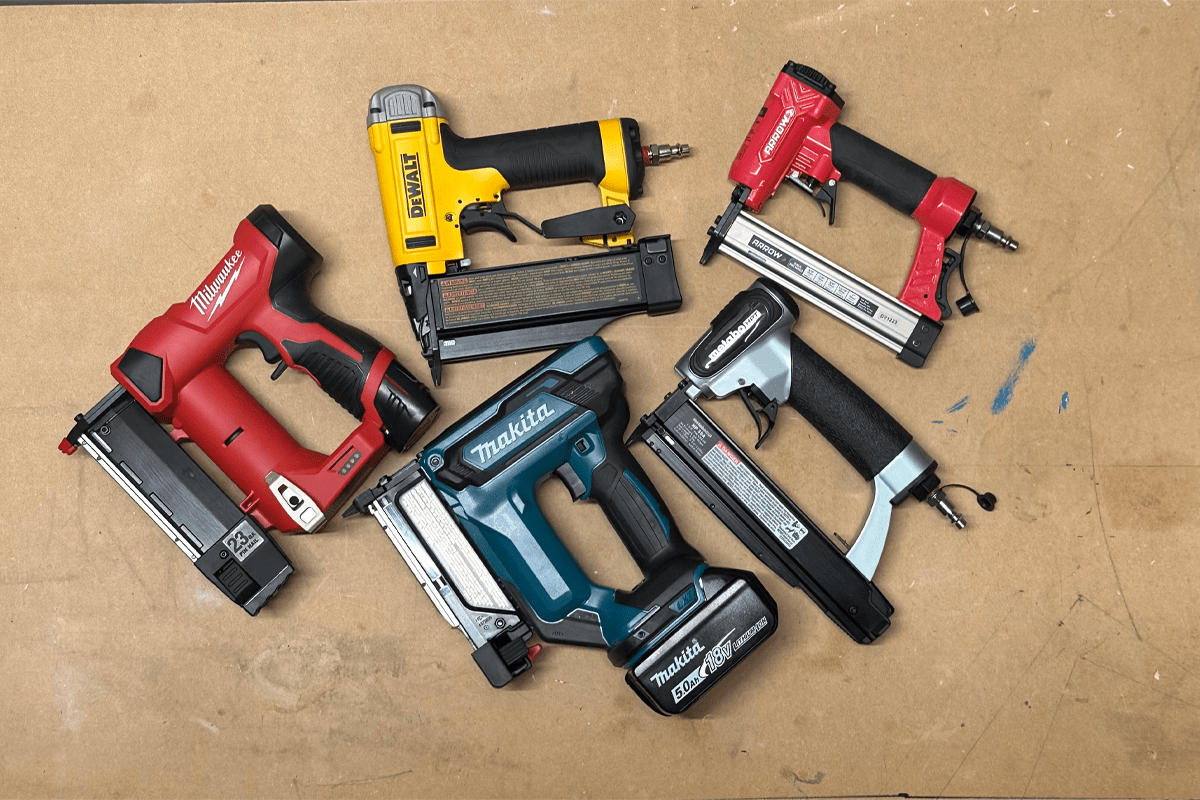
A pin nailer is the quiet specialist of the nail-gun family. It does not frame walls, build decks, or make a dramatic entrance. Instead, it slips nearly invisible 23-gauge pins into delicate trim, cabinet details, small moldings, picture frames, and glued joints without leaving craters that demand a date with wood filler.
To identify the best pin nailers, we compared manufacturer specifications with published hands-on testing from respected U.S. tool and home-improvement outlets. We focused on driving consistency, pin-length range, nose visibility, dry-fire protection, jam access, ergonomics, battery-system value, and performance in both softwood and hardwood. The result is a practical list for professional finish carpenters, furniture makers, cabinet installers, and weekend woodworkers who would rather admire their project than spend Saturday filling nail holes.
Our Top Pin Nailer Picks
| Category | Model | Power Source | Pin Range |
|---|---|---|---|
| Best Overall | DeWalt DWFP2350K | Pneumatic | 5/8 to 2 inches |
| Best Cordless Overall | Milwaukee M12 2540 | 12-volt battery | 1/2 to 1-3/8 inches |
| Best for DeWalt Users | DeWalt DCN623B | 20V MAX battery | 5/8 to 1-1/2 inches |
| Best Value Cordless | Ryobi P318 AirStrike | 18V ONE+ battery | 1/2 to 1-3/8 inches |
| Best for Makita Users | Makita XTP02Z | 18V LXT battery | 5/8 to 1-3/8 inches |
| Best Long-Pin Pneumatic | Grex P650LXE | Pneumatic | 3/8 to 2 inches |
| Best Runtime | Metabo HPT NP1835DA | 18V MultiVolt battery | 5/8 to 1-3/8 inches |
Best Overall: DeWalt DWFP2350K 23-Gauge Pin Nailer
The DeWalt DWFP2350K earns the top spot because it combines serious driving power with features that solve common pin-nailer annoyances. It accepts 23-gauge headless pins from 5/8 inch to 2 inches, can recess long pins in oak, and includes tool-free jam access and depth adjustment. Its oil-free design also lowers the chance of leaving an oily souvenir on pale trim.
Published testing found that this pneumatic pin nailer drove fasteners consistently in pine, poplar, and oak while leaving tiny entry marks. The trade-off is size: the longer cylinder that helps it handle 2-inch pins also makes the nose section bulkier than some compact competitors. For cabinet shops, finish crews, and woodworkers who already own a compressor, however, its combination of power, range, and serviceability is difficult to beat.
Why It Stands Out
- Exceptional 5/8-inch to 2-inch fastener range
- Tool-free jam release and depth control
- Dry-fire lockout with bypass and reload alert
- Strong performance in dense hardwood
Keep in Mind
It needs a compressor and hose, and its head is not the easiest to squeeze into a cramped cabinet corner.
Best Cordless Overall: Milwaukee M12 2540 Pin Nailer
Milwaukee’s M12 2540 is the cordless model to beat when mobility matters. It drives 1/2-inch to 1-3/8-inch headless pins, holds 120 fasteners, and is rated for up to 750 pins per charge with a compact 1.5Ah battery. Independent reviewers repeatedly praise its immediate firing response, confident power, small footprint, and low weight compared with bulkier 18-volt cordless nailers.
The M12 platform is especially attractive for installers who move from room to room and do not want to drag a compressor across finished flooring. Tool-free depth adjustment, an LED work light, dry-fire protection, a reload indicator, and a reversible belt clip make it feel like a professional tool rather than a battery-powered compromise. Jam clearing requires a hex wrench, and the 1-3/8-inch maximum is shorter than the range of premium pneumatic pinners, but those limitations are reasonable for such a compact package.
Best For
On-site trim repairs, cabinet scribe molding, small returns, decorative details, and punch-list work where setup time matters as much as firing power.
Best for DeWalt Battery Owners: DeWalt DCN623B
The DeWalt DCN623B is a logical choice for anyone already invested in the 20V MAX system. Its brushless motor drives 23-gauge pins from 5/8 inch to 1-1/2 inches without a hose, compressor, or gas cartridge. That extra 1/8 inch of maximum fastener length over many cordless rivals can be useful when pinning thicker trim assemblies or holding layered moldings while glue cures.
This model is more substantial than the Milwaukee M12, but the larger battery platform can be an advantage for contractors who already carry DeWalt drills, saws, and lights. Buying the bare tool avoids paying for another charger, while the cordless format reduces setup time on small jobs. It is a particularly sensible pick for remodeling crews that value platform compatibility over having the lightest possible pinner.
Best Value Cordless: Ryobi P318 AirStrike Pin Nailer
The Ryobi P318 brings hose-free pinning to the broad ONE+ battery family. It accepts 1/2-inch to 1-3/8-inch pins and adds useful jobsite features such as LED lighting, a belt clip, dry-fire lockout, and a double-trigger safety system. Reviews generally describe it as a strong value with solid driving performance, particularly for DIY users who already own Ryobi batteries.
It is not as compact as Milwaukee’s M12 model, and the tool-only configuration is less appealing to buyers who have no ONE+ batteries. For a homeowner with a Ryobi drill, sander, or yard tool already in the garage, though, the P318 can be a cost-effective way to add a cordless 23-gauge pin nailer without starting a second battery collection. Because apparently chargers multiply in dark cabinets when nobody is watching.
Best for Makita Users: Makita XTP02Z 18V LXT Pin Nailer
Makita’s XTP02Z supports six specified pin lengths from 5/8 inch to 1-3/8 inches and carries up to 120 pins. Makita rates it for as many as 5,300 shots with a 5.0Ah LXT battery, which is far beyond the needs of a normal trim session unless you are pinning an entire miniature city.
The narrow nose helps with placement, and the cordless design suits cabinetry, molding, baseboards, and decorative work. A large 5.0Ah pack maximizes runtime but also adds weight, so a smaller compatible battery may feel better during detailed or overhead work. This is not the cheapest route for someone new to Makita, but it makes excellent sense for established LXT users who want one battery system across the shop.
Best Long-Pin Pneumatic: Grex P650LXE
The Grex P650LXE is aimed at serious finish work. It accepts 23-gauge pins from 3/8 inch to 2 inches, and its self-adjusting magazine accommodates 14 fastener lengths. A narrow nose improves access, while automatic lockout helps prevent dry firing. The model also includes an override for the reserve pins and an adjustable edge guide for repeatable placement.
Its pneumatic format keeps the handpiece relatively nimble and delivers the consistency many production woodworkers still prefer. The cost is dependence on an air supply, and the feature set may be more than an occasional craft user needs. For furniture shops, cabinet builders, and trim professionals who regularly switch pin lengths, the Grex offers range and precision that justify its premium positioning.
Best Runtime: Metabo HPT NP1835DA MultiVolt Pin Nailer
The Metabo HPT NP1835DA combines cordless convenience with an unusually strong runtime claim: up to 2,700 pins per charge with the included compact 2.0Ah battery. It accepts five pin lengths from 5/8 inch to 1-3/8 inches and includes dry-fire lockout, a double trigger, an LED light, a fine-tip nose, and a mechanical spring drive system.
Its compact profile and clear sightline make it pleasant for trim and cabinet work. Hands-on testing reported excellent results in yellow pine but less consistent depth in red oak, so users who work mainly with dense hardwood should test depth on scrap before committing to visible pieces. The five-year tool warranty and compatibility with Metabo HPT’s 18V and 36V MultiVolt batteries strengthen its appeal as a complete kit.
How We Evaluated the Best Pin Nailers
Pin nailers perform a narrow job, so the evaluation criteria should be narrow too. Raw power matters, but a tool that dents the face of delicate molding is missing the point. We prioritized the following factors:
Driving Consistency
A good pinner should set fasteners to a repeatable depth without leaving proud pins or deep driver marks. Dense species such as oak and maple reveal power limitations faster than pine.
Nose Visibility and Surface Protection
The tip should make it easy to see where the pin will enter. No-mar tips and low-force contact designs help protect prefinished trim, veneer, and softwood.
Fastener Range
Short pins work well for thin decorative pieces, while longer pins provide more reach for layered molding and thicker assemblies. Pneumatic models typically offer the broadest range, with several premium tools accepting 2-inch pins.
Jam Clearing and Dry-Fire Protection
Tool-free jam access saves time. Dry-fire lockout protects the driver and prevents the nose from punching an empty mark into the workpiece.
Ergonomics
Pin nailing often involves awkward angles and precise alignment. Weight, balance, grip shape, trigger design, belt hooks, and battery size all affect control.
Pin Nailer vs. Brad Nailer: Which One Do You Need?
A 23-gauge pin nailer drives extremely thin, usually headless fasteners that leave nearly invisible holes. It is best for delicate molding, veneer, small returns, picture frames, craft assemblies, and holding glued joints in position. Pins provide limited standalone holding power, so wood glue usually does the structural work.
An 18-gauge brad nailer drives thicker fasteners with small heads. Brads hold more strongly and suit casing, baseboard, paneling, and larger trim, but they leave more visible holes and create a greater risk of splitting fragile stock. Think of the pin nailer as a discreet assistant and the brad nailer as the coworker who gets results but leaves fingerprints.
What to Look for When Buying a Pin Nailer
Pneumatic or Cordless Power
Pneumatic pin nailers are generally lighter in the hand and often accept longer pins. They are excellent in a shop where a compressor is already running. Cordless models eliminate hoses and setup time, making them ideal for service calls, installation work, and small projects around the house. Your existing battery platform should influence the decision because batteries and chargers can represent a large share of the total cost.
Maximum Pin Length
A 1-3/8-inch maximum is sufficient for most fine trim and cabinet details. Choose a 1-1/2-inch or 2-inch model when you regularly fasten thicker molding or need more bite through layered material. Longer is not automatically better; the best fastener is the shortest pin that safely holds the pieces while the adhesive cures.
Depth Adjustment
Tool-free depth control is convenient when moving between pine, poplar, oak, MDF, and prefinished material. Even with adjustment, always fire several test pins into scrap of the same thickness and species.
Safety Controls
Look for a double trigger, trigger lock, or sequential firing arrangement that reduces accidental discharge. Never bypass a safety mechanism. Wear eye protection, keep hands away from the fastener path, disconnect the battery or air hose before clearing a jam, and seek medical care after any nail-gun injury, even one that appears minor.
Experience-Based Lessons From Real Pin-Nailer Work
The most important lesson from real-world pin-nailer use is that the tool is not a substitute for glue. A 23-gauge pin has almost no head, so its great cosmetic advantage is also its structural weakness. On a mitered return, a thin bead of quality wood glue creates the lasting joint; the pin simply acts like a tiny clamp until the adhesive sets. Skip the glue, and the project may look perfect today while quietly planning its escape next month.
Second, test shots are not optional. A depth setting that is perfect in poplar may leave a proud pin in red oak or bury the driver too deeply in soft pine. Battery charge, air pressure, fastener length, grain direction, and material density all influence the result. Use offcuts from the actual project, not a random scrap that has been living behind the workbench since 2017.
Third, pin direction matters. A chisel-point fastener can follow the grain and curve as it travels through the wood. Whenever possible, orient the nailer so a deflected pin is less likely to exit the face or side of the workpiece. Keep fingers well away from the expected path, especially when fastening narrow returns or thin molding. Tiny fastener does not mean tiny consequences.
Fourth, the lightest setup is not always the fastest setup. In a production shop, a pneumatic pinner connected to a suspended hose can feel nearly weightless and fire all day. In an occupied home, dragging a compressor through hallways may take longer than the repair itself. A compact cordless model wins when the job involves five pins in three different rooms; a premium pneumatic model wins when the day involves hundreds of pins at one bench.
Fifth, nose design often matters more than the feature list. Cabinet fillers, glass stops, bead molding, and small inside returns leave little room to position the tool. A narrow, clearly visible tip helps place each pin exactly where it can hold without blowing through an edge. LED lights are useful, but they cannot compensate for a bulky magazine that blocks the sightline.
Finally, treat dry-fire lockout as a valuable feature rather than an inconvenience. It prevents the driver from striking an empty magazine and helps avoid a needless dent in a finished surface. Reload before the tool reaches its reserve limit, keep the correct hex key nearby if jam access is not tool-free, and use clean, properly sized fasteners. Many “tool problems” begin with the wrong pins, damaged strips, excessive air pressure, or the understandable human belief that reading the manual is an activity reserved for other people.
Final Verdict
The DeWalt DWFP2350K is our best overall pin nailer for users who want maximum fastener range, dependable hardwood performance, and convenient jam access. The Milwaukee M12 2540 is the best cordless choice for most mobile professionals because it balances power, compact dimensions, and genuinely useful features. Ryobi offers strong value for ONE+ owners, while Makita, DeWalt, and Metabo HPT make the most sense when their battery platforms are already part of your tool collection. For demanding pneumatic work and frequent pin-length changes, the Grex P650LXE is the specialist’s specialist.
No matter which model you choose, remember what a pin nailer does best: it holds delicate pieces neatly while glue creates the durable bond. Choose the right pin length, test on scrap, protect your eyes and hands, and let this small tool do its subtle magic without asking it to build a house.
Editorial note: Product specifications and availability can change. Confirm current fastener compatibility, included accessories, warranty terms, and battery requirements before purchasing.