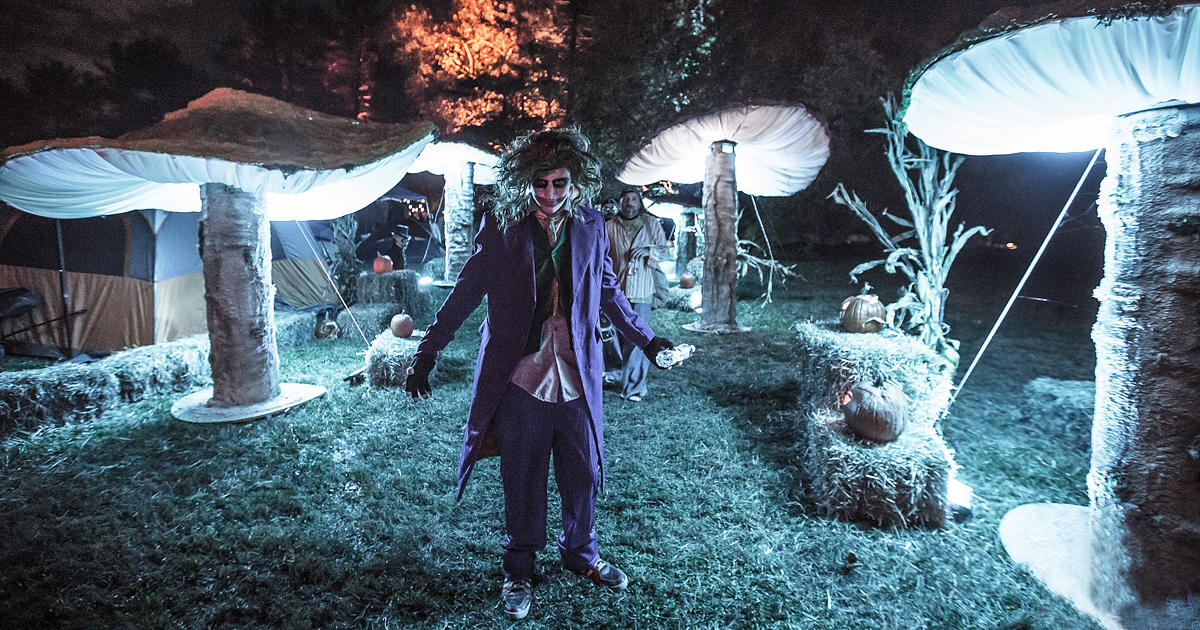
Some decorations politely occupy a corner. My giant illuminated mushrooms do not understand the meaning of “politely.” Standing between 5 and 10 feet tall, they transform gardens, festivals, weddings, and Halloween events into glowing fantasy landscapes where visitors half expect a rabbit in a waistcoat to ask for directions.
Installation artist and event designer Rania Peet originally created these oversized mushroom sculptures for an annual Halloween walk-through. The project soon developed a life beyond spooky season. With colorful caps, dramatically pleated gills, and internal LED lighting, the mushrooms proved equally at home beside a music stage, beneath trees, or near a wedding dance floor.
Their magic comes from a thoughtful combination of theatrical design and practical engineering. They must appear enormous while remaining light enough to transport, sturdy enough for repeated events, and compact enough to store without requiring a warehouse the size of a fairy kingdom.
Why Giant Illuminated Mushrooms Feel So Magical
Mushrooms already seem like objects smuggled into reality from a storybook. Their unusual proportions, hidden underground networks, sudden appearance after rain, and long association with fairy rings make them natural subjects for whimsical art.
Scale intensifies that effect. A familiar mushroom becomes something entirely different when its cap is wider than a dining table. Visitors no longer look down at it; they stand beneath it. That reversal of perspective makes adults feel temporarily small and curious again.
Light adds another transformation. During the day, the sculptures function as colorful oversized props. After sunset, their illuminated gills create soft pools of color and reveal textures that are barely noticeable in daylight. One sculpture can become a landmark, while a group creates the impression of a complete enchanted forest installation.
Building a Lightweight but Sturdy Mushroom
Starting With a Wooden Stem
Each sculpture begins with a structural core. Lumber, plywood, lag screws, and other substantial fasteners form the central stem and base. The internal frame must support the cap without becoming excessively heavy or unstable.
Getting the base right matters because the cap creates considerable visualand sometimes literaltop weight. A giant mushroom that leans slightly may look charming in a drawing. At a crowded outdoor event, it looks like paperwork waiting to happen.
Once the main stem is upright, chicken wire is wrapped around the wooden skeleton. The wire provides a flexible surface that can be pushed, curved, and tightened until the stem has an organic shape. Perfect symmetry is unnecessary. Real mushrooms are not manufactured by committee, and their irregularities give them personality.
Shaping the Oversized Cap
The detachable cap uses its own supporting structure. A combination of wood, electrical conduit, PVC tubing, and chicken wire creates the broad, curved profile. Conduit and tubing are especially useful because they can define sweeping arcs without adding the weight of a solid wooden shell.
Building the cap separately is one of the project’s smartest features. A 10-foot mushroom may look magnificent in a field, but it has strong opinions about fitting through a garage door. A removable cap allows the sculpture to be transported in sections and assembled at its destination.
The cap attaches securely through its wooden base. This modular approach also simplifies maintenance because individual sections can be inspected, repainted, rewired, or repaired without dismantling the entire sculpture.
Creating the Mushroom’s Textured Skin
Fabric Becomes the Foundation
After the frame is complete, cheesecloth or cotton scrim is attached over the chicken wire with spray adhesive. This layer bridges the openings in the mesh and creates a continuous surface for the exterior material.
The process resembles dressing a very large, very lumpy mannequin. The fabric must follow the curves without leaving unsupported gaps. Because the final texture is meant to look natural, a few wrinkles and variations are welcome.
Adding Two-Part Spray Foam
Two-component polyurethane spray foam is applied over the fabric-covered frame. Although commonly used as insulation, it can also produce lightweight dimensional surfaces for large theatrical props. The foam expands rapidly and hardens into an irregular texture that suits a mushroom remarkably well.
This stage requires professional-level safety precautions. Spray polyurethane foam components can irritate the skin, eyes, and respiratory system. Proper protective clothing, chemical-resistant gloves, goggles, suitable respiratory protection, controlled ventilation, and careful adherence to the product’s safety data are essential. Unprotected people and pets should remain outside the work area.
The material rises and firms up within minutes, but the sculptures are allowed to cure thoroughly before finishing. Manufacturer instructions should always determine curing, ventilation, and reentry times. Large-prop construction is delightful; accidentally turning your lungs into an experimental art project is not.
Painting the Caps and Making the Gills
A paint sprayer helps cover the foam’s countless ridges and crevices. Multiple colors can be layered to enhance shadows, spots, edges, and natural-looking variations. Bold reds, purples, blues, and earthy browns give each sculpture a distinct personality.
The underside of the cap demands considerably more patience. Wide white spandex is pleated and attached around the interior to imitate mushroom gills. The fabric is allowed to drape between attachment points, producing deep radial folds that catch and diffuse the internal light.
Pleating, pinning, trimming, stapling, and hot-gluing yards of fabric is repetitive work. It is also the detail that prevents the cap from looking like an upside-down salad bowl. The gills bring biological character to the sculpture and help distribute light across the entire underside.
Hot glue requires its own small dose of respect. A beautiful installation may justify many things, but fingertip burns should not become the artist’s signature technique.
How LED Lighting Brings the Mushrooms to Life
LED lighting is ideal for illuminated mushroom sculptures because the components are compact, energy efficient, colorful, and easy to integrate into irregular forms. LEDs can produce dramatic light while using substantially less electricity than traditional incandescent lighting.
Positioning the lights beneath the pleated spandex creates a diffused glow instead of a collection of harsh points. The gills appear luminous, as though the mushroom is generating light from within. Colored LEDs can establish different moods: amber feels warm and woodland-like, blue suggests an alien planet, and shifting rainbow effects are practically required whenever a DJ is nearby.
Outdoor installations need appropriately rated lighting, power supplies, cables, connectors, and enclosures. Electrical connections should be protected from rain and standing water, while cords must be routed to avoid trip hazards. For public events, organizers should work with qualified electrical and safety professionals and follow local requirements.
Designed to Travel From Place to Place
A successful festival art installation must survive more than its opening night. It may be loaded into a vehicle, carried across uneven ground, assembled in changing weather, admired by thousands of people, disassembled after midnight, and stored until its next adventure.
Detachable caps, lightweight shells, reusable fasteners, and replaceable fabric sections make that schedule possible. Later improvements can include hook-and-loop closures, reinforced connection points, fresh paint, decorative moss, and upgraded lighting.
Transportability also extends the project’s creative life. Instead of remaining fixed in one garden, the giant illuminated mushrooms can appear at Halloween attractions, music festivals, private parties, corporate events, photography sessions, or weddings. The same sculptures take on a new identity whenever their colors, placement, and surroundings change.
Where Giant Glowing Mushrooms Make the Biggest Impact
Halloween Walk-Throughs
In a haunted garden, glowing mushrooms establish atmosphere before the first costumed performer jumps from behind a tree. Dim purple, green, or red lighting can make a familiar yard feel mysterious without relying solely on fake tombstones and plastic skeletons who have clearly skipped leg day.
Music and Arts Festivals
At festivals, oversized mushrooms work as both artwork and navigational landmarks. “Meet beneath the enormous blue mushroom” is considerably easier than “meet somewhere near that field with all the people.” Their illuminated caps remain visible after dark and help create a shared visual identity for an event.
Weddings and Special Events
Woodland, fantasy, and bohemian weddings can use the sculptures to frame a ceremony, decorate a lounge, or establish an unforgettable photo area. Warm white lighting, greenery, and restrained colors soften the festival aesthetic while preserving the sense of wonder.
Placement should account for guest movement, emergency access, wind exposure, anchoring, and electrical service. The sculptures should invite exploration without blocking pathways or encouraging visitors to climb them. No matter how convincing the mushroom looks, it is still scenery rather than patio furniture.
Why Public Light Art Creates Connection
Large illuminated sculptures change how people use a space. Visitors slow down, take photographs, point out details, and talk with strangers. Children invent stories while adults rediscover the socially acceptable joy of staring at something wonderfully ridiculous.
Other mushroom-inspired public artworks have produced similar reactions. American installations include kinetic mushrooms whose caps open and close while rainbow LEDs move across their surfaces, as well as permanent fairy rings containing more than 100 internally illuminated mushroom forms. These projects demonstrate how fungi, scale, and light can convert an ordinary lawn or downtown plaza into an immersive experience.
Mushrooms also carry a deeper ecological association. The visible cap is only one part of a fungus; much of its life exists in networks below the surface. That hidden interconnectedness makes the mushroom an appropriate symbol for festivals and community spaces, where separate individuals briefly form something larger together.
Experiences Inspired by a Traveling Mushroom Forest
The most rewarding moment arrives after the difficult work is finished. During construction, a mushroom is mostly a collection of practical problems: a stubborn curve, an awkward sheet of chicken wire, a disappearing box of fasteners, or a piece of fabric that refuses to pleat in the direction civilization intended.
Then the sculpture reaches an event site. The cap is secured, the surrounding area is checked, and the final electrical connection is made. At first, nothing seems particularly dramatic. There is simply a large object standing in daylight while crew members carry equipment around it.
Dusk changes everything. As the sky darkens, the illumination under the cap becomes more visible. The white gills begin to glow, shadows deepen around the stem, and colors spread across nearby grass and trees. A structure that felt like an oversized prop an hour earlier suddenly appears alive.
People usually notice the height first. They approach from a distance, then tip their heads back when they realize how far the cap extends above them. Children tend to accept the scene immediately. Adults often pause, smile, and take out their phonesas though photographic evidence will be necessary when they later explain that they spent the evening beneath a luminous fungus.
Every location adds something different. In a wooded Halloween setting, branches and mist make the illuminated mushrooms feel secretive and slightly mischievous. At a music festival, the light responds visually to the energy of the crowd, even when the sculpture itself remains still. At a wedding, a warm glow behind the couple can turn a simple photograph into a scene from an elaborate fantasy film.
Weather and transportation provide less glamorous experiences, but they teach the most useful lessons. A removable section that seemed unnecessary in the workshop may save an hour during setup. An access panel becomes extremely valuable when a cable needs attention. Extra touch-up paint, spare fasteners, labeled wiring, and a sensible packing order can rescue an installation day before anyone notices a problem.
There is also pleasure in watching the sculptures improve from one appearance to the next. New moss softens a seam. A different color gives an older cap a fresh identity. Better connectors reduce setup time, while refined lighting makes the gills glow more evenly. The project never feels completely finished; it behaves more like a strange artificial species that keeps evolving.
The illuminated mushroom forest creates memories because it offers more than decoration. It gives visitors permission to play, imagine, and step briefly outside the ordinary. For a few minutes, a parking lot can become a woodland clearing, a lawn can become another planet, and grown adults can stand beneath a 10-foot mushroom without needing to explain themselves.
Conclusion: Let Imagination Grow After Dark
Giant illuminated mushrooms succeed because they balance fantasy with practical design. Wood, wire, conduit, fabric, foam, paint, and LED lighting are transformed into portable sculptures capable of changing the mood of nearly any setting.
The work behind them is substantial, from shaping the frame and creating hundreds of pleats to planning safe power connections and transportation. Yet the result feels effortless when the lights come on. These glowing sculptures do what memorable public art should do: interrupt routine, encourage connection, and make familiar places feel newly discovered.
Note: Two-part spray foam, electrical systems, tall structures, and outdoor installations present serious safety risks. Follow manufacturer instructions and applicable event rules, and consult qualified fabrication, electrical, and structural professionals before attempting a similar build.