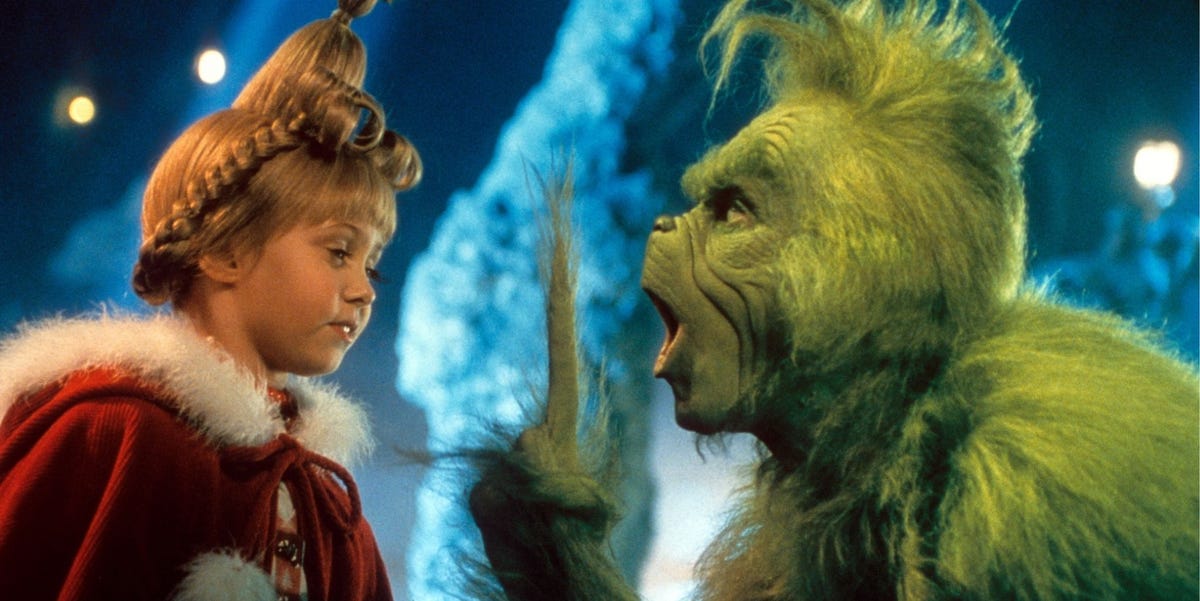
There are now several screen versions of Dr. Seuss’s green Christmas grouch. One has Jim Carrey performing facial gymnastics beneath award-winning makeup. Another gives the Grinch a polished computer-animated makeover and a surprisingly fashionable cave. Yet when December arrives and I want to visit Whoville, I return to the same version every time: Chuck Jones’s 1966 animated How the Grinch Stole Christmas!
Yes, it is technically a television special rather than a theatrical movie. It lasts only about 25 minutes. It does not explain the Grinch’s childhood, introduce a romantic subplot, or spend half an hour touring Whoville’s retail district. That restraint is exactly why it remains the best Grinch movie in my holiday lineup.
The original Grinch cartoon is quick, strange, musical, genuinely funny, and unexpectedly moving. It understands that Dr. Seuss created a fable, not a cinematic universe requiring three prequels and a Max origin story.
The 1966 Grinch Special Knows Exactly What Story It Is Telling
Dr. Seuss published How the Grinch Stole Christmas! in 1957. The book tells an elegantly simple story: a bitter creature despises the joyful Whos, steals their Christmas belongings, discovers that Christmas survives without those belongings, and experiences a dramatic change of heart.
That is the entire engine. It does not need complicated mythology. The Grinch does not require a detailed psychological diagnosis. Whoville does not need municipal politics, romantic rivalries, or a department store subplot. The story works because it moves like a fable, with every rhyme and image pushing toward one clear revelation.
The 1966 adaptation respects that structure. Directed by animation legend Chuck Jones and produced with Dr. Seuss, it expands the book just enough to create movement, music, comedy, and suspense. It does not inflate a picture book into an exhausting spectacle. It gives the material room to breathe without stuffing the sleigh with narrative furniture nobody ordered.
A Short Runtime Becomes a Creative Advantage
Modern family films often seem terrified that viewers will feel cheated unless a story lasts at least 90 minutes. The original Grinch special has no such insecurity. It arrives, does its job, carves the roast beast, and leaves before anyone starts checking the clock.
Its compact length produces momentum. Within minutes, we understand the Grinch, meet Max, observe the Whos, hear the plan, and begin the Christmas theft. There is almost no dead space. Even pauses have purpose, allowing a facial expression, musical note, or perfectly timed reaction from Max to deliver the joke.
This economy also strengthens the ending. The Grinch’s transformation does not get buried beneath side plots. When he hears the Whos singing after discovering their missing presents, the emotional turn lands with surprising force. The special has spent its limited time preparing precisely for that moment.
Chuck Jones Turns Dr. Seuss’s Drawings Into Moving Mischief
Chuck Jones was already famous for directing classic Warner Bros. cartoons before bringing the Grinch to television. His experience with exaggerated expressions, elastic movement, visual rhythm, and characters whose plans regularly backfire made him an ideal match for Dr. Seuss.
The 1966 Grinch is not merely illustrated dialogue. Jones translates Seuss’s visual language into animation. The Grinch’s body stretches, folds, slithers, and snaps according to his mood. His fingers curl like green question marks. His smile expands into an architectural hazard. When an idea forms, his entire face appears to participate in the crime.
Jones also understands the value of stillness. The special knows when to let the Grinch stare, calculate, or silently enjoy his own wicked cleverness. Those pauses make the explosive movements funnier. Animation is not only about how much a character moves; it is about choosing the exact moment when movement becomes irresistible.
The Grinch Looks Dangerous Without Becoming Frightening
In the original book, the illustrations rely heavily on black, white, and red. Jones helped establish the character’s now-famous green appearance for television. That green fur, paired with yellow eyes and a red Santa costume, created one of the most instantly recognizable holiday designs in popular culture.
The character looks sinister enough to support the story, but he never becomes too disturbing for young viewers. His sharp expressions are balanced by his theatrical behavior. He is a villain, certainly, but he is also a performer who clearly believes every room is waiting for his entrance.
His physical relationship with Max adds another layer. The dog is not just a helper. Max becomes the audience’s emotional representative, reacting to the Grinch’s plans with confusion, exhaustion, patience, and the facial expression of an employee who has stopped asking whether overtime will be approved.
Boris Karloff Gives the Grinch His Perfect Voice
Boris Karloff provides both the narration and the speaking voice of the Grinch. That casting choice sounds obvious in hindsight, but it remains inspired. Karloff was strongly associated with classic horror, including his famous performance as Frankenstein’s monster. His deep, textured voice brings darkness to the special without crushing its humor.
As narrator, Karloff sounds like an elegant storyteller inviting the audience closer to the fire. As the Grinch, he adds slyness, irritation, and smug satisfaction. The distinction between the two performances is subtle, allowing the narration and character dialogue to feel as though they belong to the same strange storybook world.
Most importantly, Karloff does not treat the material as disposable children’s entertainment. He gives the rhymes weight. He respects the pauses. He lets amusing words roll around in his voice as if he has discovered them for the first time. That seriousness makes the absurdity even funnier.
The Famous Song Is a Three-Minute Character Assassination
“You’re a Mean One, Mr. Grinch” may be the greatest holiday insult song ever recorded. The lyrics were written by Dr. Seuss, the music was composed by Albert Hague, and the unmistakably deep singing voice belonged to Thurl Ravenscroft.
Ravenscroft was not prominently credited in the original broadcast, which contributed to the long-running misconception that Karloff performed the number. Karloff voiced the character and narrator, but Ravenscroft delivered the booming musical roast.
The song does more than provide entertainment. It explains the Grinch’s personality through increasingly ridiculous comparisons. Instead of stopping after calling him unpleasant, the lyrics keep escalating until his soul, smile, heart, brain, and general social presence have all been thoroughly reviewed and denied holiday admission.
It is funny because it is specific. Generic insults disappear. A creatively described bad banana remains immortal.
The Original Grinch Cartoon Preserves the Story’s Sharpest Message
The Grinch believes Christmas is a collection of removable objects. He takes the stockings, presents, decorations, food, trees, and musical instruments. By his logic, once the evidence of Christmas is gone, the holiday must disappear with it.
Instead, the Whos gather and sing.
The simplicity of that image carries the entire message. Christmas may include gifts, meals, lights, and decorations, but it cannot be reduced to those things. Community survives the burglary. Joy survives the empty living rooms. The Grinch has stolen the merchandise but failed to steal the meaning.
The 1966 adaptation delivers this lesson without turning into a lecture. It trusts the contrast between the empty homes and the singing Whos. It lets the Grinch’s confusion become the audience’s moment of reflection.
That restraint matters because the story is not exactly anti-present. The Whos still enjoy their feast after the Grinch returns everything. The point is not that decorations and gifts are evil. The point is that they are expressions of celebration, not its foundation.
The Grinch’s Redemption Feels Suddenand That Works
Some viewers may argue that the Grinch changes too quickly. One moment, he is waiting to hear Whoville collapse into despair. Soon afterward, his heart grows three sizes and he is racing to save the stolen goods.
In a realistic drama, that transformation might require therapy, accountability, several difficult conversations, and possibly a court date. In a fable, however, revelation can arrive like lightning. The Grinch sees undeniable proof that his worldview is wrong. His physical transformation makes the internal change visible.
The special does not excuse his behavior. It shows him reversing it. He saves the sleigh, returns the presents, joins the community, and receives the honor of carving the roast beast. Redemption is presented not as a private feeling but as a changed course of action.
Why the Jim Carrey Grinch Is Impressive but Not My Grinch
Ron Howard’s live-action How the Grinch Stole Christmas arrived in 2000 with enormous sets, elaborate costumes, detailed prosthetics, and Jim Carrey operating at approximately 340 percent of normal human energy.
There is plenty to admire. Carrey commits completely to the role, turning nearly every line into a physical routine. Rick Baker and Gail Ryan won the Academy Award for makeup, and that achievement is easy to understand. The transformation is technically remarkable, allowing Carrey to remain expressive beneath layers of green prosthetics.
The production design also creates a fully realized Whoville. Curved buildings, strange vehicles, oversized hairstyles, and crowded holiday displays make the town feel like a Dr. Seuss illustration rebuilt by contractors who had never encountered a straight line.
Still, the movie’s greatest strength is also its biggest problem: there is so much of everything. A brief fable becomes a feature-length comedy filled with added history, social satire, romance, schoolyard humiliation, civic competition, and consumer chaos.
Some fans understandably love this version. For viewers who grew up with it, Carrey is the definitive Grinch. His improvised energy and endlessly quotable delivery have helped the movie become a modern holiday favorite.
For me, however, the additional material weakens the clean emotional architecture of the story. The Grinch becomes less mysterious, while the Whos become more hypocritical and materialistic. The film explains his resentment in detail, but the explanation makes the story busier rather than deeper.
I can respect the craftsmanship and still choose the 1966 special. Admiration does not require annual attendance.
The 2018 Grinch Is Pleasant, Polished, and a Little Too Nice
Illumination’s 2018 animated The Grinch offers another interpretation, with Benedict Cumberbatch voicing the title character. The movie was a major commercial success, earning more than half a billion dollars worldwide according to reported box-office figures.
This version is colorful, accessible, and carefully designed for modern family audiences. Max receives plenty of screen time. Cindy-Lou Who has an expanded storyline involving her hardworking mother. The Grinch has gadgets, routines, emotional wounds, and a cave that appears more comfortable than many city apartments.
The movie is easy to watch and difficult to hate. Yet its Grinch often feels more lonely than mean. His roughest edges have been sanded down, wrapped in a scarf, and served a warm beverage. The story provides understandable reasons for his behavior almost immediately.
That approach creates empathy, but it reduces the shock of his transformation. In the 1966 Grinch special, the character begins as an unapologetic menace. His sudden realization therefore feels enormous. The 2018 version starts closer to redemption, so the emotional distance traveled is shorter.
It is a perfectly respectable holiday film. It simply does not replace the stranger, sharper, more memorable cartoon that came before it.
Why the 1966 Version Still Feels Fresh
Many old television specials survive because adults remember watching them as children. Nostalgia certainly contributes to the original Grinch cartoon’s popularity, but nostalgia alone cannot explain its durability. Plenty of childhood favorites become difficult to revisit once the protective fog of memory clears.
The 1966 special still works because its individual elements remain strong. The character animation is expressive. The narration is sophisticated. The music is memorable. The jokes are concise. The central message remains relevant in an era when Christmas advertising appears before Halloween has removed its shoes.
Its handmade quality also gives it warmth. The backgrounds, painted shapes, limited color palette, and visible linework feel connected to the book. The special looks illustrated rather than manufactured. Its imperfections contribute to its personality.
Most of all, the story understands that holiday entertainment does not have to be enormous to become important. A 25-minute cartoon can create a yearly ritual. A single song can outlive thousands of seasonal releases. One image of joined hands can communicate more than a speech explaining the true meaning of Christmas.
My Annual Experience Watching the Only Grinch Movie I Need
My relationship with the 1966 How the Grinch Stole Christmas! is less like watching a movie and more like performing a seasonal household ceremony. It usually begins when the decorations are up but the holiday mood has not fully arrived. The calendar says December, yet my brain is still carrying unfinished work, unanswered messages, and the suspicion that I have forgotten to buy something important.
Then the opening narration begins.
Karloff’s voice immediately changes the atmosphere. The room becomes quieter. The familiar snowy mountain appears, and I know that for the next 25 minutes, nothing complicated will be required of me. I do not need to remember a character’s backstory or prepare for a sequel. I only need to watch a green creature become furious because other people are enjoying themselves.
That emotion is, frankly, more relatable during the holidays than many cheerful movies are willing to admit.
The Grinch Understands Seasonal Overload
Every year, I notice something different about the Grinch’s opening complaints. He hates the noise, the singing, the feasting, and the relentless celebration. His solution is criminal and wildly disproportionate, but the irritation beneath it is recognizable.
Christmas can be joyful while also being loud, expensive, crowded, and emotionally demanding. The Grinch becomes a ridiculous expression of the exhausted part of us that would occasionally prefer everyone to stop jingling for five minutes.
The special allows that grumpiness to exist without declaring it permanent. The Grinch does not remain trapped in resentment. He is surprised by joy rather than defeated by it. That distinction makes his change feel hopeful instead of punitive.
Max Quietly Steals Every Scene
My attention has also shifted toward Max over the years. As a child, I focused on the Grinch’s scheme. As an adult, I watch the dog.
Max is asked to wear an antler, pull an overloaded sleigh, climb a mountain, participate in a felony, and maintain a positive attitude despite receiving no visible compensation. He responds with the weary loyalty of someone who knows management has made a terrible decision but also knows the project deadline is tonight.
His expressions provide a second story beneath the main one. The Grinch believes he is a brilliant mastermind. Max knows they are one loose knot away from disaster. That contrast never stops being funny.
The Song Becomes More Enjoyable Every Year
When “You’re a Mean One, Mr. Grinch” begins, I tell myself I will simply listen. Within seconds, I am waiting for each elaborate insult like it is a favorite line in a comedy routine.
The performance works because Ravenscroft sings with complete authority. He does not sound amused by the descriptions. He sounds like an expert witness presenting evidence that the Grinch should not be invited to dinner.
The vocabulary also rewards repeat viewing. The song does not settle for obvious rhymes. It offers extravagant, disgusting imagery that children find funny and adults admire for its craftsmanship. Each verse somehow discovers a new department in which the Grinch has failed.
The Ending Still Earns Its Warmth
I know exactly what will happen when the Grinch reaches the mountaintop. I know the Whos will sing. I know he will puzzle over the sound. I know his heart will grow, the sleigh will nearly fall, and Max will perform an act of strength that should qualify him for immediate retirement.
Yet the ending still works.
Perhaps that is because the special does not demand a perfect holiday. The Whos wake to discover that their carefully prepared celebration has been destroyed. Their response is not denial. They simply refuse to let the loss eliminate their connection to one another.
That idea becomes more meaningful with experience. Holidays do not always unfold according to plan. Flights are delayed. Meals burn. Families argue. Money becomes tight. Important people may be absent. The 1966 Grinch offers a small but durable reminder that celebration can survive disappointment.
By the time the Grinch returns everything and sits at the table, my holiday mood has usually arrived. Not because the special has overwhelmed me with sparkle, but because it has cleared away the clutter surrounding a simple thought: joy has more than one source.
Then the credits appear, and the entire experience is complete before I can become restless. No franchise fatigue. No post-credits scene revealing that the roast beast survived. Just a perfect little story ending exactly where it should.
Conclusion: Sometimes the Smallest Adaptation Has the Biggest Heart
The live-action Grinch has spectacular makeup, ambitious production design, and a fearless Jim Carrey performance. The 2018 animated movie has bright visuals, modern humor, and a sweeter approach to the character. Both versions have earned devoted audiences, and neither needs my permission to remain part of anyone’s Christmas tradition.
But the 1966 How the Grinch Stole Christmas! remains the only Grinch movie I need. Chuck Jones’s animation captures the shape and mischief of Dr. Seuss’s art. Boris Karloff makes every rhyme sound important. Thurl Ravenscroft delivers an unforgettable song. Max communicates entire paragraphs with one exhausted glance.
Most importantly, the special tells the story without burying it. It is funny without becoming frantic, sentimental without becoming sugary, and meaningful without explaining its meaning until the roast beast gets cold.
Call it a cartoon. Call it a television special. Call it too short to qualify as a movie. I will still watch it every yearand my opinion is unlikely to change unless my heart mysteriously shrinks three sizes.
Research Note
Historical, production, awards, publication, reception, and box-office details were synthesized and cross-checked using information from the Library of Congress, Smithsonian Magazine, Penguin Random House, the Academy of Motion Picture Arts and Sciences, the Recording Academy, the Chuck Jones Center for Creativity, Rotten Tomatoes, Box Office Mojo, Entertainment Weekly, the Associated Press, Kirkus Reviews, The New Yorker, and other established American entertainment references.