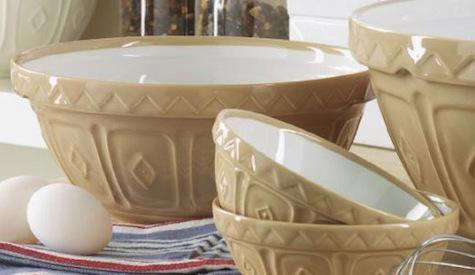
Every kitchen has at least one “main character” tool: the pan you trust, the knife you baby, the spatula you refuse to
replace even though it’s… seen things. For a lot of bakers, the Mason Cash Traditional Mixing Bowl is that tool
the bowl that shows up for birthday cakes, Sunday bread, and the occasional “I’ll just make cookies to feel something” moment.
If it looks familiar, that’s not your imagination. Mason Cash bowls have become pop-culture-famous in the U.S. thanks to their
frequent appearances on The Great British Baking Show, where contestants whip, fold, and panic-sweat into these iconic
earthenware workhorses. But a bowl doesn’t earn a fan club just by being on TV. It earns it by being useful.
What makes the Mason Cash bowl “traditional” (and why that matters)
“Traditional” isn’t code for “old-fashioned for the sake of it.” With Mason Cash, it’s about a design that’s stayed popular
because it solves real baking problems. The classic cane-style mixing bowloften called the Mason Cash Cane mixing bowl
traces its signature look back to the early 1900s, and the general silhouette has remained recognizable ever since.
That continuity isn’t nostalgia; it’s functional design that happens to be charming.
The traditional bowl is usually made from chip-resistant earthenware with a glossy glaze and an embossed pattern
around the outside. The interior is typically light-colored (often white), which sounds like an aesthetic detail until you’re
trying to see if your butter and sugar are actually creamed or just… politely acquainted.
The design features that quietly make baking easier
1) The wide, shallow shape: better mixing, easier kneading
Many mixing bowls are either tall and narrow (great for minimizing splatter) or shallow and wide (great for control).
The Mason Cash Traditional Mixing Bowl leans into a wide, shallow profile that makes stirring, folding, and scraping the sides
feel less like an arm workout and more like a competent plan. This shape is also why bakers often like it for dough: you can
mix and knead directly in the bowl without feeling like you’re wrestling a slippery sea creature.
2) The embossed exterior: not just pretty, genuinely grippy
That raised “cane” texture is more than decoration. When you’ve got flour on your hands, a towel tucked under the bowl,
and a whisk moving at the speed of ambition, grip matters. The textured pattern helps you hold and tip the bowl more securely,
especially when transferring batter into pans or pouring a vinaigrette without redecorating your counter.
3) The weight: stability you can feel
Lightweight bowls are convenientright up until they skitter across the counter like they’re late for an appointment.
Earthenware has heft, and the Mason Cash bowl’s weight helps it stay put while you mix. That stability is a big reason some
people treat it like their “serious baking bowl,” especially for thicker cookie doughs and bread doughs.
4) The glossy glaze: easier cleanup, fewer “mystery stains”
A high-gloss glaze does two things well: it cleans up more easily than porous ceramics, and it’s less likely to hang on to
stains from turmeric, cocoa, or that raspberry swirl that “definitely won’t drip.” Many versions are labeled dishwasher-safe,
which is the closest thing cookware gets to an emotional support feature.
Picking the right size (so you don’t buy a bowl that’s either too tiny or legally a kiddie pool)
One of the most confusing (and oddly satisfying) things about Mason Cash is the sizing system. You’ll often see an “S” number
stamped on the bottomS30, S24, S18, S12, S9, S6, S4, and so on. In many product guides, those markings are explained as a
manufacturing reference tied to how many bowls of that size could fit in a kiln during firing. In practical terms, the smaller
the number, the bigger the bowl.
Here’s a simple way to choose a size based on what you actually do in your kitchen:
| Common Size | Approx. Capacity | Best For |
|---|---|---|
| S30 / small | ~1.2 qt | Small batters, pudding, whisking a quick dressing, prep bowls |
| S24 / medium-small | ~2.1 qt | Cookie dough for a small batch, pastry mixing, pancake batter for two |
| S18 / medium | ~2.8 qt | Cake batter, brownies, cookie dough, whipped cream (with room to breathe) |
| S12 / medium-large | ~4.2 qt | Everyday baking: batters, doughs, tossing ingredients, marinating |
| S9 / large | ~5.3 qt | Bread dough, big cookie batches, holiday baking, “I’m feeding people” energy |
| S6–S4 / extra-large | ~6.3–10.5 qt | Multiple loaves, huge batters, salads for a crowd, proofing dough like a pro |
If you’re buying your first Mason Cash mixing bowl, a mid-size option (often around 4–5 quarts) is the sweet spot.
It’s big enough to handle serious mixing, but not so large it lives on your counter like a permanent roommate.
How it performs in real baking
For bread dough and sticky mixes
Thick dough is where this bowl’s personality shines. The weight keeps it grounded, and the wide mouth gives you room to fold,
stretch, and knead without smashing your knuckles into the rim every five seconds. It’s also a great dough-proofing bowl because
earthenware holds temperature gentlyhelpful when your kitchen is chilly and your yeast is feeling unmotivated.
For cake batter and creaming
The light interior makes it easier to judge texture and color (especially when you’re creaming butter and sugar). The sides are
curved enough to scrape efficiently, so you’re less likely to leave a stubborn stripe of flour clinging to the bottom corner.
The bowl also pours more predictably than ultra-thin metal bowls because it doesn’t flex or wobble as you tip.
For whipping cream and using a hand mixer
This is where expectations matter. Earthenware isn’t as lightweight as stainless steel, so you won’t be “one-hand whipping” like
you’re on a cooking show. But the stability can be fantastic for electric mixing. Some testers have noted that the glossy glaze
stands up well to typical mixing and resists the scuffs that show up in other ceramic bowls. Still, it’s smart to treat ceramic
like ceramic: avoid aggressive metal tools that can mark or chip the surface.
Care, safety, and how to keep it looking good for years
Many versions of the Mason Cash Traditional Mixing Bowl are sold as dishwasher-safe, and some listings also note
microwave and freezer compatibility. Some are even labeled oven-safe to moderate temperatures (often around 320–350°F), which can
be handy for keeping ingredients warm or gently tempering chocolateas long as you follow the specific care guidance for your
exact bowl.
- Avoid thermal shock: Don’t take the bowl from the freezer straight into a hot oven or pour boiling liquid into a cold bowl.
- Use smart utensils: Silicone, wood, and nylon tools are your best friends if you want to avoid marks.
- Skip the “sink drop test”: Earthenware is sturdy, but gravity remains undefeated.
- Store thoughtfully: If nesting, consider a towel between bowls to prevent rim chips.
Pros and cons (because every kitchen love story deserves honesty)
Pros
- Stays put while mixing thanks to the weight and sturdy build
- Comfortable grip from the embossed exterior pattern
- Wide, shallow shape supports kneading and easy scraping
- Classic look that doubles as a serving bowl (and a countertop flex)
- Easy cleanup with a smooth, glossy interior surface
Cons
- Heavier than stainless steel, especially in larger sizes
- Ceramic can chip if knocked or stored carelessly (even “chip-resistant” isn’t “chip-proof”)
- Not the cheapest option if you’re building a full set
- Care rules apply (thermal shock is real, and it’s rude)
Is it worth it? Who should buy a Mason Cash Traditional Mixing Bowl
The Mason Cash bowl makes the most sense for people who bake often, value stability, and want a bowl that feels like an
heirloom-quality tool rather than a disposable accessory. If your baking style involves frequent bread dough, thick cookie dough,
or big holiday batches, you’ll appreciate how steady and roomy it feels.
If you mostly do quick weeknight prepwhisking a dressing, tossing a salad, mixing a small pancake batteryou might be happier
with stainless or glass for everyday speed. And honestly, the “best” setup for many kitchens is a mix: stainless for light,
fast tasks; glass for microwave-friendly prep; and a Mason Cash earthenware mixing bowl for the moments you want the bowl to do
some of the work just by being solid and stable.
Frequently asked questions
Is the Mason Cash Traditional Mixing Bowl dishwasher-safe?
Many product listings describe it as dishwasher-safe, though hand-washing can be gentler long-termespecially if you want to
protect the finish and avoid accidental knocks in a crowded dishwasher.
Can you use it in the microwave or oven?
Some versions are labeled microwave-safe and oven-safe to moderate temperatures. Because labeling can vary by product line and
size, follow the care instructions that come with your specific bowl.
What’s the deal with the “S” number on the bottom?
It’s a size designation used across many Mason Cash bowls. Generally, the smaller the “S” number, the larger the bowl.
It’s a helpful way to identify capacity when shopping online or matching pieces in a set.
Does the embossed pattern get dirty?
It can catch flour dust during baking (because flour loves drama), but it rinses off easily. If you’re cleaning by hand,
a soft brush or sponge makes quick work of the texture.
Conclusion: a classic bowl that earns its place
The Mason Cash Traditional Mixing Bowl isn’t famous because it’s trendy. It’s famous because it’s functional.
The shape supports real baking, the weight keeps it steady, and the textured exterior gives you control when you’re pouring,
mixing, and kneading. Add in the fact that it looks good enough to serve from, and you’ve got a bowl that can handle both the
messy work and the “look what I made” moment afterward.
If you want one bowl that feels like a forever piecesomething you’ll reach for every time a recipe says “mix until combined”
the Mason Cash bowl is a strong candidate. And if nothing else, it will make your countertop look like you definitely have your
life together (even if the cookies say otherwise).
of experiences people commonly have with the Mason Cash Traditional Mixing Bowl
Ask a group of home bakers about the Mason Cash Traditional Mixing Bowl and you’ll hear a familiar theme: it changes how
“hands-on” baking feels. Not in a magical, fairy-godmother waymore like a practical “why didn’t I do this sooner?” way.
The first experience many people notice is stability. With thinner bowls, you often brace the bowl with your hip,
wedge a damp towel underneath, or do that one-handed grip that gradually turns your wrist into a question mark. With a Mason Cash
earthenware bowl, the weight does a lot of that bracing for you. When you stir thick cookie dough, the bowl tends to stay where
you put it, which makes the whole process calmer andsurprisinglycleaner.
Another common experience is discovering how much the wide, shallow shape affects your technique. Folding whipped
egg whites into batter becomes less of a “stab and hope” situation and more of a smooth, controlled motion. Scraping the bottom
is easier because you can actually reach it without the bowl turning into a deep well. People who bake bread often mention that
mixing shaggy dough feels more manageable; the dough has room to move, and you can work around it without feeling cramped.
Even simple taskslike tossing flour with blueberries for muffinsfeel more efficient because you can spread ingredients out and
see what’s happening.
Then there’s the “I didn’t realize I cared about this” factor: the light interior. A pale bowl helps you judge
doneness and consistency. You can see streaks of flour, pockets of sugar, or unmixed cocoa without having to tilt the bowl toward
the light like a detective inspecting evidence. This sounds small until you’ve baked a cake and found a surprise flour island
halfway through slicing. Bakers who make frosting or whipped cream also appreciate being able to see soft peaks, glossy sheen,
and color changes clearlyespecially when you’re adding gel food coloring and trying not to turn your buttercream into an
accidental neon experiment.
Many owners also describe a “bonus” experience: the bowl becomes a serving and display piece. It’s common to mix
dough in it, then immediately use it as a fruit bowl, a salad bowl, or a centerpiece. It photographs well, which is a polite way
of saying it makes even chaotic baking days look curated. And because it has that recognizable, old-school silhouette, people
tend to associate it with serious bakingeven if the most serious thing you made this week was a snack mix.
Finally, there’s the long-term experience: the bowl feels like it’s built for years, not seasons. Owners often talk about it as a
“forever bowl,” the one they’d replace immediately if it broke. Over time, it becomes part of kitchen routinespull it out for
holiday baking, proof dough in it on winter mornings, or whip up pancakes on lazy weekends. That’s the real experience of a
Mason Cash Traditional Mixing Bowl: it stops being a purchase and starts being a habit.
Research citations (remove before publishing):
Key product features, sizes, weights, care, and made-in info:
S-number explanation + size/capacity breakdown:
Notes on grip, white interior visibility, glossy glaze durability, dishwasher/microwave use, and warm-oven guidance:
Cultural recognition in the U.S. via The Great British Baking Show + general durability/availability notes:
Cane collection overview (traditional color + high-gloss glaze chip-resistant positioning):
Description of stability, grip, and kneading-friendly shape:
Independent mixing bowl testing context including Mason Cash as a recommended ceramic option: