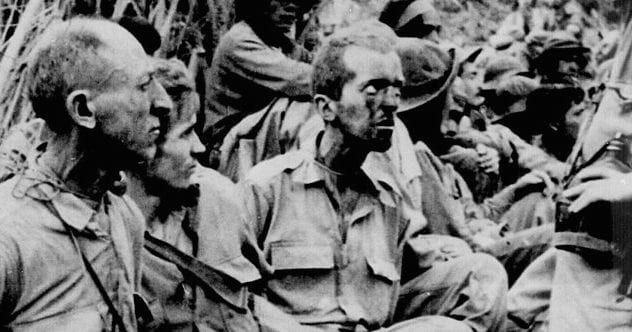
World War II death marches were not battles in the usual sense. There were no grand strategy maps, no dramatic speeches before a heroic charge, and no neat movie ending where justice arrived right on cue. These marches were forced evacuations, carried out under armed guard, often when empires were collapsing and their victims were already weakened by imprisonment, hunger, illness, and years of terror. The phrase “death march” sounds like something invented by a historian with a dark imagination, but it came from the people who endured them.
This article looks at ten survivor accounts connected to World War II death marches, including the Nazi evacuation marches from concentration camps in Europe and the Bataan Death March in the Pacific. The goal is not to turn suffering into spectacle. It is to understand how ordinary people, soldiers, teenagers, parents, students, and prisoners, were forced through extraordinary crueltyand how some lived long enough to testify.
These stories are chilling not because they dwell on graphic details, but because they reveal the terrifying efficiency of dehumanization. A road, a guard, a command to keep moving, and a person’s entire world could shrink to the next step. Yet survivor testimony also shows something else: memory can outlast brutality. A witness can become a teacher. A prisoner number can become a name again.
What Were World War II Death Marches?
During the final phase of the war in Europe, Nazi authorities forced prisoners out of camps as Allied armies approached. Prisoners were moved by foot, train, or a combination of both, often with little food, inadequate clothing, and almost no rest. The marches served several purposes for the Nazis: to prevent prisoners from being liberated, to continue using forced labor, and to hide evidence of crimes. In the Pacific, the Bataan Death March followed the 1942 surrender of American and Filipino forces in the Philippines, when prisoners of war were forced across long distances under brutal conditions.
The accounts below come from survivors whose names are attached to testimony, memoirs, museum archives, oral histories, and educational records. Each one offers a different window into the same terrible pattern: organized cruelty depended on making people seem disposable. Survival depended on endurance, luck, help from others, and sometimes the smallest act of human recognition.
10 Survivor Accounts That Still Haunt History
1. Gerda Weissmann Klein: A Long Road Toward Liberation
Gerda Weissmann Klein was a young Jewish woman from Bielsko, Poland, whose wartime path led through ghettos, forced labor, and concentration camps. Near the end of the war, she was forced onto a death march through Czechoslovakia. By the time American troops found her in Volary in May 1945, she had endured years of loss and deprivation. One of the soldiers who helped liberate her was Kurt Klein, a German-born Jewish refugee serving in the U.S. Army. The two later married, creating one of the most remarkable postwar stories of love growing out of catastrophe.
Her account is especially powerful because it does not treat survival as a simple triumph. Gerda survived, but nearly everyone she loved had been taken from her. Her testimony shows how death marches were designed to erase identity, but also how liberation began with someone seeing a prisoner as a person again. Her later life as an author and educator turned personal memory into public responsibility.
2. Elie Wiesel: Running From Auschwitz Into the Unknown
Elie Wiesel, later a Nobel Peace Prize laureate and one of the world’s most influential Holocaust witnesses, was a teenager when he and his father were forced out of Auschwitz as Soviet forces approached. The march from the Auschwitz area toward Gleiwitz and then onward toward Buchenwald became one of the most remembered passages in Holocaust literature. In his writing, Wiesel described the march as a collapse of time, family, faith, and physical strength. The cold, the darkness, and the relentless command to move reduced life to endurance.
What makes Wiesel’s account so haunting is the father-son bond at its center. The march was not only a fight against physical collapse; it was a struggle to remain morally awake in a world built to crush tenderness. His testimony helped generations understand that death marches were not chaotic accidents of war. They were the final extension of a system that had already spent years training itself not to see its victims as human.
3. Edith Eger: The Teenager Who Became a Healer
Edith Eger was deported to Auschwitz as a teenager. Near the end of the war, she and other prisoners were moved through several camps and forced toward Gunskirchen in Austria. Her survival depended not only on her own will but on help from fellow prisoners, including people who supported her when she could barely continue. After liberation, she eventually immigrated to the United States and became a psychologist specializing in trauma.
Eger’s account stands out because of what she did with memory. She did not deny the horror, but she refused to let the past become the only author of her life. Her later work emphasized choicenot the false idea that victims choose what happens to them, but the profound idea that survivors may still reclaim meaning, compassion, and agency after violence. In the history of World War II death marches, her life reminds readers that liberation was not the end of healing. It was the beginning of a much longer road.
4. Lilly Appelbaum Malnik: From Hiding to Auschwitz to Bergen-Belsen
Lilly Appelbaum Malnik was born in Antwerp, Belgium. After the German occupation, she spent time in hiding, trying to survive under a false identity. In 1944, after being denounced, she was deported through Mechelen to Auschwitz-Birkenau. Later, she was forced on a death march from Auschwitz and eventually liberated at Bergen-Belsen by British forces.
Lilly’s story reveals how the machinery of persecution stretched across countries, languages, borders, and false hopes. Hiding required constant alertness. Deportation meant losing control over even the simplest choices. The death march added another layer of terror: even as the Nazi system was collapsing, it continued to drag prisoners through one last ordeal. Her testimony is important because it connects the experience of hiding with the experience of forced evacuation. Survival did not follow a straight line. It was a series of narrow escapes, each one shadowed by betrayal and uncertainty.
5. Sam Itzkowitz: Escape During a March From Landsberg
Sam Itzkowitz was from Poland and survived ghettos, Auschwitz, and forced labor before being sent to camps in Germany. In early 1945, he was forced on a death march from Landsberg, a subcamp connected to Dachau, toward the Bavarian Alps. During the chaos of an air raid, he escaped and was later liberated by American forces.
His account shows that death marches were not only about movement. They were about control. Guards tried to keep prisoners marching even as the Nazi war effort fell apart around them. For prisoners, confusion could be terrifying, but it could also create a brief opening. Sam’s escape was not a clean adventure story. It was a desperate chance taken in a world where staying in line could be fatal and stepping away could be equally dangerous. His survival captures the thin margin between life and death in the final months of the war.
6. Sam Spiegel: Eight Days After Auschwitz
Sam Spiegel was deported to Auschwitz in 1944 and forced to work in a train factory. As the Nazis evacuated Auschwitz, he survived an eight-day death march. Soviet troops liberated him in January 1945. His story is often summarized in a few lines, but those lines contain an entire universe of endurance: deportation, forced labor, evacuation, marching, and liberation.
The number “eight days” may look small on a page. In survivor testimony, however, days during a death march were not ordinary days. They stretched into cycles of cold, fear, exhaustion, and uncertainty. Sam’s account helps modern readers understand why historical numbers must never flatten individual experience. A statistic can tell us scale. A survivor can tell us what scale felt like when it was happening one step at a time.
7. Lily Mazur Margules: A March Near Stutthof
Lily Mazur Margules was forced into the Vilna ghetto after German occupation, then deported through camps and labor sites connected to Kaiserwald, Duenawerke, and Stutthof. She was later liberated during a death march that ended in Krumau, East Prussia, in 1945. Her story demonstrates how prisoners were often moved repeatedly across the Nazi camp system, like human cargo in a collapsing network of forced labor.
Lily’s account is chilling because it shows the exhaustion of repeated displacement. Every transfer meant new rules, new dangers, new guards, and new uncertainty. The death march was not an isolated event at the end of her suffering; it was the last link in a chain of persecution. Her testimony helps readers see that the Holocaust was not one place or one method. It was a continent-wide system of removal, exploitation, and attempted erasure.
8. Abraham Lewent: Liberation After Dachau
Abraham Lewent survived the Warsaw ghetto, Majdanek, Buchenwald, and other camps before reaching Dachau. He was liberated after a death march from the Dachau camp. His account places the march within a long sequence of Nazi persecution: ghettoization, family separation, forced labor, deportation, camp transfers, and finally evacuation.
Abraham’s testimony is important because it shows how liberation could arrive after years of accumulated loss. When people discuss death marches, they sometimes imagine a single terrible journey. For survivors like Abraham, the march came after multiple earlier ordeals. By the time liberation arrived, survivors were not simply “freed” in the easy sense. They were alive, but they had to rebuild bodies, names, families, faith, and futures from the wreckage of war.
9. Lester Tenney: The Bataan Death March and a Lifetime of Witness
Lester Tenney served with the 192nd Tank Battalion in the Philippines. After the surrender of Bataan in April 1942, he became one of the American and Filipino prisoners forced onto the Bataan Death March. Thousands died during the ordeal and in the prison camp system that followed. Tenney later gave oral histories, wrote about his experiences, and became a prominent witness to the suffering of prisoners of war in the Pacific.
Tenney’s story broadens the meaning of World War II death marches beyond Europe. The Bataan Death March was part of a different theater of war, carried out by a different empire, but it shared the same terrifying logic: prisoners were treated as obstacles rather than human beings. Tenney’s later commitment to memory and reconciliation also complicates the story. He did not forget what happened. He spoke about it so that forgetting would not become the final injury.
10. Ben Skardon: Returning to the March in Memory of Others
Ben Skardon was another survivor of the Bataan Death March. He endured imprisonment and later survived the sinking of ships transporting prisoners. Decades after the war, he became known for participating in commemorative Bataan Memorial Death March events, walking shorter distances in honor of those who did not return.
Skardon’s account is chilling in part because of what he chose to do afterward. Returning symbolically to a march that had once been forced upon him transformed memory into tribute. He could not undo the suffering of his fellow prisoners, but he could keep their names and sacrifice in public view. His later walks remind us that survivor testimony is not only spoken in interviews or written in memoirs. Sometimes it is carried by the body, step after step, in remembrance.
Why These Accounts Still Matter
World War II death march survivor accounts matter because they resist abstraction. Without testimony, history can become too neat. A phrase like “forced evacuation” sounds bureaucratic, almost dull, as if people were simply relocated. Survivor accounts tear away that false neatness. They show what forced movement meant for a teenage girl from Poland, a Jewish boy trying to stay beside his father, a Belgian child in hiding, a Polish prisoner waiting for one chance to escape, or an American soldier captured in the Philippines.
These accounts also challenge the comforting myth that cruelty is always loud and obvious from the start. Death marches were organized through orders, schedules, guards, routes, and logistics. Evil did not always announce itself with theatrical villainy. Sometimes it wore a uniform, checked a list, pointed down a road, and told exhausted people to keep walking.
At the same time, survivor testimony is not only a record of cruelty. It is also a record of human connection. Friends helped friends stay upright. Prisoners shared scraps of food. Liberators treated survivors as people whose names mattered. Decades later, survivors spoke to students, wrote memoirs, recorded oral histories, and helped museums preserve evidence. Their stories are not comfortable, but comfort is not the purpose of memory.
Lessons From Death March Survivors: Memory, Endurance, and Responsibility
The experiences connected to World War II death marches offer lessons that reach beyond the history classroom. The first lesson is that survival is rarely a solo achievement. Popular culture loves the lone hero, the one person who muscles through disaster with a jawline sharp enough to slice bread. Real survivor accounts are different. They often include a sister, a friend, a stranger, a medic, a liberating soldier, or a fellow prisoner who made one more day possible. Gerda Weissmann Klein’s liberation story, Edith Eger’s memories of help from other prisoners, and Ben Skardon’s later acts of commemoration all show that human beings survive through relationships as much as through willpower.
The second lesson is that memory requires work. Survivors did not automatically become public witnesses the moment the war ended. Many were silent for years. Some had to build families, learn new languages, find work, manage grief, and live with memories that could not be filed away like old paperwork. When survivors eventually testified, they were not simply “telling stories.” They were doing difficult moral labor. They were putting language around experiences that language can barely hold.
The third lesson is that the end of violence is not the same thing as recovery. Liberation ended immediate captivity, but it did not restore lost relatives, stolen childhoods, damaged health, or vanished communities. This is why survivor accounts should be read with patience. A person can survive a death march and still carry its consequences for a lifetime. The happy ending, if we can use that phrase carefully, is not that everything became fine. It is that survivors found ways to live, love, teach, warn, and sometimes laugh again without pretending the past had disappeared.
The fourth lesson is that historical language matters. Terms like “evacuation,” “transfer,” and “relocation” can hide violence when used without context. Death march testimony forces us to ask sharper questions. Who ordered the movement? Who was forced to walk? Who benefited from silence? Who was expected not to survive? Good history does not let tidy words cover ugly realities.
Finally, these accounts remind us that remembrance is not passive. Reading about death marches should not become a quick emotional stop on the internet’s endless conveyor belt of “shocking facts.” The responsible response is slower. Learn the names. Notice the differences between the Holocaust in Europe and prisoner-of-war suffering in the Pacific. Support museums, archives, and educators who preserve testimony. Challenge dehumanizing language when it appears in everyday life. Remember that mass cruelty begins long before the final road. It begins when people are categorized as less worthy of rights, safety, food, shelter, sympathy, or truth.
World War II death march survivors gave the world more than accounts of suffering. They gave warnings. They gave evidence. They gave names to history. Their testimony asks every generation a simple but demanding question: when human dignity is pushed to the side of the road, who will stop and see it?
Conclusion
The death marches of World War II remain among the most sobering episodes of the conflict. They occurred when defeat was already approaching, which makes them even more revealing. The systems that created them were not only trying to win a war; they were trying to control memory, hide crimes, and deny victims the chance to speak. Yet survivors did speak. Gerda Weissmann Klein, Elie Wiesel, Edith Eger, Lilly Appelbaum Malnik, Sam Itzkowitz, Sam Spiegel, Lily Mazur Margules, Abraham Lewent, Lester Tenney, Ben Skardon, and many others turned survival into testimony.
Their accounts are chilling because they show how fragile civilization becomes when power is separated from conscience. But they are also necessary because they restore individuality where oppression tried to create anonymity. Each survivor name pushes back against erasure. Each account says: this happened to real people, in real places, under real orders, and it must not be softened into a vague lesson about the past.
To read these stories well is to carry them carefully. Not as trivia. Not as horror entertainment. Not as distant misery from another century. These accounts belong to the moral memory of the world, and they still ask something of us today: pay attention, protect truth, and never let human beings become invisible.