Note: This article is fully rewritten, web-publishing ready, and based on synthesized public information about liminal spaces, The Backrooms, internet horror, visual culture, architecture, and digital folklore.
Some pictures do not need a monster to feel terrifying. Give the internet an empty hallway, yellow wallpaper, buzzing fluorescent lights, a vacant mall, or a hotel corridor that appears to continue until the heat death of the universe, and suddenly everyone becomes a certified paranormal investigator with excellent Wi-Fi. That is the strange power behind liminal spaces, especially the kind that look like The Backrooms.
The phrase “liminal space” describes a place of transition: a hallway, lobby, stairwell, airport, parking garage, school corridor, waiting room, or any environment that exists between destinations. Normally, we pass through these places without thinking. But when a camera freezes them while they are empty, quiet, oddly lit, or stripped of human activity, they stop feeling ordinary. They become suspicious. The carpet looks too damp. The ceiling tiles look like they know something. The exit sign suddenly feels less like guidance and more like sarcasm.
The Backrooms, which began as an internet creepypasta and grew into one of the most recognizable examples of online liminal horror, turned this mood into a modern myth. The classic image is simple: endless yellowish rooms, old carpet, fluorescent lighting, and no visible people. Yet the fear comes from the suggestion that you are trapped somewhere familiar but wrong. It is not a haunted castle. It is worse. It is a conference center after everyone left.
Why Backrooms-Style Liminal Spaces Feel So Creepy
Backrooms-style pictures work because they combine comfort and threat in the same frame. A hallway should be safe. A school should be full of voices. A pool should echo with splashes, not silence. A hotel should have travelers, rolling luggage, and someone loudly trying to find Room 314. When those expected signs of life disappear, the brain starts asking questions it would rather not answer.
This is the core of liminal horror: the unsettling feeling that a place has lost its purpose. An abandoned shopping mall is not frightening because it is physically dangerous in every photo. It is frightening because it was designed for crowds, music, sales signs, food court smells, and teenagers pretending not to be supervised. Empty, it becomes a stage after the play ended. The scene remains, but the story is missing.
That absence creates what many viewers describe as nostalgia mixed with dread. These images often look like places from childhood: old schools, carpeted basements, indoor play areas, community centers, motel hallways, office buildings, water parks, arcades, and suburban corridors. They feel familiar enough to trigger memory, but distorted enough to feel unreal. It is like remembering a dream you never had, which is rude, frankly, because your brain already has enough tabs open.
30 Unnerving Pictures Of Liminal Spaces That Look Like The Backrooms
The following examples capture the kinds of images that dominate liminal space communities, Backrooms-inspired galleries, analog horror videos, and eerie photography collections. They are not just creepy because they are empty; they are creepy because they seem to be waiting.
1. The Endless Yellow Hallway
A narrow corridor with beige carpet, yellow walls, and fluorescent lights is practically the unofficial mascot of Backrooms imagery. The hallway does not need blood, shadows, or a creature peeking around the corner. Its horror is administrative. It feels like getting lost inside a printer manual.
2. The Abandoned Office Maze
Rows of empty cubicles, identical doors, and ceiling panels create a visual loop. These places look built for productivity, but without people, they feel like a machine that forgot what it was producing.
3. The Empty Indoor Pool
Indoor pools are already echo chambers of chlorine, tile, and weird acoustics. Remove the swimmers and the lifeguard, and the still water starts looking less refreshing and more like it is reflecting a place that should not exist.
4. The Hotel Corridor At 2 A.M.
Hotel hallways are classic liminal spaces because they are temporary by design. The repeating doors, patterned carpet, and soft lighting make them feel almost luxuriousuntil the corridor is empty and every door looks like it leads to the same room.
5. The Mall After Closing
An empty mall is a monument to missing noise. The escalators pause, storefront gates drop, and the food court chairs sit in perfect little formations, as if preparing for a meeting nobody wants to attend.
6. The School Hallway During Summer Break
A school without students feels deeply unnatural. Lockers, bulletin boards, and fluorescent lighting remain, but the normal rhythm is gone. The silence makes every classroom door look like a dare.
7. The Basement With Too Many Turns
Basements are already suspicious. Add pipes, low ceilings, beige paint, and a hallway that bends out of sight, and suddenly the whole room feels like it was designed by someone who lost an argument with geometry.
8. The Empty Airport Terminal
Airports are built for movement, announcements, delays, and emotional reunions near baggage claim. When an airport terminal is vacant, it feels like time has been delayed indefinitely, which is somehow worse than a real flight delay.
9. The Fluorescent Convenience Store
A small store glowing in the night can feel cozy from outside. Inside, with no clerk and no customers, the aisles become too straight, the snack shelves too organized, and the beverage coolers too bright.
10. The Forgotten Play Place
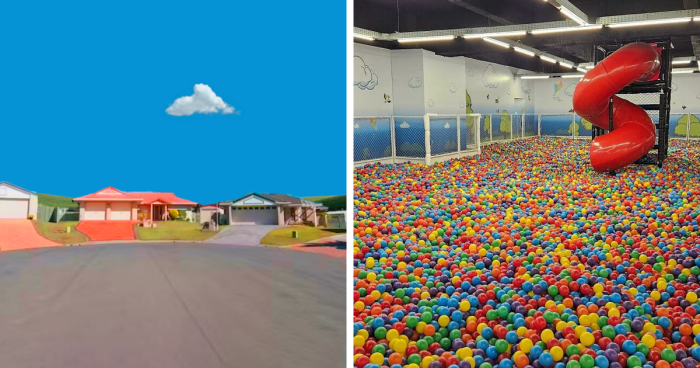
Indoor playgrounds are supposed to be chaotic, colorful, and sticky in a way nobody wants to investigate. Empty, they become surreal tunnels of plastic and foam, suggesting that childhood has clocked out and left no forwarding address.
11. The Motel Lobby With No Receptionist
A motel lobby with old chairs, fake plants, and a silent front desk can feel like a checkpoint between worlds. The bell sits there. The key rack waits. Nobody comes.
12. The Parking Garage With One Flickering Light
Parking garages are transitional spaces stacked in concrete. When they are empty, their repeating columns and low ceilings create a perfect Backrooms cousin: not yellow, perhaps, but definitely emotionally damp.
13. The Empty Hospital Waiting Area
Waiting rooms are built around anticipation. Without patients, nurses, or background television, the chairs seem arranged for invisible guests. The magazines are outdated. The silence has excellent posture.
14. The Suburban Hallway With No Windows
A plain hallway in an apartment complex or office building can become unsettling when it lacks windows, decoration, or clear direction. It is not scary because it is dramatic. It is scary because it is boring in a suspiciously committed way.
15. The Empty Community Center
Community centers often contain folding chairs, vinyl floors, bulletin boards, and multipurpose rooms. Empty, they look like a birthday party, town meeting, and minor existential crisis all happened yesterday.
16. The Stairwell That Feels Too Quiet
Stairwells are pure transition. Nobody hangs out in a stairwell unless something has gone wrong or they are in a very intense music video. A quiet stairwell with identical landings can feel endless after only two flights.
17. The Abandoned Arcade
An arcade without lights and noise feels like a sleeping robot. The machines promise play, but their dark screens reflect only the room. It is nostalgia with the power unplugged.
18. The Office Break Room At Night
A break room is supposed to be harmless: microwave, vending machine, sad chairs. But after hours, it becomes a tiny island of corporate loneliness. Even the coffee maker looks emotionally unavailable.
19. The Indoor Water Park Without Guests
Colorful slides, artificial rocks, and shallow pools become deeply strange when no one is there. These spaces are designed for fun at high volume. Silence makes them feel abandoned by joy itself.
20. The Underground Service Corridor
Service corridors beneath malls, hotels, and large buildings often look like secret infrastructure for normal life. They are practical, plain, and unsettling because they reveal the backstage of places we usually experience from the polished front.
21. The Empty Laundromat
Rows of washing machines in a fluorescent room can feel oddly hypnotic. Without spinning clothes or customers, the machines look like round windows into tiny metal planets where socks go to retire.
22. The Church Basement
Church basements often combine tile floors, old furniture, folding tables, and soft yellow lighting. They feel familiar to many people, but in a liminal photo, they become strangely theatrical, as if waiting for a potluck that was canceled in another dimension.
23. The Empty Train Platform
A train platform with no passengers and no visible train feels suspended between arrival and departure. It is a place defined by waiting, which makes the absence of movement feel especially sharp.
24. The Repeating Apartment Corridor
Apartment hallways can be unsettling because they repeat private lives behind identical doors. In a Backrooms-style image, the viewer senses dozens of possible rooms, but no sign that anyone lives in them.
25. The Department Store Furniture Section
A furniture showroom can look like a fake home assembled by aliens who studied humans using only catalogs. Sofas face nothing. Lamps illuminate nobody. Beds invite sleep in the least relaxing way possible.
26. The Empty Fast-Food Dining Room
Plastic booths, tiled floors, and bright menu boards feel cheerful during business hours. Empty, they become strangely cinematic. The ketchup station looks like evidence.
27. The School Gym With The Lights Half On
A gymnasium without players, whistles, or squeaking sneakers becomes a huge box of echoes. The basketball hoops hang there like punctuation marks at the end of a sentence nobody finished.
28. The Office Lobby With Fake Plants
Corporate lobbies often try to look welcoming while saying absolutely nothing. Empty, their polished floors, neutral walls, and artificial greenery feel like a simulation of hospitality.
29. The Empty Supermarket Aisle
Supermarkets are supposed to be full of carts, labels, decisions, and someone blocking the cereal section. A long empty aisle under bright lights looks too clean, too organized, and far too aware of your presence.
30. The Hallway With A Door At The End
The simplest liminal image may be the most powerful: a long corridor with one closed door at the far end. The viewer wonders what is behind it. The smarter viewer wonders why the photo was taken from this side.
The Visual Recipe: What Makes A Picture Look Like The Backrooms?
Backrooms-style liminal pictures usually share a few recognizable ingredients. First, they use repetition: repeating doors, walls, lights, tiles, pillars, or windows. Repetition creates the feeling that the space could continue forever. It also removes personality. One hallway is a hallway. Ten identical hallways are a problem.
Second, these images often feature flat, artificial lighting. Fluorescent lights are especially powerful because they make everything look exposed but not comforted. Shadows may be minimal, yet the image still feels unsafe. That is the genius of liminal horror: it proves that darkness is optional when the carpet is unsettling enough.
Third, the spaces are usually empty of people but full of evidence that people should be there. Chairs, signs, doors, counters, lockers, vending machines, pool ladders, and reception desks all imply human use. When no humans appear, the viewer feels the absence. The picture becomes a question: Where did everyone go, and why did they leave the lights on?
Fourth, many Backrooms-like photos have outdated design. Old wallpaper, drop ceilings, patterned carpet, wood paneling, plastic chairs, and faded signage suggest a time period that is hard to place. Not ancient. Not modern. Somewhere between 1987 and “your dentist’s old office.” This visual uncertainty makes the image feel like a memory with corrupted data.
Why The Internet Loves Liminal Horror
The internet did not invent eerie architecture, but it gave it a fan club, a vocabulary, and enough image boards, subreddits, TikTok edits, YouTube videos, and creepypasta communities to turn it into a global aesthetic. The Backrooms became popular because it is simple enough for anyone to understand and flexible enough for anyone to expand. One person sees an empty office. Another imagines an infinite maze. A third adds levels, rules, creatures, found-footage footage, and a lore document long enough to qualify as cardio.
Unlike traditional horror, liminal horror often avoids obvious threats. The fear is atmospheric. It does not say, “A monster is chasing you.” It says, “You may never find the exit, and also this wallpaper has been here since before you were born.” That quiet dread works perfectly online, where a single image can spread faster than a full story.
Backrooms-style pictures also connect with modern life. Many public spaces now feel standardized: chain stores, office parks, hotels, schools, airports, and malls often use similar materials, colors, and layouts. When photographed empty, these familiar designs become interchangeable. The result is a strange sense of placelessness. You recognize the room, but you cannot say where it is. It could be in Ohio, Florida, Nevada, or inside your laptop after midnight.
How To Read A Liminal Space Photo Like A Horror Fan
When looking at an unnerving liminal space picture, pay attention to what is missing. Are there no people? No windows? No visible exit? No clear purpose? The absence matters as much as the objects in the frame.
Next, notice the perspective. Many Backrooms-like photos are shot straight down corridors or across large empty rooms. This makes the viewer feel physically placed inside the scene. You are not observing the hallway from a safe distance. You are in it. Congratulations, your prize is anxiety.
Finally, look for emotional contradictions. Does the space seem childish but abandoned? Safe but wrong? Bright but threatening? Clean but dead? These contradictions create the uncanny effect. Liminal spaces are not simply spooky locations; they are ordinary places that have slipped out of context.
Personal Experiences With Backrooms-Like Liminal Spaces
Almost everyone has experienced a real-life liminal space, even if they did not have the vocabulary for it at the time. Maybe it was a school hallway after a late club meeting, when the building seemed too large without the usual crowd. The lockers were the same, the posters were the same, and the fluorescent lights still hummed overhead, but the entire place felt borrowed from a dream. One minute earlier, it had been a normal school. Suddenly, it felt like a level you were not supposed to unlock.
Hotels can create the same feeling. Walking down a long corridor at night, with patterned carpet underfoot and identical doors on both sides, has a way of making distance feel elastic. Room 218 should be right there, but somehow the hallway seems to stretch. The ice machine rattles from somewhere unseen. A television murmurs behind a door. You are not in danger, but your brain still quietly prepares a dramatic soundtrack.
Another common experience is the empty shopping center. During business hours, a mall is ordinary: stores, music, people, smells from the food court, and someone trying to sell phone cases with the determination of a medieval knight. But near closing time, when the crowds thin and the lights stay bright, the mall changes. The open space feels too wide. Escalators move with no riders. Store mannequins become deeply unhelpful emotionally. It is the same building, yet it feels like the building has stopped pretending.
Even small places can feel Backrooms-like. A laundromat late at night. A quiet airport bathroom far from the main terminal. A basement hallway in an older apartment building. A community center after an event, with folded tables stacked against the wall. These places are not designed for lingering, and that is exactly why lingering in them feels strange. They are spaces between tasks, between people, between moments.
The real reason these experiences stick with us is that liminal spaces mirror emotional transitions. Growing up, moving, graduating, ending a relationship, starting a new job, or waiting for important news can all feel like standing in a hallway without knowing which door will open. Backrooms-style images make that invisible feeling visible. They turn uncertainty into architecture.
That may be why people keep collecting and sharing unnerving pictures of empty rooms, deserted pools, vacant malls, and endless corridors. The images are creepy, yes, but they are also oddly comforting. They prove that other people recognize the same strange mood: the feeling of being between places, between versions of yourself, between what was familiar and what comes next. The Backrooms may be fictional, but the emotion is very real. And if you ever find yourself alone in a yellow hallway with buzzing lights and damp carpet, remember the most important rule of liminal horror: do not split up, do not follow the humming, and absolutely do not trust a hallway that looks like it has a sequel.
Conclusion
Backrooms-like liminal spaces are unnerving because they make ordinary architecture feel alien. Empty hallways, vacant malls, silent schools, hotel corridors, office mazes, and abandoned pools all become powerful when photographed without the people and purpose that normally define them. They remind us that places carry emotional memory, and when that memory is interrupted, the result can feel nostalgic, surreal, funny, and frightening all at once.
The fascination with liminal space pictures is not just an internet trend; it is a visual language for modern uncertainty. These images capture the mood of being stuck between destinations, surrounded by familiar details that no longer behave as expected. The Backrooms turned that mood into a myth, but the feeling existed long before the meme: the quiet hallway, the empty lobby, the too-bright room, the sense that you have been here before even when you know you have not.