Some family stories are dramatic. Some are emotional. And some arrive in the mail wearing the smug little smile of a dad who has waited nearly three decades to say, “Your move, kid.” That is exactly why the story of a revenge birthday card after 28 years became such a viral hit: it is funny, sweet, low-stakes, and just petty enough to qualify as world-class dad behavior.
The story centers on Rob Witts, who, at age 14, made a sarcastic birthday card for his father’s 42nd birthday. The card teased Dad for turning 42, because teenagers have always been brave when they are not the ones finding gray hair in the mirror. Rob apparently thought the joke was done. His father, however, had other plansor at least the kind of attic-based opportunity that makes fathers look like patient criminal masterminds.
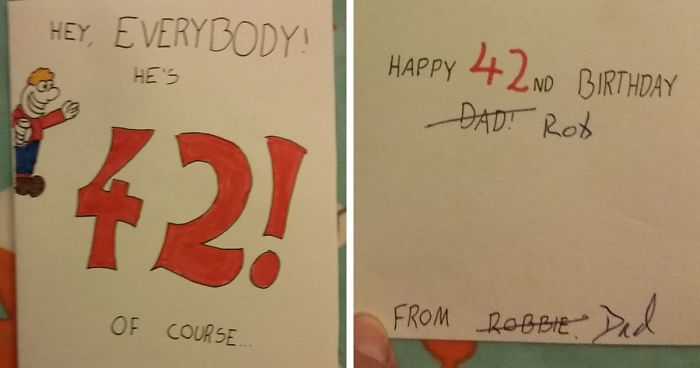
Twenty-eight years later, when Rob turned 42 himself, the very same handmade card came back to him. His dad had saved it, edited the wording, crossed out the old names, and returned it like a perfectly preserved boomerang of birthday sarcasm. The internet did what the internet does best when it finds something wholesome, funny, and mildly vengeful: it collectively applauded.
The Viral Birthday Card Story: What Actually Happened?
When Rob was a teenager, he gave his father a homemade birthday card for his dad’s 42nd birthday. It was not a polished store-bought greeting with glitter, embossed lettering, and a prewritten poem about love. It was handmade, cheeky, and full of adolescent confidence. The message essentially poked fun at his father’s age, with the kind of “wow, you’re old” energy only a 14-year-old can deliver while still needing a ride to the store.
Instead of tossing it away, Rob’s dad kept the card. That detail is the emotional engine of the whole story. A parent saving a child’s handmade card is already touching. A parent saving it for 28 years and then returning it at the exact same milestone age? That is not just sentimental. That is archival comedy.
On Rob’s 42nd birthday, his parents sent him an envelope. Inside were family items, including the old card. But the card had been lightly modified. References to “Dad” were changed to “Rob,” and the signature was adjusted so the joke now pointed back at the son who had started it all. The result was a birthday greeting, a time capsule, and a gentle roast wrapped into one.
Why the Internet Loved This Dad’s “Revenge”
The phrase “revenge birthday card” sounds intense, but this was not revenge in the angry, dramatic, reality-TV sense. No one flipped a table. No one hired a skywriter. No one made a 17-part documentary series with ominous music. This was revenge in its purest dad form: patient, funny, affectionate, and barely more dangerous than a raised eyebrow.
People loved the story because it felt real. It had the texture of family life: the old card in a box, the rediscovered childhood object, the inside joke that aged better than anyone expected. Viral stories often depend on surprise, and this one delivered a perfect twist. A teenage joke came back 28 years later, wearing reading glasses and carrying a mortgage.
The Perfect Viral Ingredients
Several things made this birthday card story easy to share. First, it was simple. Anyone could understand it in seconds. Second, it was visual. A handmade card, especially one with crossed-out names and old handwriting, feels more personal than a typed post. Third, it was emotionally layered. It was funny on the surface, but underneath the joke was a father who had kept a piece of his son’s childhood for nearly three decades.
That combination is powerful. The internet may be crowded with hot takes, arguments, and videos of people yelling at kitchen appliances, but it still has a soft spot for tiny human moments. A dad keeping a card and returning it years later reminds people of their own families, their own old jokes, and the little artifacts hiding in drawers that suddenly become priceless.
The Power of a Handmade Birthday Card
Birthday cards have been around for a long time because they do something digital messages often cannot: they create a physical record of care. A text can disappear under delivery notifications, bank alerts, and group chat chaos. A card can sit in a drawer for decades, waiting to ambush its original creator with emotional consequences.
Handmade cards go even further. They are imperfect in the best way. The drawing might be lopsided. The handwriting might look like it survived a small earthquake. The joke might be too sarcastic, too silly, or too deeply specific for anyone outside the family to understand. But that is exactly why handmade cards matter. They are evidence of time spent, not just money spent.
In Rob’s case, the card became more meaningful because it was not perfect. It was a teenage creation with a joke aimed at Dad’s age. When it returned decades later, the imperfection became the charm. The card had aged into a family artifact, complete with its own punchline.
Dad Humor: Corny, Patient, and Secretly Brilliant
Dad humor has a reputation for being cheesy, but this story proves that dads sometimes operate on a higher comedic timeline than the rest of us. Most people tell a joke and wait for laughter. Rob’s dad apparently waited 28 years for the punchline to mature. That is not a joke; that is a comedy investment portfolio.
The best dad jokes often work because they are safe. They tease without cruelty. They embarrass without harm. They turn ordinary life into a small performance. In this case, the joke landed because it was affectionate. Rob’s dad was not mocking him in a mean-spirited way. He was participating in a shared family language that had begun years earlier.
Why Family Jokes Last So Long
Every family has its own unofficial dictionary. One household might have a phrase from a vacation disaster. Another might have a nickname born from a toddler mispronunciation. Another might still bring up the time someone burned the rolls at Thanksgiving in 2009. These jokes survive because they are tied to identity. They say, “We were there. We remember. This belongs to us.”
The revenge birthday card worked the same way. It transformed a casual teenage joke into a family tradition, even if nobody knew it was becoming one at the time. That is often how the best traditions begin: accidentally, with someone laughing too hard to throw something away.
Why Old Family Keepsakes Hit Differently
There is a reason people keep cards, letters, ticket stubs, children’s drawings, and old photographs. These objects hold emotional weight because they connect us to specific moments. A birthday card is not just paper. It is proof that someone paused long enough to think about you, write something down, and hand it over.
When those objects resurface years later, they can collapse time. Suddenly, the adult is also the teenager. The parent is also the younger dad. The family joke is both old and brand new. Rob’s card did not go viral simply because it was funny. It went viral because it showed how love can hide inside ordinary things.
And let us be honest: the attic deserves a supporting actor award. Without that storage box, this story might never have happened. Somewhere, millions of parents read the story and felt fully justified for keeping every macaroni necklace, school photo, and mysterious clay object their children ever made.
What This Story Says About Parenting
Good parenting is not only about big speeches, strict rules, and emergency snacks in the glove compartment. Sometimes it is about paying attention to the small stuff. Rob’s dad kept the card because it meant something. Maybe he loved the humor. Maybe he loved that his son had made it himself. Maybe he simply thought, “One day, this will be useful.” Fathers are mysterious creatures.
The beautiful part is that the card was not used to embarrass Rob publicly in a cruel way. It became a shared laugh. Rob posted about it because he appreciated the joke. Online audiences responded because they could recognize the warmth behind the sarcasm. The card showed a relationship where teasing was part of affection.
Healthy Teasing Has a Secret Ingredient
Teasing works best when both people feel safe. The difference between a loving joke and a hurtful one is the relationship underneath it. In this viral birthday card story, the joke landed because it was built on decades of trust. Rob’s dad knew the card would be funny, not painful. Rob understood the message behind the prank: “I remember you. I love you. Also, you are 42 now, so welcome to the club.”
Why “What Goes Around Comes Around” Was the Perfect Punchline
The phrase “what goes around comes around” is usually used as a warning. Here, it became a birthday blessing with a smirk. Rob teased his father for turning 42. Then Rob turned 42. The joke completed its orbit. Somewhere in the universe, a cosmic party horn sounded.
That circular structure is why the story is so satisfying. It has a setup, a long delay, and a payoff. Most viral posts are fast. This one was slow-cooked for 28 years. The delay made the joke better. A card returned after two weeks would be mildly funny. A card returned after 28 years becomes legendary.
The Role of Social Media in Making Small Stories Huge
Before social media, this story might have stayed within one family. Rob would have laughed, called his parents, maybe told a few friends, and placed the card back in a drawer. But online platforms turn small personal moments into public campfires. People gather around, laugh, comment, share, and add their own memories.
That is one reason wholesome viral stories travel so far. They invite participation. After reading about Rob’s dad, people naturally think of their own parents: the dad who saved every school report, the mom who kept baby teeth in a container nobody wanted to find, the grandparent who still has birthday cards from 1973. The story becomes bigger because it unlocks other stories.
Why This Viral Dad Story Feels So Refreshing
The internet can be exhausting. Some days it feels like a stadium full of strangers arguing about soup. That is why a story like this lands so well. It is clean, funny, and emotionally generous. Nobody loses. Nobody is humiliated. The only victim is teenage Rob’s confidence that age jokes do not come with a 28-year return policy.
It also reminds readers that humor does not have to be complicated to be memorable. The card was not expensive. The joke was not elaborate. The timing was everything. In a culture obsessed with bigger, faster, and newer, this story celebrated something slow, personal, and handmade.
Lessons From the Revenge Birthday Card
1. Save the Small Things
Not every object deserves permanent storage, but some small things become meaningful later. A handmade card, a funny note, or a child’s drawing can become a bridge to the past. You do not need to keep every receipt from 1998, but if something makes you smile, it may be worth saving.
2. Let Humor Age
Some jokes get better with time. The revenge birthday card is proof that patience can turn a simple gag into family folklore. In a world of instant replies, delayed comedy is underrated.
3. Make Birthdays Personal
The best birthday gifts are not always the most expensive. A personal message, an old photo, or a callback to a shared memory can mean more than another gift card tossed into a generic envelope. Although, to be clear, gift cards are still welcome. Especially if coffee is involved.
4. Keep Family Teasing Kind
This story works because the teasing is affectionate. The goal is laughter, not embarrassment. A good family joke should make people feel included, not targeted.
Experience Section: What This Story Teaches Us About Real Family Moments
Stories like this dad’s revenge birthday card feel familiar because many families have their own version of a long-running joke. It may not involve a 28-year-old card, but it often involves something equally ordinary: a refrigerator magnet, a holiday ornament, a school project, or a photo that one sibling desperately wishes would disappear before every family gathering.
One experience many people can relate to is the strange emotional power of finding old handwriting. A message written years ago can feel more alive than a thousand digital photos. Maybe it is a note from a parent packed into a lunchbox, a birthday message from a grandparent, or a silly card from a sibling who was clearly trying to be funny and accidentally became adorable. Handwriting carries personality. The slant, the pressure, the misspellings, and the doodles all say, “A real person was here.”
That is why Rob’s story resonates beyond the joke. It reminds us that family love is often stored in strange containers. Sometimes it is in a shoebox under the bed. Sometimes it is in an attic. Sometimes it is in a folder labeled “important documents” that contains zero important documents and 47 handmade cards. Parents often keep these things quietly, without announcing it. Years later, the child discovers that a moment they forgot was remembered by someone else all along.
There is also an experience lesson here about timing. Families often repeat the same jokes because repetition creates belonging. The first time someone tells a joke, it is just a joke. The tenth time, it becomes annoying. The hundredth time, somehow, it becomes tradition. This is the mysterious life cycle of family humor. A dad saying the same pun every birthday may cause groans, but those groans become part of the celebration. Remove the joke, and the room feels slightly off.
Another relatable experience is the way birthdays change as people grow older. At 14, 42 sounds ancient. At 42, it sounds like “please let me sit down for five minutes.” Rob’s teenage card captured that youthful misunderstanding of age. His father returning it years later gently highlighted the comedy of growing up. Everyone eventually becomes the age they once considered impossible. The joke comes for us all, preferably with cake.
For parents, the story offers a small but meaningful reminder: the things children make are not just crafts. They are snapshots of who they were at that exact stage. A sarcastic card from a teenager may not look precious at first, but decades later it can reveal humor, confidence, and connection. Saving it is not clutter when it preserves a relationship.
For adult children, the story is a reminder to appreciate the quiet memory-keepers in the family. Someone has probably saved your old drawings, school papers, photos, or awkward cards. Someone remembers the joke you forgot. Someone has a box that could emotionally destroy you at Thanksgiving, but lovingly.
Most of all, this viral birthday card teaches that meaningful family experiences do not require perfection. The best memories often come from imperfect objects, bad drawings, corny jokes, and timing so good it feels scripted. A card made by a teenager became a gift from a father nearly three decades later. That is the magic of family history: ordinary things wait patiently until they are ready to become extraordinary.
Conclusion
This dad’s revenge birthday card after 28 years went viral because it delivered everything people love in a family story: humor, patience, nostalgia, and a perfectly timed punchline. Rob Witts made a sarcastic card for his father’s 42nd birthday when he was 14. His dad saved it and returned it when Rob turned 42, transforming a teenage joke into a viral reminder that family love can be playful, patient, and brilliantly petty in the sweetest possible way.
The story also proves that the smallest keepsakes can become the biggest memories. A handmade birthday card may look simple when it is created, but years later it can carry laughter, history, and love across generations. In the end, the card was not just a prank. It was a message: we remember, we laugh, and yes, what goes around really does come around.