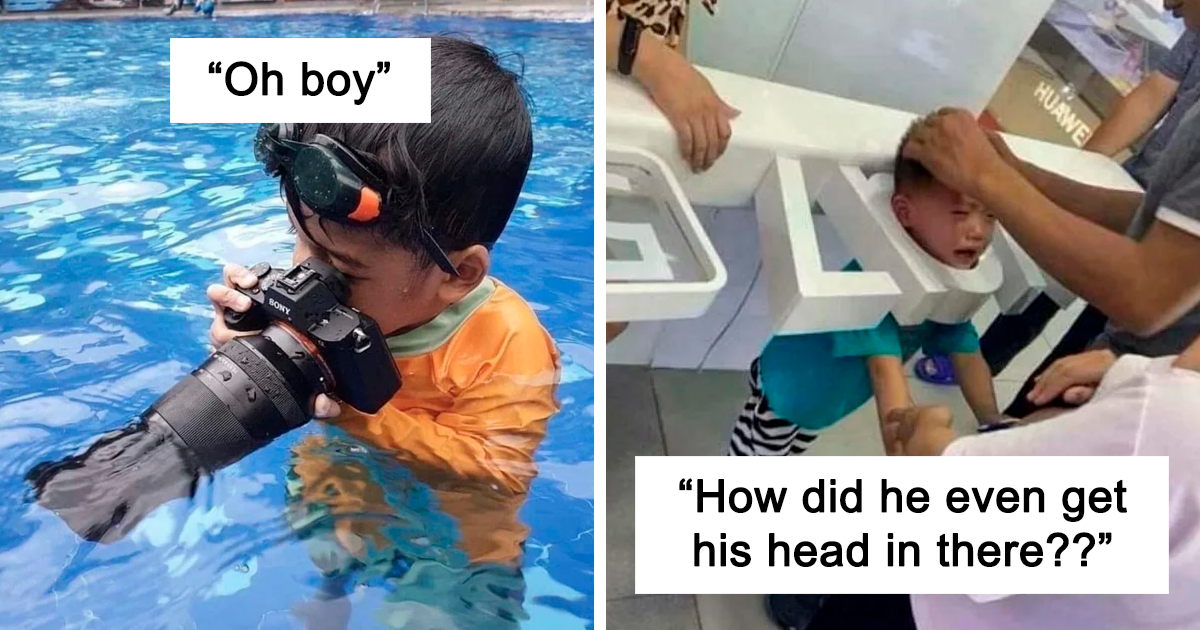
Parenting is one of the few life experiences that can make you laugh, cry, apologize to your vacuum cleaner, and hide in the pantry with a granola bar all in the same afternoon. That is exactly why collections like “50 Painfully Funny Posts Of Kids Ruining Their Parents’ Days, As Shared On This Online Group” hit so hard. They are not just funny because children are chaotic. They are funny because they are painfully familiar. Every parent, grandparent, babysitter, older sibling, and exhausted adult who has ever muttered, “Why is it sticky?” understands the genre immediately.
These posts usually feature the classic ingredients of domestic disaster: a child with huge confidence, limited impulse control, suspicious silence, and access to either markers, scissors, toothpaste, or the family pet. Add one tired parent who turned away for twelve seconds, and boom, you have internet gold. One minute the house is calm. The next, a toddler has shampooed the dog, redecorated the walls with ketchup, and announced to strangers in Target that Dad has “butt medicine.”
But what makes these stories more than cheap laughs is that they reveal something true about family life. Kids are curious. Kids are impulsive. Kids are emotional. Kids test limits like tiny trial lawyers working on commission. And parents, for all their planning, routines, and color-coded calendars, are often just trying to keep the cereal in the bowl and the glitter out of the air vents.
So let’s talk about why these painfully funny parenting posts are so addictive, what they reveal about real child behavior, and why the best family comedy usually starts with the words, “You are not going to believe what my kid did today.”
Why These Parenting Posts Go Viral So Fast
There is a reason parents love this kind of content. It feels like emotional backup. Raising children can be joyful, meaningful, beautiful, and deeply absurd. Online posts about kids ruining their parents’ days offer a strange kind of comfort because they remind adults that chaos is not always a sign of failure. Sometimes it is just Tuesday.
When a mom shares that her preschooler flushed an entire roll of toilet paper because he was “making snow,” or a dad posts a photo of a peanut butter handprint mural across the couch, the internet responds with the same energy: sympathy first, laughter second, judgment never. Or at least, judgment ideally never. The best versions of these posts work because they create community. They tell overwhelmed parents, “No, you are not alone. Yes, your child is feral. Ours too.”
They also tap into a truth child-development experts point out again and again: young kids are wired to explore, test, imitate, and push against boundaries. Adults call it “ruining my day.” Childhood calls it “science.”
What These Posts Usually Reveal About Kids
1. Curiosity Has No Respect for Furniture
Children learn by touching, tasting, stacking, dumping, squeezing, and asking “what happens if…” approximately nine hundred times a week. That curiosity is wonderful when it leads to reading, building, and discovery. It is less wonderful when it leads to a lipstick mural on the dog or a gallon of milk poured into a toy kitchen sink “to make it realistic.”
Many of the funniest parenting posts come from this exact mismatch: children are doing what developing brains naturally do, but they are doing it in a way that causes adults to briefly leave their bodies. A toddler is not thinking about the security deposit. A toddler is thinking, “I wonder if yogurt bounces.”
2. Impulse Control Is Still Under Construction
Another reason these stories feel so universal is that children, especially younger ones, often act before they think. The forbidden button gets pushed. The expensive thing gets dropped. The secret gets announced in a crowded elevator. This is not because kids wake up every morning and draft a plan titled Ways To Humble My Parents Before Lunch. It is because self-control develops over time, and the road there is paved with spectacularly bad decisions.
That is why one child will cut their own bangs five minutes before picture day, while another will confidently feed crackers to a robot vacuum and then cry when the machine “eats them.” They are experimenting with power, reaction, and consequence. Parents call it destruction. Development calls it a phase.
3. Kids Repeat Everything, Especially the Wrong Thing
If the internet has taught parents anything, it is this: children are microphones with sneakers. They repeat what they hear, sometimes word for word, usually at the least convenient moment possible. That is how family jokes become school announcements and private adult comments become loud public performances.
This is the birthplace of some of the funniest posts in parenting groups. A child hears one spicy phrase in traffic and debuts it at preschool. A toddler overhears Grandma complaining about her knees and tells the cashier, “She’s broken.” A kindergartner learns a mildly embarrassing household truth and shares it at full volume in the pharmacy line. Parents then experience the unique thrill of wanting the floor to open beneath them while also realizing the story is objectively hilarious.
4. Big Feelings Make Small Problems Feel Massive
Many “ruined my day” stories are not about mess at all. They are about meltdowns. The sandwich was cut wrong. The blue cup is suddenly offensive. Socks are unacceptable because they are socks. Screen time ended. Bedtime appeared. The banana broke in half, which apparently qualifies as a major betrayal.
To adults, these events look ridiculous. To children, especially toddlers and preschoolers, they can feel enormous. Their emotional systems are still maturing, which means a simple transition can become an Oscar-worthy tragedy. That is why so many funny parenting posts begin with something tiny and end with a child lying face down on the kitchen floor like a Victorian widow.
The Funniest Categories of “Kids Ruining Their Parents’ Days” Posts
Across collections like this, a few classic categories always rise to the top.
The Home Redesign Disaster
This is when a child decides the house needs “improvement.” Walls become canvases. Furniture becomes a laboratory. A sibling becomes a salon client. Somewhere, a parent stares at a Sharpie masterpiece and whispers, “This is why nice things fear us.” These posts are funny because they combine innocence with catastrophic confidence. Kids genuinely believe they are helping.
The Public Embarrassment Special
Few internet genres are stronger than children exposing family business in public. These are the posts where a kid points at a stranger and asks a loud question no adult wants answered in aisle seven. Or they announce that Mommy hides chocolate. Or that Dad snores “like a dying lawn mower.” Brutal. Honest. Unforgettable.
The Bathroom Incident
No family comedy archive is complete without bathroom content. Toilet paper avalanches. Toothpaste floods. Potty training misunderstandings. Soap experiments. Mysterious puddles nobody wants to claim. These stories endure because bathrooms are where children go to explore physics and parents go to lose hope.
The Sibling War Crime
Siblings are experts in creating moments that are equal parts criminal and creative. One child cuts the other’s hair. One steals the other’s cookie and hides the evidence in a shoe. One convinces the other that underwear can be worn as a hat “because astronauts do it.” Parents end up refereeing, documenting, and mentally drafting the future memoir.
The Tech Sabotage Plot
Modern parenting has added a new flavor of pain: children versus electronics. The laptop gets closed during a meeting. The phone gets dropped in juice. Thirty-seven photos of nostrils appear in the camera roll. The smart speaker is taught to say weird things. The tablet disappears into the couch for three business days. Technology was supposed to make life easier. Then a four-year-old learned your password.
Why Parents Laugh Instead of Just Losing It
Because laughter is survival with better branding.
Seriously, humor matters in family life. It helps parents step back from frustration and turn a terrible moment into a story with a punchline instead of a grudge. That does not mean every stressful parenting moment is cute. Some days are hard, exhausting, and not funny until six months later. But humor can lower the emotional temperature. It can transform “my child destroyed my afternoon” into “you will never believe this.”
And that shift matters. Parents do not share these stories online just to go viral. They share them because storytelling gives chaos shape. It turns stress into connection. It reminds people that family life is not a polished commercial filled with tidy children in matching linen. It is usually a beautiful mess with fruit snacks stuck to the car seat.
What These Posts Actually Teach Parents
Pick the Lesson, Not Just the Battle
One reason these online posts resonate is that they highlight a constant parenting challenge: deciding what truly matters. Is the outfit ridiculous? Fine. Is the wall painted with barbecue sauce? Less fine. Strong parenting is often about identifying which moments call for calm correction and which ones can be solved with a towel, a photo, and a future therapy joke.
Calm Works Better Than Drama
Children borrow emotional tone from adults. When parents react with screaming, panic, or shame, the moment often gets worse. When they react with calm, clear limits, and a little humor, kids learn faster. No, that does not mean anyone becomes a zen monk when glitter hits the ceiling fan. It just means that after the initial internal screaming, steady responses usually work best.
Behavior Has Context
Not every wild moment is simple mischief. Sometimes a child is tired, overwhelmed, overstimulated, anxious, impulsive, or frustrated. Sometimes the “bad behavior” is really a child broadcasting that they do not yet have the skills to manage what they are feeling. That is useful for parents to remember, especially when online posts make it look like every family disaster is pure comedy. Some are. Some are signals.
You Can Love Your Kids and Still Need a Minute
This may be the biggest truth hidden inside these painfully funny posts. Loving your child deeply does not cancel out frustration. Good parents still get overwhelmed. Great parents still mutter into dish towels. Healthy families are not the ones with zero chaos. They are the ones that keep showing up, cleaning up, apologizing when needed, and finding ways to reconnect after the madness.
Why This Kind of Parenting Humor Works So Well Online
The best parenting humor is never really about mocking children. It is about recognizing the absurdity of raising tiny humans who are both adorable and wildly committed to bad timing. These posts work because they capture the emotional whiplash of family life. One second your child is telling you they love you more than the moon. The next they are pouring applesauce into your shoe “to feed it.”
That contrast is comedy. It is also why these online groups keep growing. Parents are not looking for perfection anymore. They are looking for honesty. They want stories that admit kids are funny, loud, weird, sweet, messy, and occasionally determined to destroy peace like it owes them money.
In that way, the title says it all. These are not just funny posts. They are painfully funny. The pain is what makes the humor real. It is not polished sitcom parenting. It is a child drawing eyebrows on themselves with permanent marker five minutes before Grandma arrives. It is cereal on the floor, a missing shoe, and a parent laughing because crying would ruin the mascara they barely had time to apply.
Real-Life Parenting Experience: What These Days Actually Feel Like
Here is the part people who do not live with children sometimes miss: a “funny parenting disaster” almost never feels funny in the first five seconds. In the moment, it feels like confusion, cleanup, and the slow realization that your child has once again discovered a brand-new way to test your love and your stain remover.
It usually starts with silence. Suspicious, cinematic silence. Parents learn quickly that quiet is not always peace. Quiet can mean reading. Quiet can also mean your toddler is in the bathroom using half a bottle of hand soap to wash a plastic dinosaur and the sink. Both are possible. Only one ends with bubbles in the hallway.
Then comes discovery. You walk into the room and immediately know two things: first, something terrible has happened; second, your child is incredibly proud of it. They are standing in the center of the wreckage with the confidence of a startup founder who has disrupted the home décor industry. Maybe they cut the dog’s fur. Maybe they fed blueberries to the laundry basket. Maybe they used diaper cream as “snow paint.” Whatever it is, they are expecting praise.
The parent experience in that moment is complicated. There is frustration, obviously. There is also disbelief. Sometimes there is admiration, because honestly, the creativity is almost impressive. Nobody trained this child to remove every tissue from the box one by one and arrange them into what they claim is a “blanket kingdom,” yet here we are. You are angry, tired, and weirdly aware that this story is going to destroy at family dinners for years.
And that is the secret life of these online posts. They are born from messy, inconvenient, sometimes exhausting moments that later become family mythology. The day your son flushed his socks because he wanted to “send them on vacation.” The afternoon your daughter told an entire checkout line that you wear “special big underwear.” The morning your kid licked a frosty car window and then cried because the car was “mean.” These moments are maddening in real time, but they become the stories families retell forever.
Parents remember the stress, yes, but they also remember the face their child made, the logic behind the nonsense, and the bizarre sincerity of it all. That is why humor becomes such an important part of the parenting experience. It helps adults carry the hard parts without turning every rough day into a crisis. It says, “This was ridiculous. I survived it. Please laugh with me.”
So if you see yourself in these painfully funny posts, congratulations: you are probably having a very real parenting experience. Not a perfect one. Not a curated one. A real one. The kind with mystery crumbs, emotional negotiations over cups, and stories so unbelievable they could only be true. And someday, after the mess is cleaned up and the child is asleep and the house is finally still, you will probably laugh too.
Conclusion
Collections like “50 Painfully Funny Posts Of Kids Ruining Their Parents’ Days, As Shared On This Online Group” are more than quick entertainment. They are snapshots of family life in its most honest form: messy, hilarious, exhausting, and full of love. The humor lands because the situations are real. Kids test limits, copy what they hear, react with huge feelings, and create memorable chaos simply by being developing humans. Parents cope by cleaning, correcting, surviving, and eventually turning the whole thing into a story worth retelling.
That is what makes these posts so satisfying. They do not sell an impossible fantasy of perfect parenting. They celebrate resilience, perspective, and the strange magic of discovering that your worst moment of the week is also your funniest. In a world full of polished family content, that kind of honesty is refreshing. Also, it is excellent for everyone except the person scrubbing crayon off the refrigerator.