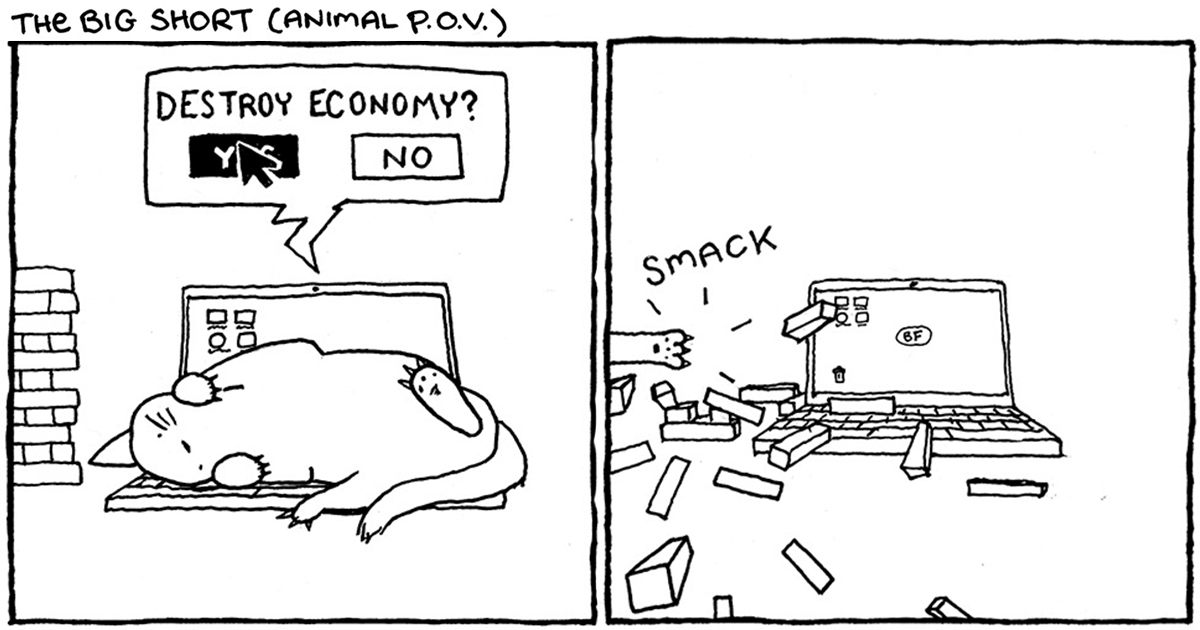
Oscar season is usually a parade of velvet gowns, nervous speeches, dramatic envelopes, and enough expensive tailoring to make a tuxedo weep. But illustrator Geoffrey Hewer-Candee took a delightfully different route during the 2017 awards season: he imagined Oscar-nominated films through the eyes of the animals who happened to be nearby.
The result was an “Animal P.O.V.” comic series that turned serious Hollywood storytelling into tiny, clever scenes of animal confusion, curiosity, and accidental commentary. Instead of asking what a character feels during an emotional breakthrough, the comics ask a far more pressing question: what would the rabbit, bird, dog, or other bewildered bystander think?
That shift may sound simple, but it changes everything. A tense drama becomes a mystery about strange human behavior. A historical film becomes a moment when animals watch people build machines, argue about science, or run around in fancy clothes for reasons no squirrel could possibly understand.
When Oscar Movies Meet Animal Logic
The 89th Academy Awards honored a wide range of films, from intimate coming-of-age dramas to science fiction, historical stories, war films, musicals, and modern Westerns. Moonlight won Best Picture, while La La Land earned major awards including Best Director and Best Actress.
That makes the animal-perspective approach especially funny. These were not lightweight movies designed around talking pets or dancing penguins. Many of the nominated films dealt with grief, identity, racism, love, ambition, war, survival, family conflict, and the uncomfortable fact that adulthood often feels like trying to assemble furniture after losing the instructions.
Hewer-Candee’s approach did not mock the films themselves. Instead, it gently poked at the human tendency to believe that every dramatic moment belongs entirely to us. Animals are present in our neighborhoods, homes, streets, fields, and workplaces. They are often nearby while people make enormous decisions, have emotional breakdowns, invent things, leave doors open, or drop food.
From an animal’s perspective, humans are fascinating but deeply suspicious creatures. We speak constantly, move furniture for no obvious reason, drive metal boxes at alarming speeds, and occasionally stand in the rain arguing about feelings. A rabbit watching an Oscar drama might reasonably conclude that humans are large, anxious mammals with poor communication skills and very complicated hats.
The Hidden Figures Comic: A Smart Joke About Intelligence
One of the strongest examples in the animal-perspective series is inspired by Hidden Figures. The comic places small animal observers near a NASA setting as they try to understand a brilliant Black woman whose work involves mathematics and computing.
At first, the animals interpret her intelligence in exaggerated, cartoonish terms. They wonder whether she is some kind of powerful machine, superhero, or unstoppable force. Then the joke lands: she is not a robot, a monster, or a mystery. She is a mathematician.
That tiny reversal works because it reflects one of the central ideas behind Hidden Figures: extraordinary intelligence should not be treated as unbelievable simply because society has trained itself to overlook the people who possess it. The real women whose work helped advance NASA’s early space program were mathematicians, engineers, and programmers, not magical anomalies. They were professionals doing work that history too often placed in the background.
In the comic, the animals react with the same stunned curiosity many viewers may have felt while learning more about the women behind the story. The humor is gentle, but the point is sharp. Sometimes the most unbelievable thing is not that someone is brilliant. It is that the world needed so long to notice.
Why the Animal Point of View Works So Well
It Makes Familiar Stories Feel New
Most moviegoers watch films from the emotional center of the human characters. We follow the hero, fear the villain, cheer the breakthrough, and try not to cry when the soundtrack starts doing that soft piano thing. Animal-perspective art steps to the side of the main story.
Suddenly, the central conflict is not just about the protagonist. It is also about the dog that hears shouting through a wall, the bird trying to sleep while a couple sings under a streetlight, or the rabbit watching humans launch rockets into the sky.
This is a classic storytelling trick: change the observer, and the scene changes meaning. A grand romantic gesture may look beautiful to one person and extremely inconvenient to a pigeon trying to access its usual bench.
It Uses Humor Without Flattening the Film
Comedy based on serious movies can go wrong quickly. Nobody wants a joke that treats grief, discrimination, violence, or trauma as a punchline. Hewer-Candee’s animal comics avoid that trap by aiming the humor at the observer’s misunderstanding rather than at the emotional weight of the original story.
The animals are not saying that the films do not matter. They are simply reacting in the limited, practical way animals might react. A squirrel does not care about a character arc. A squirrel cares about whether there are snacks, whether the humans are yelling, and whether that shiny object can be stolen.
That contrast creates the comedy. Human beings can make every situation feel like a life-changing opera. Animals often remind us that the world is still full of ordinary details: food, shelter, weather, companionship, danger, and the occasional mysterious plastic bag blowing across a parking lot.
It Makes the Background Feel Alive
Movies are packed with background life. A scene may include a dog under a table, birds above a road, cows in a field, cats near an apartment window, or wildlife moving through a space just outside the frame. Most of the time, viewers barely notice.
The animal-perspective illustration gives those overlooked creatures a voice. Not a literal voice, thankfully. The last thing Hollywood needs is a three-hour prestige drama narrated by a raccoon with opinions. But the idea asks viewers to notice the larger ecosystem around human stories.
Wildlife filmmakers have explored this kind of perspective in more literal ways, using cameras carried by animals to reveal behavior and environments humans would not normally see. PBS programs featuring animal-worn cameras have shown how changing the camera’s location can transform the way audiences understand a landscape and its inhabitants.
Hewer-Candee’s comics do something similar through humor. They do not claim to show exactly what animals think. Instead, they use animal logic as a playful storytelling lens.
Oscar-Nominated Films Are Perfect Material for Tiny Animal Dramas
The 2017 Best Picture lineup included films such as Arrival, Fences, Hacksaw Ridge, Hell or High Water, Hidden Figures, La La Land, Lion, Manchester by the Sea, and Moonlight. The Academy’s official nominations reflected a year full of sharply different worlds, from coastal towns and NASA offices to war zones, city streets, deserts, and moonlit musical Los Angeles.
That variety is exactly why animal point-of-view art has so much potential. Each film contains a world that can be slightly shifted by placing a creature at the edge of the frame.
Imagine a gull in a La La Land-style musical scene, wondering why two humans are singing directly at traffic instead of locating a discarded French fry. Picture a ranch animal in a modern Western, trying to understand why humans keep discussing banks when there is perfectly good grass nearby. Think about a bird watching a spaceship launch and deciding that humans are clearly attempting to become much louder birds.
These are not replacements for the original films. They are affectionate side stories. The comedy depends on viewers already understanding the emotional or visual language of the movie. The better known the scene, the funnier it becomes when an animal quietly misunderstands it.
From Animal Problems to Movie Commentary
Geoffrey Hewer-Candee became known for his “Animal Problems” illustrations, which place animals in situations that mirror familiar human frustrations. A hedgehog, for example, may struggle with affection because of its spines. A short bird may have trouble seeing over taller animals. A predator may discover that confidence and hunger are not always the same thing.
The drawings are simple, colorful, and deceptively smart. They work because the animals remain animals. They are not simply humans in fur coats. Their jokes come from real traits: size, habitat, diet, body shape, instinct, or reputation.
Bringing that style into Oscar-nominated films was a natural extension of the series. It let the artist use the same familiar visual language while responding to a huge cultural event. Awards season can sometimes feel formal, self-important, and packed with speeches that have been rehearsed in front of bathroom mirrors. Animal comics bring it back down to earth.
They remind viewers that prestige cinema is still made of ordinary visual ingredients: people in rooms, people outside rooms, people looking at each other, people walking away dramatically, and animals nearby wondering whether anyone is going to feed them.
Animals Have Always Been Quiet Movie Stars
Animals have played memorable roles in cinema for decades, even when they are not listed above the title. Dogs, horses, birds, cats, and other creatures can shape the mood of a scene without speaking a word. A loyal dog can make a character feel warmer. A bird in an empty street can make a city seem lonely. A horse can turn a landscape into an adventure before anyone says a single line.
Hollywood has even sparked recurring debates about whether animal performers deserve greater recognition. Animal-focused award features and playful “animal Oscars” have celebrated memorable screen performances by dogs, monkeys, horses, and other creatures who often steal scenes without demanding a larger trailer.
Of course, an animal does not need an acceptance speech. A golden statue is difficult to hold without thumbs, and an emotional thank-you speech from a Labrador would probably contain only three words: “Treat. Friend. Again.” Still, animals often add emotional texture that human viewers feel immediately.
Hewer-Candee’s comics celebrate that invisible presence. They ask us to imagine animals not merely as props or scenery, but as accidental witnesses to human drama.
The Bigger Appeal of Animal Perspective Art
There is something comforting about seeing the world from a creature’s viewpoint. Animals reduce complicated human situations to immediate concerns. Is this safe? Is there food? Who is friendly? Why are those people shouting? Can I sit in that patch of sunlight?
That simplicity does not make animals shallow. It makes their imagined perspective refreshing. Humans often create layers of status, expectation, embarrassment, and social performance around every experience. Animals, at least in comic form, cut through the clutter.
When an artist gives an animal the role of observer, the image becomes both funny and revealing. The animal does not know the rules of the human world, so it exposes how strange those rules can be.
A red carpet becomes a confusing hallway full of glittering humans. A formal speech becomes a long delay before dinner. A serious argument becomes loud noises near a perfectly good nap location. And an Oscar-nominated drama becomes a tiny mystery observed by creatures with much better instincts about weather than people will ever have.
The Experience: Watching Movies Like a Backyard Animal
There is a small but surprisingly meaningful experience hidden inside animal-perspective art: it encourages people to watch movies more carefully. The next time you watch a film, try ignoring the main character for a few seconds. Look at the edge of the frame. Notice the street, the weather, the bird on the telephone wire, the dog crossing behind a conversation, or the empty chair in the corner.
Movies train us to follow important faces. Directors use lighting, camera movement, dialogue, music, and close-ups to guide our attention. But the world inside a film is usually larger than the plot. There are imagined lives happening just outside the main story, including animal lives.
Watching through an animal lens can make familiar scenes feel oddly fresh. A character running through a city may be having the worst day of their life, while a pigeon nearby is simply trying to avoid a bicycle. A couple may be having a life-changing conversation on a park bench, while a squirrel is conducting a high-stakes investigation into a dropped granola bar.
That does not make the human story less important. It makes the world feel fuller. Real life works the same way. While one person is celebrating, another is grieving, a child is learning something new, a neighbor is carrying groceries, and a cat is sleeping in a box despite owning a perfectly comfortable bed.
Animal-perspective storytelling also gives viewers a break from the pressure of taking every moment too seriously. Oscar films often deal with major subjects, and they should. Great cinema can explore injustice, heartbreak, ambition, trauma, and hope with incredible power. But even the heaviest story can benefit from a small reminder that the planet is shared with creatures who do not care about our dramatic timing.
A dog does not know whether a scene deserves Best Picture. A crow is not checking review scores. A rabbit is not comparing cinematography styles. Yet their imagined reactions can help us notice something valuable: humans are not the only beings moving through the world.
This is why the concept behind Geoffrey Hewer-Candee’s Oscar comics remains charming. It is funny because it is absurd, but it is also thoughtful because it changes the scale of the story. The human characters stop being the only center of the universe. They become part of a larger, stranger, and much more entertaining ecosystem.
So the next time an awards-season drama reaches its emotional climax, take a moment to imagine the nearby animal witness. Maybe a seagull is wondering why everyone is crying near the ocean. Maybe a dog is waiting patiently for someone to stop arguing and open the car door. Maybe a cat is staring at the whole situation with the calm disappointment of someone who knew humans would eventually make everything complicated.
That imaginary animal may never receive an Oscar. But in the background of every great movie, it may still be giving the performance of a lifetime.