Note: This article is an original, web-ready analysis inspired by public information about the “Trash & Culture” account and broader research on visual culture, waste, Instagram recommendations, meme pages, media literacy, and found-object art. Bored Panda published a feature with this title on February 24, 2023, describing the account’s appeal as a mix of trash, creativity, street-level oddities, and user-submitted visual surprises.
When Trash Becomes Culture, the Internet Starts Squinting
Some Instagram accounts want to make you hungry. Some want to make you jealous of a stranger’s vacation breakfast. Then there is “Trash & Culture,” the kind of page that makes you pause mid-scroll and whisper, “Wait… is this art, an accident, or a cry for help from a shopping cart?”
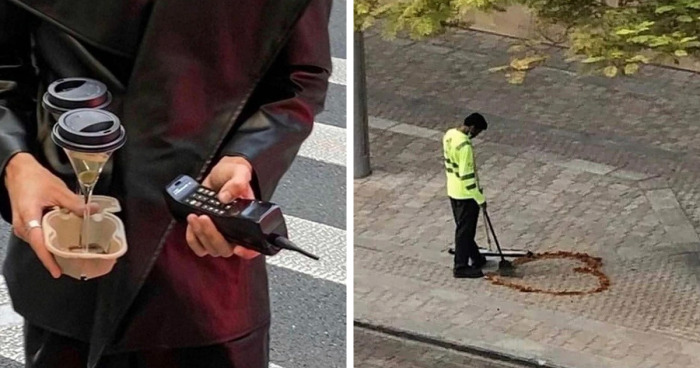
The appeal of “Trash & Culture” lies in that exact confusion. The account collects images that feel oddly staged by the universe: discarded objects that resemble sculptures, city corners that look like album covers, public spaces that accidentally become punchlines, and strange human decisions that somehow survived long enough to be photographed. It is funny, yes. But it is also weirdly thoughtful. The best posts do not simply say, “Look at this mess.” They ask, “Why does this mess feel so familiar?”
That question matters because modern culture produces both physical waste and visual waste at heroic speed. The United States generated 292.4 million tons of municipal solid waste in 2018, according to EPA data, equal to about 4.9 pounds per person per day. Plastics alone accounted for 35.7 million tons, or 12.2% of that waste stream. Meanwhile, online platforms turn everyday scenes into content before we have even decided whether they are funny, sad, or suspiciously shaped like a duck.
What Makes “Trash & Culture” So Addictive?
The account works because it sits at the intersection of three irresistible internet forces: visual absurdity, social commentary, and the universal joy of seeing something that should not make sense but somehow does.
1. It Turns Everyday Objects Into Accidental Art
A broken chair on a sidewalk can be junk. Put it under the right shadow, beside a peeling wall, with one lonely sneaker nearby, and suddenly it looks like a graduate thesis on late capitalism. That is the magic of accounts like “Trash & Culture.” They do not always need captions because the image itself arrives already wearing a tiny philosophical hat.
This is not entirely new. Museums and art educators have long recognized that ordinary objects can carry meaning. The Smithsonian American Art Museum notes that artists have used nontraditional materials such as bottle caps, tinfoil, toys, and beads to create art while exploring storytelling, imagination, and sense of place. MoMA also defines found objects as items not originally designed for art but repurposed in an artistic context. In other words, the internet did not invent found-object art. It just gave it a filter, a comments section, and possibly a raccoon.
2. It Rewards the “Double Take”
Social media is usually built for speed. Scroll, like, forget, repeat. But “Trash & Culture” rewards slowing down. The viewer has to decode the image: What am I looking at? Who did this? Was it intentional? Should I laugh? Should I call someone? The best posts create a tiny mystery, and the brain loves a tiny mystery almost as much as it loves snacks.
This double-take quality makes the account SEO-friendly in spirit, too. People naturally search for “weird Instagram posts,” “funny urban photos,” “cursed images,” “trash art,” “strange street photography,” and “visual culture memes” because these images live in the blurry zone between humor and analysis. They are not just pictures; they are little puzzles with questionable plumbing.
The Bigger Cultural Meaning Behind the Weirdness
At first glance, “Trash & Culture” looks like a gallery of oddball posts. But underneath the laughs is a surprisingly sharp look at how people treat objects, cities, and attention itself.
Trash Reveals What Society Values
Trash is never just trash. It is evidence. A pile of fast-food packaging says something about convenience. A discarded TV says something about technology cycles. A lonely plastic chair in a field says something about either human carelessness or the chair’s bold decision to pursue a solo career.
Environmental agencies have repeatedly warned that discarded materials do not simply disappear. NOAA identifies plastic as the most common type of marine debris in oceans, waterways, and the Great Lakes, and explains that debris can enter water through littering, wind, rain, lost fishing gear, and improper disposal. This gives “Trash & Culture” a sharper edge: the images are funny because they are strange, but they are also unsettling because they remind us that the leftovers of daily life are everywhere.
Urban Spaces Become Unofficial Galleries
A city is not only built by architects and planners. It is also edited daily by residents, weather, pets, delivery drivers, vandals, maintenance crews, and people who leave mattresses on sidewalks with the confidence of museum curators. The result is a living collage. Some parts are beautiful. Some are chaotic. Some look like a public bench lost a fight with a vending machine.
That is why posts from accounts like “Trash & Culture” often feel more honest than polished lifestyle photography. They show the city without makeup. Cracked pavement, awkward repairs, improvised signs, strange decorations, and abandoned objects reveal how people actually live, not how a brochure would prefer us to live.
Why Instagram Is the Perfect Home for This Kind of Content
Instagram is built around visual recognition. A strange image can travel faster than a long explanation because viewers understand the joke before they can explain it. The platform’s recommendation systems also push users toward content that matches their interests and engagement patterns. Meta’s Transparency Center describes Instagram Explore as an AI-ranked system that retrieves and ranks personalized media, while Instagram’s own help pages describe Explore, Reels, and suggested accounts as recommendation experiences.
That matters because weird visual content thrives on recommendations. A user who likes one odd street photo may suddenly receive more surreal objects, cursed design fails, and urban absurdity. Congratulations: the algorithm has discovered your taste, and apparently your taste is “a traffic cone wearing a wig.”
Pew Research Center found that half of U.S. adults reported using Instagram in 2025, making it one of the most widely used social platforms in the country. Among teens, Pew reported in 2024 that most use social media and smartphones, with nearly half saying they are online almost constantly. This helps explain why visual culture accounts can become part of everyday media diets. They are quick, funny, shareable, and easy to understand across language barriers.
50 Posts, 50 Tiny Questions About Modern Life
The title promises “50 posts,” but the deeper point is not the exact number. It is the repetition. One strange image is a joke. Fifty strange images become a pattern. That pattern asks questions such as:
- Why do we throw away so much?
- Why do some discarded objects look more expressive than expensive public art?
- Why are humans so good at making signs and so bad at proofreading them?
- Why does a broken chair sometimes understand the mood of the century?
- Why do we photograph urban decay instead of fixing it?
These questions are not meant to ruin the fun. They make the fun better. A good “Trash & Culture” post can be enjoyed in two seconds, but it can also sit in the back of your mind like a shopping cart with unfinished business.
Examples of the “Trash & Culture” Effect
Imagine a discarded mannequin hand sticking out of a trash bin. Instantly, it becomes a horror movie, a joke, and a recycling problem. Or picture a traffic sign bent at such a dramatic angle that it seems personally disappointed in the road. Or a pile of boxes arranged so perfectly it looks like a minimalist sculpture titled “Delivery Anxiety No. 4.” These are the kinds of scenes that make the account compelling: they are accidental, public, and weirdly expressive.
The account’s best material often lands in the same emotional zone as “cursed images,” but with more cultural texture. Instead of being disturbing for its own sake, the image says something about consumption, boredom, city life, design failure, and the human ability to turn almost anything into a visual gag.
Media Literacy: Laugh First, Then Look Twice
Because pages like this rely on images found across public spaces and user submissions, viewers should practice light media literacy. That does not mean ruining every joke with a courtroom-level investigation. It means remembering that images can be cropped, staged, reposted, or stripped of context.
The News Literacy Project describes lateral reading as a fact-checking method that involves cross-referencing information on other websites to judge credibility. Stanford Graduate School of Education also reported that students who received short digital literacy lessons became better at spotting questionable websites, partly by learning how professional fact-checkers investigate sources across tabs.
For weird Instagram posts, the practical lesson is simple: enjoy the oddity, but avoid assuming every caption tells the whole story. A photo of a bizarre public object may be funny, but it may also be staged, mislocated, or reposted from another creator. Good internet citizenship includes crediting artists, avoiding stolen content, and admitting when the mystery is part of the fun.
Why “Trash & Culture” Feels So Relatable
The account works because everyone has seen something like it. Maybe it was a sofa abandoned on a curb like it had been asked to leave the family. Maybe it was a sign taped to a vending machine that said “DO NOT TRUST HIM.” Maybe it was a trash can overflowing beside a luxury storefront, which is basically modern society writing poetry by accident.
These images feel relatable because they show the backstage of daily life. Most online platforms encourage polish: perfect meals, perfect rooms, perfect outfits, perfect skin, perfect vacations. “Trash & Culture” points the camera at the opposite: the busted, the strange, the overused, the forgotten. And somehow, that can feel more comforting. Perfection is exhausting. A garbage bag shaped like a celebrity? Now that has emotional range.
Experience Section: What Looking at “Trash & Culture” Teaches You About the Real World
After spending time with this kind of content, you may start seeing your own neighborhood differently. The walk to the grocery store becomes an unofficial gallery tour. A cracked planter is no longer just a cracked planter; it is a small monument to weather, neglect, and somebody’s ambitious basil phase. A misplaced traffic cone becomes a character. A handwritten sign becomes a short story. Even a dented trash can can feel like it has survived three economic cycles and a breakup.
The first experience is visual patience. Most of us move through public space too quickly. We are checking messages, dodging scooters, thinking about dinner, or wondering why one sock always disappears in the laundry like it joined a secret society. Accounts like “Trash & Culture” train the eye to notice what is already there. You begin looking at corners, reflections, shadows, and object placement. The world becomes less like a background and more like a messy, interactive museum.
The second experience is humor as a form of coping. Urban life can be frustrating. There is noise, clutter, pollution, bad design, and the occasional sidewalk puddle with unknown ambitions. But when someone photographs the absurdity just right, irritation turns into laughter. That laughter is not shallow. It helps people process the weirdness of shared spaces. It says, “Yes, this is ridiculous, and yes, we all saw it.”
The third experience is a sharper awareness of consumption. When you see enough discarded furniture, packaging, broken toys, and abandoned decorations, you start thinking about where things go after their brief moment of usefulness. The funny image becomes a quiet reminder that objects have afterlives. They leave homes, enter streets, get photographed, become content, and sometimes return to culture as jokes. That cycle is fascinating, but it is also a little uncomfortable, like realizing your takeout container has a more adventurous life than you do.
The fourth experience is creative permission. You do not need a studio, a fancy camera, or a dramatic mountain sunset to notice something interesting. A strange arrangement of everyday objects can be enough. That is encouraging for writers, photographers, artists, and anyone who wants to become more observant. Creativity often begins with attention. The world is already making compositions. Your job is to catch them before sanitation services do.
The fifth experience is humility. The internet loves certainty, but images like these often resist explanation. We may never know why someone placed a plastic flamingo beside a broken microwave, or why a chair appears to be facing a wall in deep personal reflection. The mystery is the point. Not every image needs a clean answer. Sometimes it is enough to laugh, wonder, and move on slightly changed.
That is why “Trash & Culture” has staying power. It is not just a feed of weird posts. It is a reminder that culture is not only made in galleries, studios, boardrooms, or glossy advertisements. Culture also appears in alleyways, thrift piles, taped-up warnings, bad repairs, and ordinary objects that accidentally become profound. The account makes viewers question things because the things themselves seem to be questioning us back.
Conclusion: The Beautiful Nonsense of Everyday Life
“Trash & Culture” succeeds because it understands a truth the internet never gets tired of proving: reality is often funnier, stranger, and more visually inventive than anything we could plan. The account’s posts may begin as odd photos, but they open the door to bigger conversations about waste, design, city life, media literacy, creativity, and the way algorithms turn small moments into shared culture.
In a world overloaded with polished content, these images feel refreshingly unpolished. They are messy, imperfect, and alive. They make us laugh, then make us look again. And sometimes, that second look is where the real meaning shows up, dragging a broken lamp behind it.