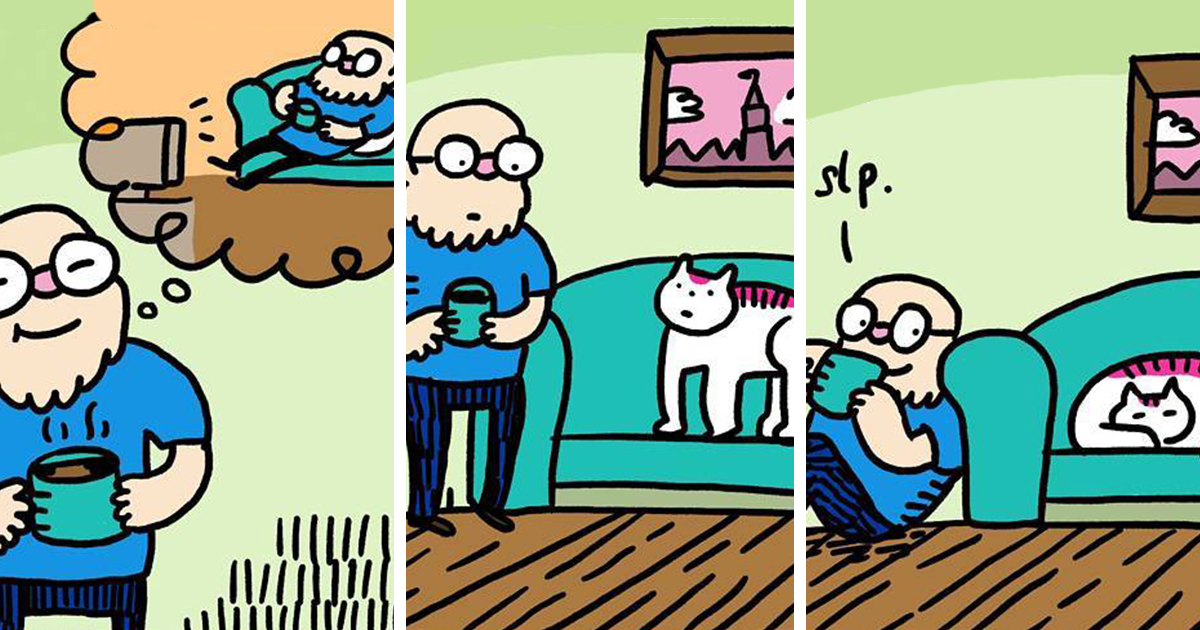
Some comics need a punchline. Some need a speech bubble. And then there are the magical ones where a cat simply looks at a box, makes one questionable life decision, and somehow tells an entire story without saying a single word. That is the charm behind Pussloose, the wordless cat comic series by Dutch illustrator and comic artist Rob van Barneveld.
In a noisy online world where every post seems to shout for attention, these feel-good wordless cat comics do something refreshingly different: they stay quiet. No dramatic monologues. No overexplained jokes. No cat delivering a five-paragraph TED Talk about tuna. Just clean visual storytelling, expressive feline body language, and tiny everyday moments that make readers smile before they even realize they needed it.
The title “50 Feel-Good Wordless Cat Comics That Will Make Your Day By This Dutch Illustrator” says exactly what readers are looking for: a cozy escape, a laugh, and maybe a suspiciously accurate reminder that cats are tiny chaos managers wrapped in fur.
Who Is Rob van Barneveld?
Rob van Barneveld is a Dutch illustrator and comic artist known for creating Pussloose, a textless, feel-good webcomic centered around cats and the small, funny moments that make living with them endlessly entertaining. He has been connected with comics for years, with earlier Dutch comic work such as Rood Gras, and later became widely recognized online for his charming cat-centered illustrations.
What makes Rob’s work stand out is not only the cuteness of the cat, although let’s be honest, the cat is doing plenty of heavy lifting. The real strength is timing. His panels often unfold like a tiny silent movie. A cat enters. Something ordinary happens. The cat misunderstands reality with total confidence. Then the comic lands with warmth instead of sarcasm.
His comics are easy to share because they do not require translation. A reader in the United States, the Netherlands, Brazil, Japan, or anywhere else can understand the same joke instantly. A cat climbing where it absolutely should not climb is, apparently, an international language.
Why Wordless Cat Comics Work So Well
Wordless comics succeed when the drawings do more than decorate the page. They must carry the entire story. In Pussloose, the absence of words makes the humor more universal and more immediate. Readers do not need to pause for dialogue; they follow the action through facial expressions, posture, movement, and visual rhythm.
This is especially powerful with cats because cats are already masters of silent drama. One raised tail can say, “I am pleased.” One sideways glance can say, “You have disappointed me as a species.” One slow stretch across your laptop can say, “Your deadline is now my mattress.”
Good wordless comics invite readers to participate. Instead of being told what the joke means, you discover it. That tiny moment of recognition creates a personal connection. You are not just reading the comic; you are decoding it, laughing at it, and probably remembering a cat you know who once did the exact same thing.
The Feel-Good Formula Behind Pussloose
1. Everyday Situations Become Tiny Adventures
Many Pussloose-style jokes begin with ordinary situations: a cat near food, a cat discovering a box, a cat exploring furniture, a cat interacting with a human who foolishly thinks they are in charge. The setting is familiar, which makes the twist more satisfying.
That is part of the appeal. These comics do not need giant fantasy worlds or complicated plots. The living room is enough. The kitchen is enough. A blanket, a couch, a plant, or a cardboard box can become the stage for a miniature comedy.
2. The Cat Is Cute, But Never Boring
Many cat cartoons lean only on cuteness. Pussloose goes further by giving the cat a personality: curious, stubborn, playful, lazy, affectionate, and occasionally convinced that physics is merely a suggestion. The cat is not just a pet in the panels; it is the main character.
That personality makes the comics memorable. Readers come back not only because they enjoy cats, but because they recognize a specific type of cat logic. It is the logic that says the expensive cat bed is useless, but the shipping box it came in is a five-star resort.
3. The Humor Is Gentle
These are not mean-spirited comics. The humor comes from affection, not cruelty. The cat may cause chaos, but it is adorable chaos. The human may be confused, but never in a way that feels harsh. The result is comedy that feels safe, warm, and re-readable.
That gentle tone is a major reason feel-good cat comics perform well online. Readers often open them during lunch breaks, after school, before bed, or while avoiding a task that has been staring at them like an unpaid bill. The comics offer a quick emotional reset.
Why Cats Are Perfect Comic Characters
Cats are naturally funny because they combine elegance and absurdity in one fluffy package. They can leap onto a narrow shelf like Olympic athletes, then immediately get trapped inside a paper bag. They can appear deeply mysterious, then spend ten minutes arguing with a closed door.
From an illustration standpoint, cats give artists a wonderful range of visual cues. Their tails, ears, eyes, backs, paws, and poses can all communicate emotion. A puffed tail suggests alarm. Forward ears suggest interest. A relaxed loaf shape says comfort. A dramatic flop on the floor says, “I have suffered greatly because dinner is four minutes late.”
Rob van Barneveld uses these cues to create humor without words. The reader understands the cat’s mood through movement and expression. That makes the comedy feel natural, as if the cat is not acting for the audience but simply being a cat while we are lucky enough to witness the incident.
What Readers Love About These 50 Feel-Good Wordless Cat Comics
They Are Easy to Understand
Because the comics are wordless, readers do not need context, translation, or cultural background to enjoy them. A cat being fascinated by a laser pointer does not require footnotes. A cat squeezing into a box three sizes too small is comedy with global citizenship.
They Are Quick Mood Boosters
Feel-good comics work because they ask for very little and give back a lot. In a few panels, they offer surprise, recognition, and a soft laugh. Cat media has long been associated with positive emotions online, and comics like these fit neatly into that tradition: they are short, charming, and easy to revisit.
They Capture Real Cat Behavior
The best cat comics feel funny because they feel true. Cats really do knead blankets like tiny bakers. They really do chase invisible enemies at midnight. They really do sit in the exact place where you are trying to work. Rob’s art taps into these familiar behaviors and exaggerates them just enough to turn daily pet life into visual comedy.
They Are Shareable Without Being Loud
Online humor often tries to be bigger, faster, and louder. Pussloose succeeds by being calm and clear. The panels are easy to understand at a glance, and the emotional tone is friendly. That makes the comics ideal for sharing with friends, family, coworkers, and anyone who has ever said, “I am not really a cat person,” right before adopting two cats and making them Instagram accounts.
The Art of Saying Nothing Beautifully
Creating a wordless comic is harder than it looks. Without dialogue, the artist must carefully guide the reader’s eye from panel to panel. Every pose matters. Every object placement matters. The joke must be visible, but not too obvious. The ending must feel surprising, but not confusing.
Rob van Barneveld’s Pussloose comics often use simple, readable compositions. That simplicity is not a weakness; it is the secret. Clean visual storytelling gives the reader room to focus on the action. The cat’s expression becomes the punchline. A tiny shift in posture becomes the emotional turn. The silence becomes part of the joke.
In that way, the comics feel almost musical. There is rhythm in the setup, pause, reaction, and reveal. Even without words, the reader can feel the beat: curious cat, suspicious object, bold decision, ridiculous consequence. Applause. Maybe a snack.
Why This Dutch Illustrator’s Cat Comics Feel Universal
One reason these comics travel so well online is that they are built around shared experiences. Cat owners everywhere know the strange honor of being ignored until food is involved. They know the emotional roller coaster of buying a fancy toy only to watch the cat fall in love with the receipt. They know that a sleeping cat can look like a peaceful angel and a tiny landlord at the same time.
But even people without cats can enjoy the comics because the humor is based on curiosity, comfort, surprise, and companionship. The cat’s world is small, but the emotions are big. That balance makes the comics accessible to readers of different ages and backgrounds.
There is also something wonderfully Dutch in the understated charm: clean lines, quiet humor, and a preference for letting the scene speak for itself. The comics do not beg for attention. They simply place a cat in a funny situation and trust the reader to smile.
Examples of Moments These Comics Capture So Well
Although each comic has its own visual surprise, the series often plays with classic cat-life themes. A cat may turn a normal household object into an adventure. A human may try to control a situation and learn, once again, that cats have not read the house rules. A cozy moment may suddenly become silly because the cat follows its own mysterious priorities.
Think of the universal cat experiences: the sacred cardboard box, the dramatic demand for attention, the sudden zoomies, the suspicious inspection of new furniture, the nap in a place that makes no sense, and the unshakable belief that every closed door is a personal insult. These are the building blocks of great cat comedy.
The genius lies in making these moments feel fresh. Rob’s comics do not simply say, “Cats are weird.” They show exactly how a cat’s weirdness unfolds, step by step, until the reader recognizes the truth and laughs.
Why Feel-Good Comics Matter
Feel-good content is sometimes dismissed as lightweight, but that misses the point. A small comic that improves someone’s mood has value. A sweet drawing that makes a reader pause, breathe, and smile can be a tiny act of kindness. Not every piece of art has to shake the earth. Some art simply has to make Tuesday less annoying.
That is what these wordless cat comics do beautifully. They offer comfort without becoming sentimental. They are funny without being cynical. They are simple without being empty. In a few panels, they remind us that joy can be found in small domestic scenes, especially when a cat is involved and gravity is about to be challenged.
How Pussloose Fits Into the Long History of Cat Art
Cats have inspired artists for thousands of years, from ancient visual culture to modern memes, cartoons, comics, and viral videos. The internet did not invent our fascination with cats; it simply gave it Wi-Fi.
Modern cat comics continue that tradition in a new format. Instead of painted portraits or formal illustrations, we now have quick webcomics that travel across social platforms. They are easy to save, easy to share, and easy to understand. Pussloose belongs to this online era, but it also connects to something older: the human habit of watching cats and thinking, “What exactly is going on in that little head?”
Tips for Enjoying These Comics Like a True Cat Person
First, slow down. Wordless comics reward attention. Look at the cat’s ears, tail, eyes, and body position. Notice the objects in the background. The joke may depend on a small visual clue.
Second, read the comic twice. The first read gives you the surprise; the second read lets you enjoy the setup. Many good visual jokes become funnier once you know where they are going.
Third, share them with someone who needs a mood lift. A feel-good cat comic is basically a digital cup of cocoa, except less likely to spill on your keyboard. Unless your cat is nearby, in which case all bets are off.
500-Word Experience Section: Why These Comics Feel Like a Small Daily Vacation
There is a specific kind of happiness that comes from discovering a good wordless cat comic. It is not the loud, dramatic kind of happiness. It is the quieter kindthe little smile that appears when you see a cat do something completely unnecessary with total confidence. That is why a collection like “50 Feel-Good Wordless Cat Comics That Will Make Your Day By This Dutch Illustrator” feels less like a regular article and more like a tiny vacation from the internet’s usual chaos.
The experience begins with recognition. Maybe you see a cat staring at a simple object as if it has uncovered an ancient mystery. Maybe you see a human trying to help while the cat refuses every reasonable solution. Maybe you see a cozy scene turn into a miniature disaster because the cat has chosen adventure over common sense. In each case, the humor works because it feels familiar. Even if you have never owned a cat, you probably understand the personality type: independent, curious, dramatic, and somehow always innocent.
Reading these comics also creates a sense of calm. Because there are no words, your brain does not have to process heavy explanations. You simply follow the pictures. The pacing feels gentle. Your eyes move from one panel to the next, and the joke blooms naturally. It is a very different experience from reading a loud meme or watching a fast video. Wordless comics let you participate at your own speed.
Another enjoyable part is how the comics make ordinary life feel more playful. A blanket is not just a blanket; it is a mountain range. A cardboard box is not packaging; it is a luxury apartment. A window is not a window; it is a theater where birds perform unpaid entertainment. The cat transforms the home into a playground, and the reader gets to see the world through that mischievous imagination.
For cat owners, the comics may feel almost suspiciously accurate. You might think, “Did this illustrator secretly visit my living room?” That accuracy is part of the fun. The comics capture the strange balance of living with a cat: you are technically the person who pays rent, buys food, and owns the furniture, yet the cat clearly believes it is the lead decision-maker. And somehow, the cat may be right.
For non-cat owners, the comics offer a clean dose of pet humor without the responsibility of cleaning a litter box or negotiating with a furry roommate at 5 a.m. You get the charm, the silliness, and the emotional warmth without having your shoelaces attacked.
Most importantly, these comics remind readers that small joys are still joys. A funny drawing can improve a mood. A silent cat joke can become the best part of a break. A few panels can make the day feel softer. That is the real gift of Rob van Barneveld’s Pussloose comics: they do not try to solve the world’s problems. They simply add a little more warmth to it, one wordless cat adventure at a time.
Conclusion
“50 Feel-Good Wordless Cat Comics That Will Make Your Day By This Dutch Illustrator” is more than a catchy title. It captures exactly why Rob van Barneveld’s Pussloose comics have such wide appeal. They are simple, clever, expressive, and full of the kind of gentle humor that makes readers feel better almost instantly.
By combining relatable cat behavior with strong visual storytelling, these comics prove that words are not always necessary. Sometimes all you need is a curious cat, a perfectly timed panel, and the shared understanding that cats are adorable little weirdos who make life funnier.
Note: This article is written as original web content based on publicly available information about the illustrator, his Pussloose comics, wordless storytelling, cat behavior, and the popularity of feel-good cat media. It does not reproduce copyrighted comic panels or captions.