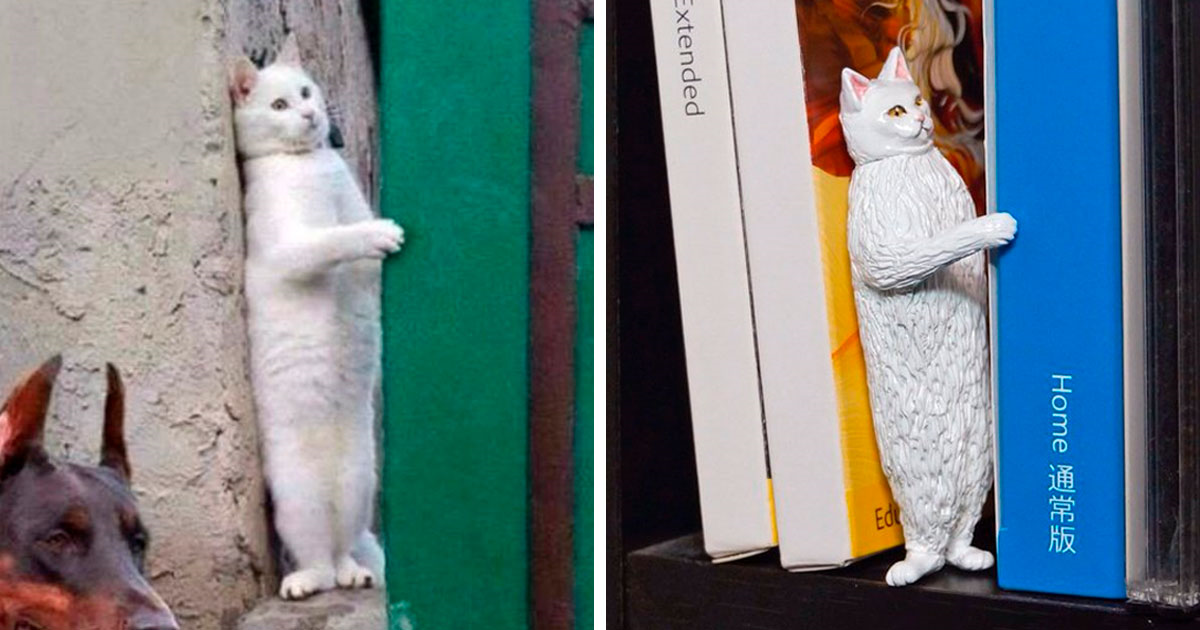
Some animal photos are funny because they are cute. Others are funny because they look like nature briefly handed the camera to a stand-up comedian. A cat becomes liquid in a plastic box. A dog misses a Frisbee with Olympic-level commitment. A squirrel freezes mid-command like a tiny traffic officer. Most of us see these images, laugh, share them, and move on. Japanese artist Meetissai does something much more dangerous: he asks, “What if this ridiculous moment became a real object?”
The answer is a collection of hilarious animal sculptures that feel like internet memes escaped the screen and enrolled in art school. Meetissai, a Japanese sculptor who works under a pseudonym, is known for transforming perfectly captured animal images into miniature 3D figures. These are not polished, idealized pet portraits. They are celebrations of the awkward, the wobbly, the impossible, and the “my cat is definitely a cryptid” school of photography.
At first glance, the project sounds simple: take a funny animal photo and sculpt it. But the magic is in the translation. A viral image is flat, fast, and temporary. A sculpture is physical, slow, and built to be examined from every angle. Meetissai takes the split-second weirdness of a photo and gives it weight, texture, shadow, and a tiny pair of feet that may or may not obey biology.
Who Is Meetissai?
Meetissai is a Japanese artist and sculpting enthusiast best known for turning viral animal memes into handmade figurines. The artist has chosen to remain largely anonymous, which somehow makes the work even more fitting. The internet often turns animals into celebrities without asking them first; Meetissai turns their strangest red-carpet moments into small, handcrafted icons.
The project reportedly began when the artist searched for a real-life version of a favorite animal meme and could not find one. Rather than accept defeat like a normal person with laundry to fold, Meetissai made one from scratch. That simple impulse grew into a recognizable creative practice: finding awkward animal images online, studying their strange poses, and recreating them as small sculptures made with epoxy putty, stone powder clay, and careful hand-painting.
The results have attracted a large international audience because they sit at the perfect intersection of cute animal content, meme culture, Japanese miniature art, and handmade craftsmanship. In other words, they are small enough to fit on a shelf and powerful enough to ruin your productivity for twenty minutes.
Why These Animal Sculptures Are So Funny
Meetissai’s sculptures work because they preserve the exact joke of the original image. The artist does not “fix” the animal’s pose or smooth out the absurdity. If a cat in the reference photo appears to have misplaced its skeleton, the sculpture honors that architectural decision. If a dog’s face suggests it has just discovered taxes, that expression remains intact.
1. They Turn Bad Timing Into Great Art
Many funny animal photos are accidents of timing. A pet jumps, slips, stretches, sneezes, or looks at the camera at precisely the wrong second. That wrong second becomes the whole joke. Meetissai’s genius is treating these accidental images as worthy artistic references. The awkward moment is not a flaw. It is the blueprint.
This is why the sculptures feel different from standard animal figurines. A typical dog sculpture might show loyalty, grace, or noble energy. A Meetissai-style dog sculpture might show a creature failing to catch a disc while wearing the expression of someone who just remembered they left soup on the stove. Both are valid. Only one makes the internet wheeze.
2. They Make Digital Humor Touchable
Memes move quickly. They appear in a feed, make people laugh, and vanish beneath news alerts, recipe videos, and someone’s 47-photo vacation carousel. By sculpting meme animals, Meetissai slows the joke down. The viewer can look at the body shape, the expression, the paws, the curve of the tail, and the tiny details that would normally disappear in a scroll.
That shift from digital image to physical object gives the humor a second life. The animal is no longer just a funny picture. It becomes a little monument to internet chaos. It says, “This moment was ridiculous, and therefore it deserves a pedestal.” Honestly, a lot of modern culture could use that kind of honesty.
3. The Sculptures Respect the Weirdness
One reason fans love Meetissai’s work is that the sculptures do not mock the animals. They celebrate them. The humor is affectionate, not cruel. Cats, dogs, pandas, squirrels, and other animals are not presented as failures; they are presented as accidental performance artists. The weird pose is the point. The clumsy movement is the charm. The impossible anatomy is the punchline, and the punchline is adorable.
The Craft Behind the Comedy
It is easy to laugh at these sculptures and forget how much technical work they require. A funny photo may look spontaneous, but recreating it in 3D demands observation, structure, proportion, balance, and patience. A sculptor has to understand not only what the animal looks like, but how the joke functions visually.
Meetissai often works with materials such as epoxy putty and stone powder clay. These materials allow for shaping, refining, sanding, and painting. The process can take days, and some pieces have been reported to require around ten days of work. That timeline makes the final result even funnier: a fleeting animal blooper, captured in a fraction of a second, becomes the subject of a careful handmade process. It is like writing a symphony about a cat falling off a couch.
From Photo Reference to Tiny Legend
The transformation usually begins with a reference image: a viral photo, a strange pet snapshot, or an animal caught in an unnatural-looking pose. The artist studies the silhouette first. What makes the image instantly recognizable? Is it the cat’s stretched body? The dog’s confused face? The squirrel’s upright stance? The answer becomes the center of the sculpture.
Next comes structure. The artist has to solve a problem that the original photo never had to answer: how does this impossible pose exist from the side, the back, and above? A photo can hide a lot. A sculpture cannot. If a cat looks like a furry rectangle in a container, the sculptor must decide what that rectangle looks like in three dimensions. If an animal appears to have extra limbs because of perspective, the sculpture may lean into the illusion and make the impossible feel delightfully real.
Finally, paint brings the figure to life. Fur patterns, eyes, paws, shadows, and tiny facial details complete the joke. A millimeter can change an expression from “majestic” to “I have seen the vacuum cleaner and I choose violence.” That is a serious artistic responsibility.
Why the Internet Loves Awkward Animal Art
Funny animal content has been part of internet culture for decades. Cats and dogs became stars of early email forwards, forums, blogs, image boards, YouTube, Tumblr, Instagram, TikTok, and every other platform humans invented to avoid cleaning the kitchen. The appeal is not mysterious: animals are expressive, unpredictable, and often completely unaware of the dramatic narratives we assign to them.
A cat staring into space becomes a philosopher. A dog missing a jump becomes a motivational speaker having a difficult quarter. A raccoon holding a snack becomes a tiny masked bandit with rent due. These interpretations are human projections, of course, but that is part of the fun. We look at animals and see emotions we understand: confusion, confidence, betrayal, joy, suspicion, and the ancient household drama of “why is there no more food in the bowl?”
Cuteness Meets Chaos
Meetissai’s sculptures also tap into the psychology of cuteness. People tend to respond warmly to small, round, wide-eyed, or baby-like features. Add a ridiculous pose and the emotional reaction doubles. The viewer gets cuteness and comedy at the same time. It is a one-two punch of “aww” and “what is happening?”
This is especially powerful with miniature sculpture. Small objects invite close attention. They feel collectible, intimate, and precious. When the subject is a cat shaped like a loaf with an existential crisis, the contrast becomes irresistible. The craftsmanship says “museum display.” The pose says “Tuesday at 3:14 a.m. when the cat heard one dust particle move.”
Meetissai and the Tradition of Japanese Miniature Art
Although Meetissai’s work is deeply connected to internet culture, it also feels at home within a broader appreciation for Japanese miniature craftsmanship. Japan has a long history of small, detailed objects, from netsuke carvings to contemporary capsule toys and collectible figures. These traditions value compact storytelling: a tiny object can hold character, movement, humor, and personality.
Meetissai’s animal sculptures are not traditional netsuke, and they are not merely toys. They belong to the modern world of social media, viral imagery, and fan-driven visual culture. Still, they share a similar pleasure in scale and detail. A small sculpture can reward careful looking. It can be funny from across the room and even funnier up close.
There is also something very modern about the way these works circulate. The original animal photo spreads online. The sculpture appears online beside it. Viewers compare the two, laugh at the accuracy, and share the result again. The meme becomes art, the art becomes content, and the content becomes another meme. Somewhere, a cat knocks a cup off a table to restore balance to the universe.
Specific Examples That Capture the Charm
Meetissai’s collection includes many types of animals, though cats naturally appear often because the internet has apparently signed a lifetime contract with them. Some memorable styles include the “liquid cat,” where a feline melts into a container as if physics has resigned; the upright cat, which looks like it is late for a business meeting; the Frisbee-failing dog, frozen at the exact moment optimism leaves the body; and the masked cat sculpture, inspired by a viral image from the early pandemic era.
Other works include animals whose poses appear almost mythical: a squirrel standing like a tiny security guard, a panda melting into relaxation, or a dog whose body shape seems edited by a phone camera with a sense of humor. These pieces are funny because they feel both accurate and impossible. The viewer recognizes the animal, then immediately questions whether the animal is actually a licensed creature or a software glitch wearing fur.
Why This Project Feels So Refreshing
In a digital culture that often rewards speed, Meetissai’s work rewards attention. The sculptures remind us that a silly image can still inspire serious craft. They also prove that humor does not need to be loud or mean to be memorable. Sometimes all it takes is a tiny handmade cat standing on two legs like it has just been promoted to middle management.
The project also highlights the collaborative nature of internet creativity. A pet owner captures a strange moment. The internet shares it. Meetissai reimagines it. Fans respond, remix, comment, and request more. The result is a loop of visual storytelling where ordinary animals become shared cultural characters.
That loop matters because it makes art feel accessible. You do not need an art history degree to understand why a clay dog missing a Frisbee is funny. You only need eyes, a sense of humor, and perhaps personal experience with a pet that has made a deeply questionable life choice in public.
Experience Section: What It Feels Like to Discover These Sculptures
Discovering Meetissai’s animal sculptures feels a little like walking into a tiny museum curated by your group chat. At first, you laugh because the source image is already funny. Then you look at the sculpture and laugh again because the artist has not simply copied the animal; he has translated the exact emotional temperature of the moment. The cat is not just standing strangely. It is standing strangely with purpose. The dog is not just failing. It is failing with theatrical dignity.
One of the best experiences related to this kind of art is comparing the original photo with the finished sculpture. The photo gives you the instant joke. The sculpture gives you the slow joke. You notice how the artist handled the angle of the head, the paws, the belly, the bend of the back, or the expression in the eyes. You start thinking about the decisions behind the work. Should the animal look realistic, or should the impossible parts stay impossible? Should the sculptor correct the anatomy, or preserve the chaos? Meetissai usually chooses chaos, and that is the correct answer.
For anyone who has lived with pets, the sculptures hit even harder. Pet owners know that animals have two modes: majestic documentary subject and complete goblin. A cat can look elegant in sunlight at 9:00 a.m. and like a haunted slipper by 9:04. A dog can radiate loyalty, intelligence, and courage, then lose a fight with a paper bag. These moments are not exceptions to pet ownership; they are the premium subscription.
That is why Meetissai’s sculptures feel personal even when the animals are strangers. Viewers recognize the spirit of their own pets in them. Maybe your cat has also folded itself into a container too small for soup. Maybe your dog has also attempted athletic greatness and achieved abstract comedy instead. Maybe you have taken a blurry photo that made your pet look like a mythical beast from a badly translated legend. Meetissai’s work validates those moments. It says, “Yes, this is art. Yes, your pet is weird. Both things can be true.”
The sculptures also make people appreciate the value of slowing down. Online, we often consume funny animal images in seconds. We smile, tap, scroll, and forget. A handmade sculpture asks for more time. It turns a disposable laugh into an object of attention. That experience is surprisingly satisfying. It is not only about comedy; it is about noticing how much joy can hide inside one accidental photo.
There is a lesson here for artists, photographers, pet lovers, and casual internet wanderers. Inspiration does not always arrive wearing a dramatic cape. Sometimes it arrives as a cat in a box, a dog mid-flop, or a squirrel acting like a crossing guard. Meetissai’s sculptures encourage us to look twice at the ridiculous things we usually dismiss. The world is full of tiny masterpieces, especially when animals are involved and dignity has left the premises.
Conclusion
“40 Perfectly Captured Animal Images Get Turned Into Hilarious Sculptures By Japanese Artist” is more than a funny internet headline. It describes a delightful creative process that turns fleeting animal chaos into lasting handmade art. Meetissai’s sculptures are charming because they combine technical skill, meme literacy, affection for animals, and a fearless commitment to awkwardness.
In a culture overflowing with digital images, these miniature sculptures stand out because they make the internet feel tangible. They give viral animals weight, texture, and a second chance to make us laugh. Whether it is a melted cat, a heroic dog fail, or a squirrel with the energy of a tiny police officer, each piece reminds us that art does not always need to be solemn. Sometimes art can be small, furry, ridiculous, and absolutely perfect.
Note: This publish-ready HTML body is written in original American English and synthesized from publicly available information about Meetissai, animal meme culture, miniature sculpture, and the psychology of cute animal content.