Note: This article is for general driving-safety education in the United States. Right-of-way rules can vary by state, city, and roadway design, so always follow posted signs, signals, police directions, and your state driver handbook.
Right of way sounds simple until you are sitting at a four-way stop with three other drivers, one cyclist, a pedestrian who may or may not be crossing, and someone in a pickup waving like they are directing an airport runway. Suddenly, the question “Who goes first?” becomes a tiny roadside math examexcept the calculator is honking behind you.
The good news is that determining right of way is not magic. It is a process. You look for traffic controls, identify the type of intersection, check for pedestrians and special road users, and then use defensive judgment when the situation is unclear. The even better news? You do not need to “win” right of way. In fact, the safest drivers treat right of way less like a trophy and more like a responsibility.
In plain English, right of way means the legal or expected priority to proceed before another road user. But here is the key point many drivers forget: right of way is usually something you yield, not something you grab. A green light does not protect your bumper from a red-light runner. Being “technically correct” does not help much when your car is shaped like an accordion. So, let’s break down four practical ways to determine who has right of way without turning every intersection into a courtroom drama.
1. Read the Signs, Signals, and Road Markings First
The first rule of determining right of way is simple: traffic controls outrank assumptions. Before thinking about who arrived first or who is on the right, look for signals, stop signs, yield signs, lane arrows, crosswalk markings, railroad gates, flashing lights, and directions from police officers or flaggers.
Traffic lights tell you when to gobut not when to stop thinking
A green light generally means you may proceed, but it does not mean “close your eyes and trust humanity.” You still must yield to pedestrians lawfully in the crosswalk, avoid blocking the intersection, and wait for oncoming traffic before making a left turn. If you are turning right, check for pedestrians, cyclists, and scooters moving beside you. Many crashes happen because a driver sees a green light and forgets that turning traffic often crosses someone else’s path.
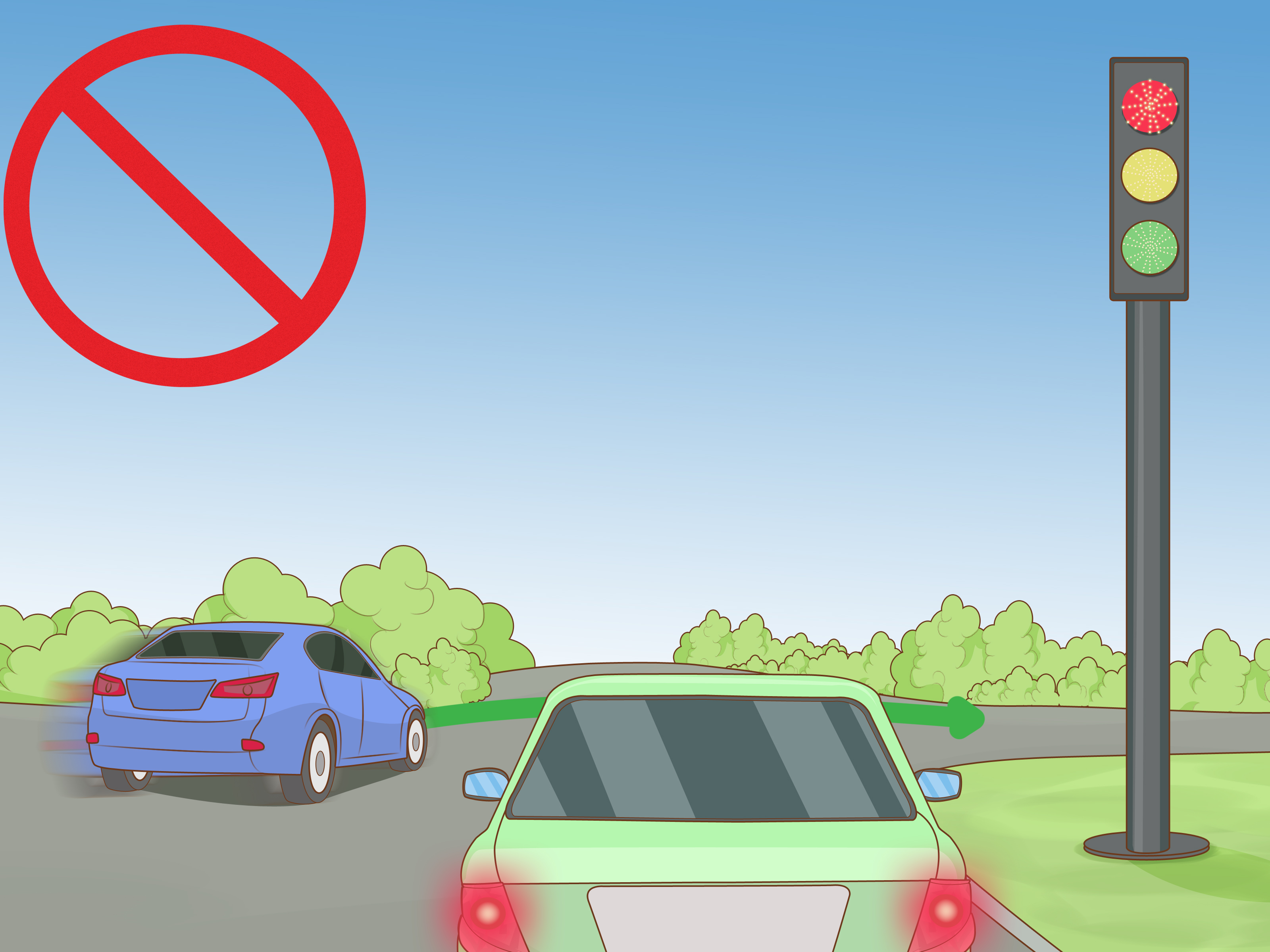
A yellow light means the signal is changing. If you can stop safely, stop. If you are already too close to stop without causing a rear-end surprise party, proceed carefully. A red light means stop before the limit line, crosswalk, or intersection. In many places, a right turn on red is allowed after a full stop unless a sign says otherwise, but the turning driver must yield to pedestrians, cyclists, and vehicles with the right of way.
Stop signs and yield signs are not decorative street furniture
At a stop sign, come to a complete stop. That means the wheels stop moving. A “California roll” may sound like sushi, but on the road it is a bad habit. Stop before the limit line or crosswalk. If neither exists, stop before entering the intersection where you can see approaching traffic.
A yield sign means slow down and prepare to stop. You may proceed only when the way is clear. If another vehicle, pedestrian, or cyclist is close enough to be a hazard, you wait. Yielding is not losing; it is how traffic avoids becoming a metal sculpture exhibit.
Police officers and flaggers override normal controls
If a police officer, firefighter, construction flagger, or authorized traffic controller gives directions, follow those directions even if a signal or sign appears to say something else. For example, an officer may wave traffic through a red light after a crash or power outage. In that moment, the officer’s instruction controls the intersection.
Also watch road markings. Turn-only arrows, bike-lane markings, crosswalks, stop bars, and lane-use signs all help assign movement. A driver in a left-turn-only lane should not suddenly go straight because the coffee kicked in late. Road markings help everyone predict everyone else, which is basically the secret sauce of safe driving.
2. Identify the Type of Intersection and Apply the Basic Priority Rules
Once you have checked for signs and signals, the next step is to identify what kind of intersection you are entering. Right-of-way rules often depend on whether the intersection is controlled, uncontrolled, all-way stop, two-way stop, T-intersection, roundabout, driveway, or merging lane.
At a four-way stop, first arrival usually goes first
At a four-way stop, the vehicle that stops first generally proceeds first. If Driver A arrives and stops before Driver B, Driver A goes first. Simple enough. Problems start when everyone arrives at almost the same time and suddenly becomes either overly polite or weirdly brave.
If two vehicles arrive at the same time, the driver on the left yields to the driver on the right. This is the classic “yield to the right” rule. If two vehicles face each other and one is turning left while the other is going straight, the left-turning driver usually yields. If one driver is turning right and the opposite driver is turning left into the same lane, the left-turning driver waits.
If all four vehicles arrive at exactly the same time, there may not be a perfect universal answer. Use eye contact, signals, patience, and small movements to communicate. If another driver clearly moves first, let them go. The goal is not to prove your knowledge of traffic law; the goal is to leave with the same number of headlights you arrived with.
At an uncontrolled intersection, slow down and yield carefully
An uncontrolled intersection has no stop signs, yield signs, or traffic lights. These are common in neighborhoods, rural roads, parking lots, and smaller streets. When two vehicles approach an uncontrolled intersection at about the same time, the driver on the left usually yields to the driver on the right. If one vehicle is already in the intersection, let it clear before entering.
Visibility matters. If buildings, parked cars, hedges, or a delivery truck block your view, treat the intersection like it is hiding a surprise. Slow down, cover the brake, look left-right-left, and be ready to stop. A blind intersection is not the place to audition for a racing movie.
At a T-intersection, through traffic usually has priority
A T-intersection occurs when one road ends at another road. Usually, vehicles on the terminating road must yield to traffic on the through road, unless signs or signals say otherwise. Think of it this way: if your road ends, your priority usually ends with it. Stop or slow as required, check both directions, and enter only when there is a safe gap.
At a roundabout, circulating traffic has the right of way
Roundabouts are designed to keep traffic moving smoothly, but only when drivers follow the pattern. Slow down as you approach, yield to traffic already inside the roundabout, enter when there is a safe gap, travel counterclockwise, and signal before exiting when appropriate. Do not stop inside the roundabout unless traffic conditions require it, and do not change lanes unless markings allow it and it is safe.
If you miss your exit, do not panic. Continue around and try again. Roundabouts are forgiving; sudden lane dives are not.
When merging, traffic already in the lane usually has priority
Drivers entering a freeway, highway, or travel lane from an on-ramp, driveway, alley, parking lot, or private road generally must yield to traffic already moving in that lane. Use the acceleration lane to match speed, signal early, check mirrors and blind spots, and merge into a safe gap. Drivers already on the roadway should not be rude about it, but the entering driver carries the main responsibility to merge safely.
3. Watch for Pedestrians, Cyclists, Emergency Vehicles, School Buses, and Trains
Right of way is not only about cars. Streets are shared by pedestrians, bicyclists, motorcyclists, emergency vehicles, buses, trucks, scooters, mobility devices, and trains. Some road users are more vulnerable. Others are harder to stop. Both facts affect right-of-way decisions.
Pedestrians often have priority in crosswalks
Drivers must use special care around pedestrians. In many U.S. states, pedestrians have the right of way in marked and unmarked crosswalks, especially at intersections. A crosswalk does not always need bright white paint to exist. At many intersections, the legal crossing area may be considered an unmarked crosswalk.
When approaching a crosswalk, slow down and be prepared to stop. Never pass a vehicle stopped at a crosswalk; that vehicle may be blocking your view of a person crossing. Stop far enough back so other drivers can see the pedestrian too. This is one of those tiny choices that can prevent a very large tragedy.
Pedestrians also have responsibilities. They should obey signals, avoid stepping suddenly into traffic, and yield when crossing outside a crosswalk or intersection where vehicles have the right of way. But as a driver, do not turn that into a debate while your car is moving. If a person is in the road, protect the person first and sort out the lecture laterpreferably never.
Pedestrians with white canes or guide dogs deserve extra caution
When a pedestrian with a white cane or guide dog is crossing or about to cross, stop and allow the person to complete the crossing. Do not honk, creep forward, rev the engine, or try to “help” by waving wildly. Those actions can confuse or startle someone who relies on sound, touch, and predictable vehicle movement.
Cyclists usually follow vehicle rules, but drivers must look twice
Bicyclists often have the same rights and responsibilities as drivers, depending on state law and location. That means they may need to stop at signs, yield when required, and signal turns. Drivers, meanwhile, must check bike lanes before turning, give safe passing space, and avoid cutting off cyclists at intersections.
Right turns are a common danger point. Before turning right, check your mirror, signal, look over your shoulder, and make sure no cyclist is continuing straight beside you. The phrase “I didn’t see them” is common after crashes, but it is not a strategy.
Emergency vehicles get priority when lights and sirens are active
When you see or hear an emergency vehicle approaching with lights and sirens, safely pull to the right edge of the road and stop until it passes. If you are already in an intersection, continue through the intersection first, then pull over when safe. Do not slam on the brakes in the middle of the intersection, do not block the emergency vehicle, and do not follow closely behind it like you found a secret traffic shortcut.
Many states also have “move over” laws requiring drivers to move over or slow down for stopped emergency, service, or hazard vehicles with flashing lights. The exact rules vary, but the safety idea is universal: give roadside workers and first responders space to stay alive.
School buses and trains are special cases
Stopped school buses with flashing red lights usually require surrounding drivers to stop, though details vary by state and by whether the roadway is divided. Children can be unpredictable, small, fast, and hidden by the busbasically the perfect recipe for why drivers must be extra careful.
Trains are even simpler: trains have the right of way at railroad crossings. They cannot stop quickly, they cannot swerve, and they will not lose an argument with your vehicle. Stop when lights flash, gates lower, a flagger signals, or a stop sign is posted. Never drive around lowered gates, and never stop on tracks unless you have suddenly developed a desire to meet physics personally.
4. Use Defensive Driving When the Right-of-Way Rule Is Unclear
Even when the rules are clear, people are not always clear. Drivers get distracted. Pedestrians hesitate. Cyclists may be hidden behind parked cars. Signals malfunction. Sun glare turns windshields into mirrors. Right of way is a rule system, but safe driving is also a judgment system.
Never assume another road user will yield
The safest drivers understand this sentence deeply: having the right of way does not guarantee you will receive it. A driver may run a stop sign. A pedestrian may step out suddenly. A cyclist may be in your blind spot. A vehicle may wave you forward even though another lane is still moving. The road is full of humans, and humans occasionally operate like computers with 37 browser tabs open.
Before proceeding, ask yourself: Do I have a clear view? Do others seem to see me? Is my path free of pedestrians, cyclists, and vehicles? Can I complete the movement without blocking traffic? If the answer is no, wait.
Communicate clearly, but do not create confusion
Use turn signals early enough to help others understand your plan, but not so early that you confuse them. Position your vehicle correctly in the lane. At a four-way stop, move when it is your turn, not five seconds later after everyone has emotionally moved into the intersection.
Be careful with hand waves. Waving another driver or pedestrian forward may feel polite, but it can be dangerous if you cannot control all lanes of traffic. For example, one driver may stop and wave a pedestrian across while another vehicle in the next lane continues. Instead of directing traffic, stop as required and let the person decide when it is safe.
When in doubt, yieldbut do it predictably
Yielding is often the safest choice when the right-of-way situation is uncertain. However, do not stop suddenly in a moving lane for no reason. Unexpected “polite stops” can cause rear-end crashes or confuse other drivers. Good yielding is smooth, visible, and predictable.
If you are unsure at a stop-controlled intersection, pause, make eye contact when possible, check for signals, and proceed only when safe. If another driver appears aggressive, let them go. Your pride may complain, but your insurance company will applaud.
Common Right-of-Way Examples
Example 1: Two cars arrive at a four-way stop together
You arrive at the same time as a vehicle on your right. You yield. The driver on the right goes first, then you proceed when the intersection is clear.
Example 2: You are turning left on a green light
You have a green light, but oncoming traffic is approaching. You must wait until oncoming vehicles and pedestrians are clear before turning. Green does not mean “left turn now”; it means “left turn when safe.”
Example 3: You are entering a roadway from a driveway
You stop before crossing the sidewalk, yield to pedestrians and cyclists on the sidewalk, then yield to vehicles already on the roadway. Enter only when there is a safe gap.
Example 4: A pedestrian is in an unmarked crosswalk
You slow and stop as needed to allow the pedestrian to cross safely. You do not pass another vehicle stopped at the crosswalk, because someone may be hidden from your view.
Example 5: An ambulance approaches from behind
You signal, move safely to the right edge of the road, and stop. If you are already inside an intersection, continue through first, then pull over when safe.
Experience-Based Advice: What Right-of-Way Looks Like in Real Driving
After enough time on the road, drivers learn that right of way is not just a rulebook topic. It is a rhythm. You begin to notice who is slowing early, who is rolling through the stop sign, who is looking at a phone, who is inching forward because they are impatient, and who has absolutely no idea it is their turn. Real driving experience teaches you to read both the law and the behavior.
One of the most useful habits is counting arrival order at stop signs. As you approach a four-way stop, quietly note: “blue sedan first, white SUV second, me third.” This small mental checklist prevents that awkward intersection dance where everyone taps the brake, creeps forward, freezes, and then tries to go at once. If you lose track, do not guess aggressively. Pause, watch, and proceed only when the path is clearly open.
Another experience-based lesson is that pedestrians can be hard to predict near crosswalks. A person standing near the curb may be waiting to cross, waiting for a rideshare, checking a text, or deciding whether life choices have led them to this particular corner. Slow down anyway. Look for body language: feet angled toward the road, head turning toward traffic, stroller wheels near the curb, or a dog pulling forward. These clues often tell you what may happen before the person actually steps into the street.
Parking lots are right-of-way chaos in miniature. They combine pedestrians, backing vehicles, shopping carts, distracted drivers, delivery vans, and people who suddenly forget lanes exist. In parking lots, drive slowly, yield generously, and expect cars to back out without warning. Legally, the rules may still matter, but practically, low speed and patience matter more. A parking lot is not the place to demonstrate dominance. It is the place to protect your doors from becoming modern art.
Experience also teaches that big vehicles need extra respect. Trucks and buses may require more room to turn, longer distances to stop, and wider paths through intersections. If a large vehicle is turning right, avoid squeezing beside it. If it is turning left, do not assume it can accelerate quickly. Giving larger vehicles space is not only courteous; it is self-preservation with cup holders.
Finally, seasoned drivers learn not to trust “the wave” blindly. A driver may wave you across, but they may not see the motorcycle passing beside them, the cyclist in the bike lane, or the pedestrian entering from the other side. Treat a wave as information, not permission. Check for yourself. The safest right-of-way decision is the one based on your own clear view, not another driver’s hand gesture.
The best real-world approach is simple: know the rules, drive predictably, yield when required, and yield again when safety demands it. Being right is nice. Getting home without a crash is better.
Conclusion
Determining who has right of way comes down to four practical steps: obey traffic controls, identify the intersection type, watch for vulnerable and special road users, and use defensive judgment when the situation is unclear. These steps work because they turn confusion into a checklist. Instead of guessing, you observe. Instead of rushing, you verify. Instead of fighting for priority, you choose safety.
Right-of-way rules are designed to create order, but they depend on drivers, pedestrians, and cyclists acting predictably. That is why the smartest driver is not the one who knows every rule by heart and charges forward like a legal scholar in a sedan. The smartest driver is the one who knows the rules, expects mistakes, and leaves room for everyone to survive them.
So the next time you reach a four-way stop, a busy crosswalk, a roundabout, a driveway, or a flashing-light emergency scene, take a breath. Look for signs and signals. Check who arrived first. Yield to pedestrians and emergency vehicles. When in doubt, let safety go first. It is always the best traveler on the road.