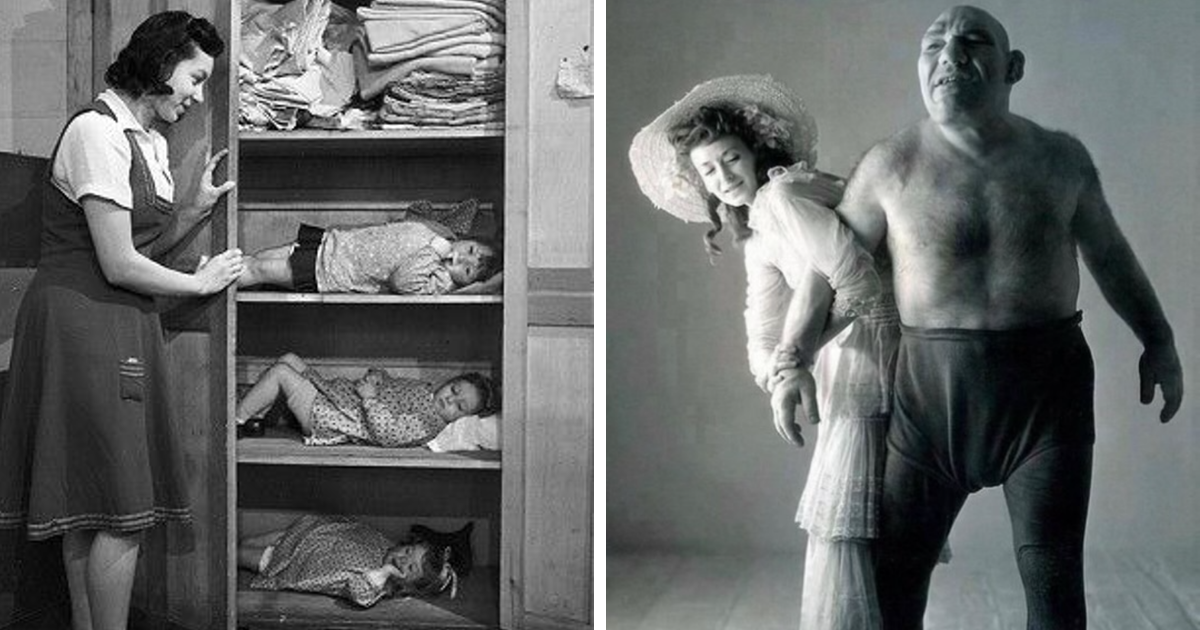
History books are wonderful, but let’s be honest: sometimes they arrive wearing heavy boots and carrying 900 footnotes. Historical pictures, on the other hand, walk right up, tap us on the shoulder, and say, “Look closer.” A single photograph can show what a paragraph needs three cups of coffee to explain: the bravery of a crowd, the cost of progress, the absurdity of fashion, the ambition of inventors, or the quiet dignity of people who had no idea they were posing for the future.
The most fascinating historical pictures do more than freeze time. They challenge what we think we know. They reveal the ordinary details behind extraordinary events: the muddy ground under a famous airplane, the tired faces behind migration statistics, the scaffolding behind an iconic skyline, or the stiff collars people somehow tolerated before modern laundry became a miracle of civilization.
Below are 35 fascinating historical pictures that might teach you something new about our world. Think of this as a visual time machineminus the awkward risk of accidentally becoming your own great-grandparent.
Why Historical Pictures Still Matter
Historical photographs are not just decorations for museum walls. They are evidence. They preserve body language, technology, architecture, clothing, public spaces, and social rules. They show who was included, who was ignored, and who stood just outside the frame. A photo can confirm a fact, complicate a myth, or make a familiar event feel startlingly human again.
They also remind us that history was lived by real people, not marble statues with excellent posture. Someone had to lace those boots, pack that suitcase, build that bridge, hold that protest sign, or climb that terrifying steel beam without looking down. Pictures help us see the world as unfinished, improvised, and deeply connected to the choices people made before us.
35 Fascinating Historical Pictures and What They Teach Us
1. The First Permanent Photograph
Joseph Nicéphore Niépce’s early image from the 1820s looks blurry by modern standards, but it represents a giant leap. It teaches us that every crystal-clear smartphone photo owes something to an experiment that began with patience, chemistry, and a very long exposure time.
2. Daguerre’s Paris Boulevard
Louis Daguerre’s famous street scene captured a busy Paris boulevard that appears strangely empty because moving people vanished during the long exposure. The lesson? Early cameras were not slow; they were practically meditating.
3. Early Daguerreotype Portraits
Those serious 19th-century portraits were not proof that everyone had forgotten how to smile. Exposure times were long, and sitting still mattered. The rigid expressions teach us how technology shaped not only images, but behavior.
4. Civil War Battlefield Photography
Civil War photographs changed how Americans understood conflict. Instead of heroic paintings, the public saw real landscapes, soldiers, camps, and consequences. Photography made war feel less distant and much harder to romanticize.
5. Abraham Lincoln by Mathew Brady
Lincoln’s portraits helped define presidential image-making. Brady’s photographs did more than record a face; they shaped public perception. Long before social media profile pictures, leaders understood the power of lighting, framing, and a good beard.
6. The Golden Spike Ceremony, 1869
The photograph of locomotives meeting at Promontory Summit celebrated the transcontinental railroad. But it also teaches a quieter lesson: images can leave people out. Chinese laborers, essential to the railroad’s construction, were largely absent from the famous celebratory frame.
7. Construction of the Eiffel Tower
Photos of the Eiffel Tower rising over Paris show a monument before it became a postcard superstar. They remind us that landmarks are first construction sites, full of bolts, scaffolding, doubt, and probably someone asking, “Are we sure this is tall enough?”
8. Immigrants at Ellis Island
Early Ellis Island photographs capture families, clothing, luggage, and expressions shaped by uncertainty and hope. These images teach that immigration history is not abstract. It is made of names, faces, accents, recipes, and heavy bags.
9. The Wright Brothers’ First Flight
The 1903 photograph of the Wright Flyer lifting off at Kitty Hawk looks modest compared with modern aviation, but that is the magic. A fragile machine, sandy ground, and 12 seconds helped launch the aerial age.
10. Child Labor Photographs by Lewis Hine
Lewis Hine’s photographs of children working in mills, mines, and factories helped expose harsh labor conditions. They teach us that reform often begins when hidden realities become impossible to ignore.
11. The 1913 Woman Suffrage Parade
Photos of women marching in Washington, D.C., for voting rights show courage organized into public spectacle. The images teach that democracy expands when people are willing to be seen demanding a place in it.
12. Early Assembly Lines
Photographs of automobile assembly lines reveal the rise of mass production. They show how efficiency changed labor, consumer culture, cities, and even the pace of daily life. Progress, it turns out, often comes wearing work gloves.
13. Workers Building Skyscrapers
Images of steelworkers high above New York remain both thrilling and mildly bad for anyone afraid of heights. They teach us that modern skylines were built by human risk, not just architectural imagination.
14. The Empire State Building Under Construction
Construction photographs from the early 1930s show the Empire State Building growing during the Great Depression. The pictures capture ambition during hardshipa reminder that cities often dream upward when life on the ground feels uncertain.
15. Breadlines During the Great Depression
Depression-era photos of breadlines reveal the scale of economic suffering in plain human terms. Numbers explain unemployment; faces explain what unemployment felt like.
16. Dorothea Lange’s “Migrant Mother”
Dorothea Lange’s 1936 image of Florence Owens Thompson became one of the most recognized photographs of the Great Depression. It teaches the power of documentary photography to create empathy without needing a single dramatic caption.
17. Dust Bowl Farm Families
Photographs of Dust Bowl migrants show environmental disaster, poverty, and resilience tangled together. They remind us that climate, agriculture, economics, and family life are not separate stories.
18. The Hindenburg Disaster
Images of the 1937 Hindenburg disaster marked the symbolic end of the passenger airship era. They teach that one public catastrophe can change trust in a technology almost overnight.
19. Pearl Harbor After the Attack
Photographs from Pearl Harbor show smoke, damaged ships, and stunned military personnel. They teach how quickly a single morning can redirect a nation’s future.
20. Women Factory Workers in World War II
Photos of women working in wartime factories show how World War II altered American labor. These images teach that social change sometimes arrives through necessity before society fully admits it has changed.
21. D-Day Landing Photographs
Photographs from the Normandy invasion capture planning, danger, weather, machinery, and human courage. They remind us that major turning points are made of countless individual steps, many taken under impossible pressure.
22. Japanese American Incarceration Camps
Photos of Japanese American families during World War II incarceration reveal one of the most painful chapters in U.S. history. They teach that national fear can damage civil rights when justice is treated as optional.
23. Jackie Robinson on the Baseball Field
Photographs of Jackie Robinson playing Major League Baseball show athletic excellence and social courage in the same frame. The lesson is clear: sports history is often civil rights history wearing cleats.
24. The Greensboro Lunch Counter Sit-Ins
Images of students sitting at segregated lunch counters in 1960 show protest through stillness. They teach that courage does not always shout. Sometimes it simply sits down and refuses to move.
25. Civil Rights Marches
Photos from civil rights marches show ordinary people becoming part of extraordinary pressure for change. The signs, clothes, and expressions reveal both discipline and determination.
26. Rosa Parks’ Booking Photograph
Rosa Parks’ arrest-related images are powerful because they show calm resolve. They teach that history often turns when an ordinary person makes an extraordinary refusal.
27. The Berlin Airlift
Photographs of aircraft delivering supplies during the Berlin Airlift show logistics as a form of diplomacy. Sometimes history changes not with speeches, but with cargo planes full of flour, coal, and resolve.
28. Early Computers Filling Entire Rooms
Photos of room-sized computers remind us that today’s pocket devices descend from machines that needed serious floor space. The lesson? Never underestimate technology that begins as a giant blinking cabinet.
29. Sputnik-Era Classrooms
Cold War-era classroom photos show how the space race reshaped education. Science, math, and engineering became national priorities, proving that even classrooms can become front lines of global competition.
30. Apollo 8’s “Earthrise”
The 1968 “Earthrise” photograph showed Earth rising above the lunar surface. It taught humanity a new perspective: our planet is not endless background scenery. It is small, beautiful, fragile, and very much worth not ruining.
31. Apollo 11 on the Moon
Photos from Apollo 11 show astronauts, equipment, footprints, and the lunar landscape. They teach that exploration is both magnificent and practical: even moonwalkers need checklists.
32. The First Mobile Phones
Images of early mobile phones are hilarious and humbling. They look like someone attached a telephone to a brick and called it innovationwhich, to be fair, it was. They show how quickly “futuristic” becomes “adorably enormous.”
33. The Fall of the Berlin Wall
Photographs of people climbing and breaking the Berlin Wall in 1989 capture joy, disbelief, and political transformation. They teach that even concrete barriers can become temporary when public pressure becomes unstoppable.
34. Early Internet Workstations
Photos of early computer labs and internet terminals reveal a quieter revolution. The people in those rooms were not just using machines; they were helping build the connected world that now sends us recipes, news, memes, and mysterious password reset emails.
35. Everyday Street Scenes From the Past
Sometimes the most fascinating historical pictures are not famous at all. A street corner, market, schoolyard, or family picnic can teach us how people moved, dressed, worked, laughed, and lived when nobody thought the moment was historic.
What These Historical Pictures Reveal About Our World
The biggest lesson from historical pictures is that the past was never simple. A single image can show achievement and exclusion at the same time. The Golden Spike photograph celebrates national connection, but it also invites us to ask who did the work and who received the applause. Photos of early factories show innovation, but they also raise questions about labor, safety, and childhood. Space photographs celebrate human genius, while reminding us that Earth is the only home we have with snacks, oxygen, and decent Wi-Fi.
Historical pictures also teach us to notice details. A suitcase at Ellis Island says as much as a statistic. A lunch counter stool can hold the weight of a movement. A steel beam above Manhattan can explain ambition better than a corporate slogan. These details make history feel close enough to touch.
Most importantly, photos encourage better questions. Who took the picture? Why was it taken? Who is missing? What happened five minutes before or after? What did viewers at the time understand that we might miss today? Asking these questions turns a photograph from a pretty old image into a doorway.
Personal Experiences and Reflections: Learning From Historical Pictures
Looking at historical pictures is a different experience from reading dates on a timeline. A date tells you when something happened. A picture whispers, “This happened to people.” That difference matters. When you see an immigrant family standing at Ellis Island, you do not simply think about migration policy. You think about tired feet, unfamiliar language, nervous children, and the strange courage required to begin again in a place that may or may not welcome you.
One of the most powerful experiences related to historical photographs is realizing how ordinary many world-changing moments looked while they were happening. The Wright brothers’ first flight does not look like the beginning of global aviation. It looks like a homemade machine barely lifting itself off the sand. Yet that small, awkward-looking moment changed travel, war, commerce, tourism, and the shape of the modern world. It is a reminder that important beginnings rarely arrive with cinematic music. Sometimes they wobble.
The same is true of civil rights photography. Images of sit-ins or marches often show people sitting, walking, waiting, or looking straight ahead. There is no lightning bolt in the frame. The drama comes from knowing the pressure surrounding those calm faces. These photos teach patience as a form of bravery. They show that progress is not always loud; sometimes it is disciplined, organized, and deeply uncomfortable.
Historical pictures also help us develop humility. Early technology photos are especially useful for this. When we laugh at huge computers, giant phones, or clunky machinery, we should remember that future generations may laugh at our “advanced” devices too. Somewhere, a person in the future may see a picture of us holding a smartphone and say, “They carried rectangles? How vintage.” History has a great sense of humor, and it usually waits a few decades before delivering the punchline.
Another valuable experience is learning to look beyond the center of the image. The background often tells the better story. In a parade photo, the crowd matters. In a factory photo, the posture of workers matters. In a street scene, advertisements, transportation, sidewalks, and clothing reveal how people organized daily life. The background is where history hides its spare keys.
For students, writers, teachers, and curious readers, historical pictures are excellent training tools. They sharpen observation, encourage critical thinking, and make research feel less like homework wearing a gray sweater. A good photo invites comparison: What changed? What stayed the same? What problems did people solve, and what problems did they pass forward?
In the end, the best historical pictures do not simply teach us about the past. They teach us how to see the present more clearly. Every current event, every family snapshot, every construction site, every protest, every classroom, and every ordinary street corner may someday become evidence. The future is already collecting us. So perhaps the real lesson is this: pay attention. History is happening, and it has excellent camera coverage.
Conclusion
Fascinating historical pictures are more than old photographs. They are visual lessons about invention, struggle, courage, migration, labor, technology, and memory. They help us understand that the world we live in was built by people who experimented, failed, protested, endured, dreamed, and occasionally posed with facial expressions so serious they could curdle milk.
These 35 images remind us that history is not locked away in dusty archives. It is alive in the details: a worker’s hands, a child’s stare, a machine’s shadow, a crowd’s movement, a planet rising over the moon. When we learn to read photographs carefully, we gain more than facts. We gain perspectiveand perspective is one of history’s best gifts.