Trying to tell the age of a horse can feel a little like guessing the age of a charming cowboy at a county fair: you can gather clues, but you should not bet the farm on one wrinkle, one tooth, or one confident opinion from a stranger leaning on a fence. Still, horses leave surprisingly useful evidence behind, especially in their mouths. Their teeth erupt, wear down, change shape, and develop marks in a fairly predictable pattern. That is why horse owners, veterinarians, trainers, rescue workers, and buyers have long used equine teeth as a practical age-estimation tool.
The key phrase is age estimation, not magic. A horse with excellent dental care, soft feed, and good genetics may look younger than a horse that has spent years grazing sandy soil or chewing like it has a personal grudge against hay. Habits such as cribbing, uneven bites, missing teeth, injuries, and previous dental work can also blur the clues. In other words, the mouth is a history book, but sometimes a few pages are smudged with molasses.
This guide explains 3 ways to tell the age of a horse using real, practical signs: checking tooth eruption, reading tooth wear and shape, and looking at overall body clues. These methods are especially helpful when records are missing, when adopting or buying a horse, or when you simply want to know whether your “young-at-heart” pasture buddy is actually a senior citizen with excellent PR.
Why Horse Age Matters
A horse’s age affects nearly everything: nutrition, training, dental care, workload, insurance, breeding decisions, and long-term management. A two-year-old still developing physically should not be treated like a mature campaigner. A twenty-year-old may be perfectly useful and happy, but may need closer monitoring for dental disease, weight changes, arthritis, and feed efficiency.
Age also matters during a purchase. A horse advertised as “around ten” might truly be ten, or it might be a well-preserved eighteen-year-old with the confidence of a retired show champion. That difference can affect price, care costs, and expectations. For the most accurate answer, ask for registration papers, veterinary records, microchip information, brand records, or a professional veterinary examination. When those are not available, the following three methods can help you make a smart, informed estimate.
Way 1: Check the Teeth for Eruption and Replacement
The most reliable dental age clues appear in young horses. That is because foals, yearlings, and young adults follow a fairly consistent schedule as baby teeth are replaced by permanent teeth. If the horse is under five years old, tooth eruption can often narrow the age more closely than any other visible clue.
Know the Basic Horse Teeth Layout
When people estimate a horse’s age, they usually focus on the incisors, the front teeth used for biting grass. Adult horses have twelve incisors: six on the top and six on the bottom. The center pair are called central incisors or nippers, the next pair are intermediates, and the outside pair are corners.
Behind the incisors are premolars and molars, which grind feed. Male horses commonly have canine teeth, sometimes called tushes, while mares may have them less often or in smaller form. Some horses also have wolf teeth, small teeth that may appear in front of the cheek teeth and are often removed if they interfere with the bit.
Use the Young-Horse Timeline
Foals are born with some baby teeth or develop them quickly. As the horse grows, the baby incisors are replaced by permanent incisors in stages. A helpful general timeline is:
- Birth to 1 week: central baby incisors may be present or erupt shortly after birth.
- 4 to 6 weeks: intermediate baby incisors usually appear.
- 6 to 9 months: corner baby incisors usually erupt.
- About 2.5 years: permanent central incisors replace the baby centers.
- About 3.5 years: permanent intermediate incisors come in.
- About 4.5 years: permanent corner incisors erupt.
- About 5 years: most horses have a “full mouth,” meaning the permanent incisors are present and in wear.
This is the easiest stage for age estimation. If a horse has permanent center incisors but baby intermediates and corners, it is likely around three. If the corners are erupting and the mouth is almost complete, the horse is likely approaching five. Think of young horse teeth like nature’s awkward school photos: the growth stages are hard to hide.
Look for Caps in Young Horses
During the transition from baby teeth to permanent teeth, a young horse may shed “caps,” which are the remains of deciduous teeth. Sometimes owners find these caps in feed tubs, bedding, or water buckets and briefly wonder whether the horse is falling apart. Usually, it is just normal dental development. However, retained caps can cause discomfort, uneven chewing, or training resistance, so young horses should receive regular dental checks.
For horses between two and five, routine dental care is especially important because eruption and shedding create a lot of activity in the mouth. If a young horse drops feed, resists the bit, tilts its head, loses weight, or develops bad breath, a veterinary dental exam is a wise move.
Way 2: Read Tooth Wear, Cups, Shape, and Angle
Once a horse reaches five, estimating age becomes less exact. The permanent teeth are in place, so the focus shifts from eruption to wear. This is where horse-age detective work gets interesting. You are no longer asking, “Which teeth are here?” You are asking, “What story have these teeth been telling every time this horse eats breakfast?”
Check the Cups
New permanent incisors have dark, hollow-looking marks in the grinding surface called cups. As the horse chews over the years, those cups gradually wear away. Traditionally, the disappearance of cups has been used as a major way to estimate age.
In a common age pattern, cups disappear first from the lower central incisors, then the lower intermediates, then the lower corners. Upper incisors tend to hold cup marks longer. By around eleven to twelve years old, the cups are often gone from the lower incisors. However, this pattern can vary. A horse grazing abrasive, sandy pasture may wear teeth faster, while another horse on softer feed may show slower wear.
That means cups are useful, but not perfect. They are one clue in a larger puzzle. If someone tries to sell you a horse’s exact birthday based only on one cup mark, smile politely and keep inspecting.
Look for Dental Stars
As cups wear away, another mark called a dental star becomes more noticeable on the chewing surface of the incisors. Dental stars are related to the pulp cavity and become clearer as the tooth wears. They can help separate a younger mature horse from an older one, especially after the cups have faded.
At first, dental stars may appear as narrow lines. Later, they become more oval or round. Like cups, they should be interpreted carefully because tooth wear varies by diet, bite, environment, and individual biology.
Study the Shape of the Incisor Surface
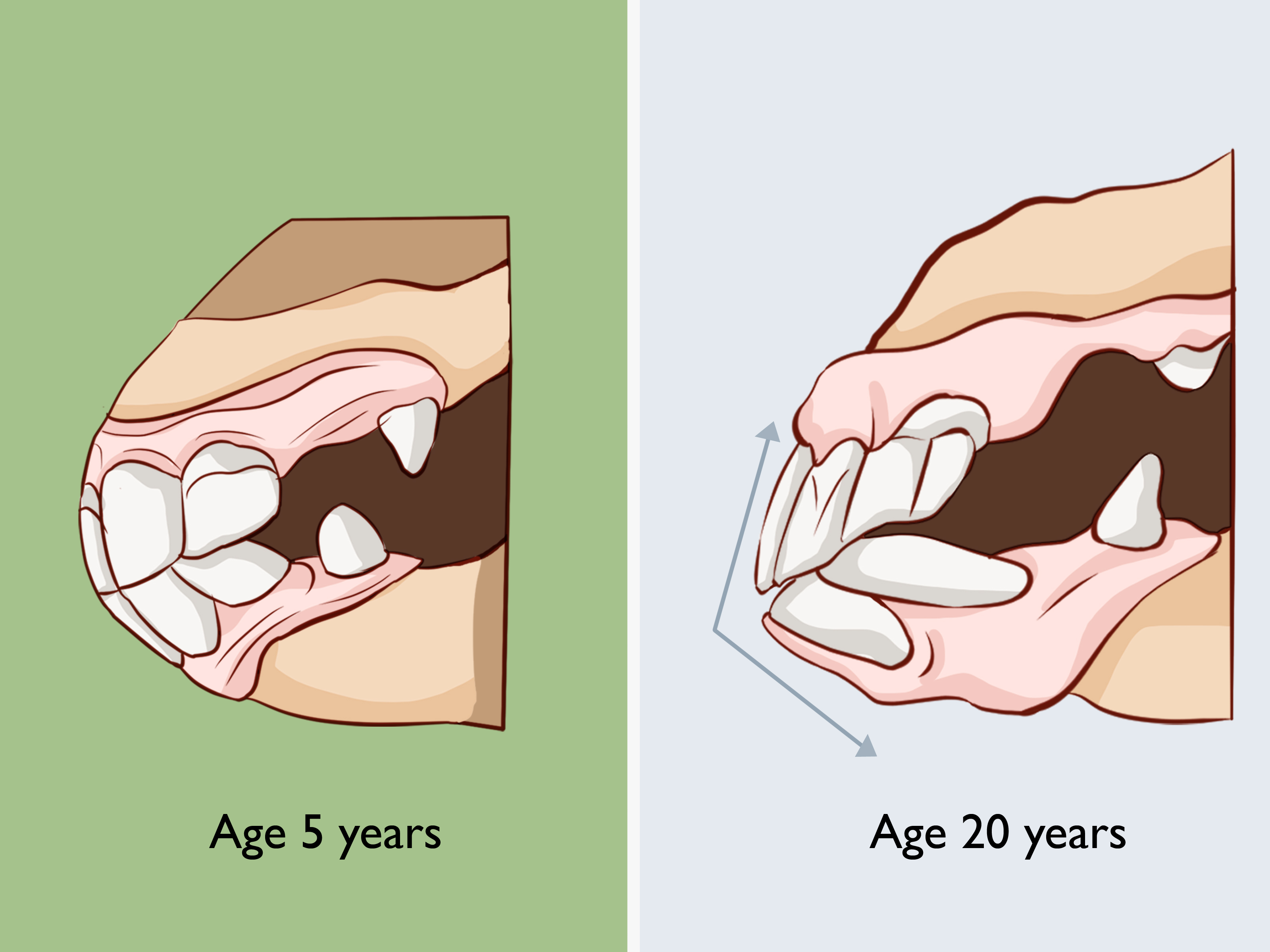
The grinding surface of the incisors changes shape with age. In younger mature horses, the surface often appears wider from side to side. As the horse ages, the surface may become more oval, then triangular, and later longer from front to back. This change is one reason older horses are described as “long in the tooth.” The teeth are not actually growing like tree branches forever; more of the reserve crown becomes visible as the teeth erupt and wear.
A horse around eight to twelve may show more oval surfaces. By the mid-teens, triangular surfaces may become more obvious. Around twenty, the incisors may look longer and narrower. Again, these are estimates, not courtroom evidence.
Check the Angle of the Incisors
Young horses usually have incisors that meet at a fairly upright angle. As horses age, the incisors tend to slant forward, creating a sharper angle where the upper and lower front teeth meet. From the side, an older horse may show a noticeably longer, more angled bite.
This clue is easy for beginners to notice because it does not require identifying tiny marks. Stand safely to the side, look at the profile of the front teeth, and compare the angle with a younger horse if one is available. The more sloped and elongated the incisors look, the older the horse may be.
Use Galvayne’s Groove Carefully
Galvayne’s groove is a vertical groove that may appear on the outside surface of the upper corner incisor. Traditionally, it is said to appear near the gumline around age ten, reach halfway down the tooth around fifteen, extend the full length by twenty, recede from the top by twenty-five, and disappear by thirty.
That sounds wonderfully tidy, as if horses read the manual before growing teeth. Unfortunately, not every horse follows this schedule. Galvayne’s groove can be faint, absent, irregular, or misleading. It can still be a helpful clue for older horses, but it should never be used alone.
Watch Out for the 7-Year Hook
Some horses develop a hook on the upper corner incisor around age seven, and a similar hook may appear again around age eleven. This happens because the upper and lower corner incisors may not wear evenly as the mouth changes shape. However, hooks are inconsistent and can be affected by bite alignment and dental care. They are interesting, but not reliable enough to carry the whole age estimate.
Way 3: Use Body Condition, Behavior, and Records as Supporting Clues
Teeth are the star of the show, but they are not the entire cast. To estimate a horse’s age well, combine dental clues with general physical signs, behavior, and any available records. This method is especially useful for mature and senior horses, where dental age estimation becomes less precise.
Look at the Face and Body
Older horses may develop deeper hollows above the eyes, a more angular face, a swayback, reduced muscle over the topline, or more gray hairs around the muzzle and eyes. Some seniors remain sleek and muscular, while some younger horses look rough because of poor care, parasites, illness, or underfeeding. That is why body clues should support the dental picture, not replace it.
A shiny coat does not always mean young, and a bony frame does not always mean ancient. A twenty-two-year-old horse with great care can look better than a neglected eight-year-old. Good management is basically anti-aging cream, except it comes in the form of forage, farrier work, dental care, and someone who notices when the water trough is suspiciously green.
Observe How the Horse Eats
Dental wear affects how well a horse chews. Older horses may drop partially chewed feed, create little hay balls called quids, take longer to finish meals, lose weight despite a good appetite, or prefer soaked feed. These signs do not prove age by themselves, but they may point toward senior dental changes or dental disease.
Any horse that struggles to chew needs a veterinary dental exam. Painful hooks, sharp enamel points, missing teeth, wave mouth, periodontal disease, and resorptive conditions can all affect comfort and nutrition. Senior horses often benefit from more frequent dental monitoring, especially if they have missing teeth or uneven wear.
Consider Training and Life Experience
Behavior can offer hints, though it is not a dependable age calculator. A very young horse may be mentally immature, easily distracted, or still learning basic handling. A mature horse may have settled work habits, clearer training responses, and a more predictable attitude. A senior horse may be calm and experienced, though plenty of older horses still have enough spice to make a rider question their life choices.
Training history can help. Show records, racing records, breed association papers, previous veterinary invoices, Coggins paperwork, microchip registration, and sale documents may provide dates. When records and teeth agree, confidence improves. When they disagree, ask questions and involve a veterinarian.
How Accurate Is Aging a Horse by Teeth?
Aging by teeth is most accurate in horses under five because eruption follows a clearer schedule. From five to the early teens, wear patterns can still be helpful, but variation increases. In older horses, the estimate often becomes broader, such as “late teens” or “twenties,” rather than a precise year.
Several factors can change dental appearance:
- Diet: sandy soil and coarse forage can increase wear.
- Dental care: floating and corrective work can alter visible clues.
- Genetics: some horses simply wear teeth differently.
- Habits: cribbing or chewing fences can damage incisors.
- Malocclusions: uneven bites can create hooks and abnormal wear.
- Missing teeth: gaps can change how remaining teeth meet.
- Human tampering: unethical alteration of teeth, known as bishoping, can make a horse appear younger.
Because of these variables, a careful age estimate should combine multiple signs. The best approach is simple: inspect the teeth, observe the horse, check records, and ask a qualified equine veterinarian to confirm your findings.
A Simple Age-Checking Routine for Beginners
Before looking in a horse’s mouth, remember that horses are large animals with opinions, and some of those opinions involve moving their heads quickly. Do not pry open a horse’s mouth if you are inexperienced or if the horse is nervous. Ask a knowledgeable handler or veterinarian for help.
Step 1: Start With Records
Ask for registration papers, veterinary files, dental records, brand inspection documents, adoption paperwork, show records, or previous bills. Written records are usually more reliable than visual guessing.
Step 2: Look at the Incisors
If it is safe, gently lift the lips and look at the front teeth. Note whether the horse has baby teeth, permanent teeth, cups, dental stars, tooth shape changes, or a strong forward slant.
Step 3: Match Multiple Clues
Do not rely on one sign. A horse with a full mouth is likely at least five. A horse with no lower cups and visible dental stars may be older than eleven. A horse with strongly slanted incisors, long tooth appearance, senior body changes, and chewing difficulty may be in the late teens or beyond.
Step 4: Get a Professional Opinion
For purchases, rescues, breeding decisions, or health concerns, schedule a veterinary exam. A veterinarian can examine the whole mouth with proper equipment and may identify issues that are invisible from a quick lip-lift inspection.
Experience Notes: What Real Horse People Learn Over Time
After spending enough time around barns, you learn that estimating a horse’s age is part science, part pattern recognition, and part humility. The first horse that fools you is usually a good teacher. Maybe you meet a compact, bright-eyed gelding with a glossy coat and playful trot, and you guess he is twelve. Then the owner tells you he is twenty-three and still believes every feed bucket is a personal emergency. Lesson one: vitality does not always come with a birth certificate.
Another common experience happens during horse shopping. A seller says a horse is “probably about nine,” which is barn-speak that can mean anything from eight to eighteen unless paperwork appears. You lift the lip and notice the incisors are more angled than expected. The lower cups are gone, the dental stars are obvious, and the Galvayne’s groove looks more like a middle-aged clue than a youthful detail. Suddenly “about nine” feels like a very optimistic math problem. That does not mean the horse is bad. Many older horses are priceless teachers. It simply means price, workload, and care plans should match reality.
Rescue horses teach another lesson: condition can lie. A thin horse with a rough coat may look ancient, but after deworming, dental treatment, groceries, and months of consistent care, the same horse may bloom into a much younger-looking animal. On the other hand, a well-fed senior with excellent dental care can pass for younger at first glance. That is why experienced owners do not judge age by ribs, shine, or attitude alone. They check the mouth and the management history.
Dental exams also reveal how much comfort matters. A horse that drops grain, avoids hay stems, or balls up forage may not be “picky.” It may be uncomfortable. Once sharp points are corrected or painful teeth are managed, the horse may eat better, gain weight, and act brighter. In real barns, these changes are often dramatic. People sometimes joke that the horse got younger after the dentist came. Technically, no; emotionally, yes.
The most useful habit is to think in ranges. Instead of declaring, “This horse is exactly fourteen,” say, “The teeth suggest mid-teens, but I would confirm with a vet.” That kind of answer is honest and practical. Horses appreciate honesty. Well, actually, horses appreciate hay, turnout, and not being bothered during dinner, but honesty is still good for humans.
Conclusion
Learning how to tell the age of a horse starts with the mouth, especially the incisors. In young horses, tooth eruption and replacement give the clearest clues. In mature horses, cups, dental stars, tooth shape, Galvayne’s groove, and the angle of the bite can help estimate age. In older horses, body condition, eating habits, dental health, and records become increasingly important supporting evidence.
The smartest method is to combine all three approaches: check tooth eruption, read tooth wear, and compare those findings with the horse’s overall condition and paperwork. Use dental aging as a practical guide, not a crystal ball. For buying, rescue evaluation, or health decisions, involve an equine veterinarian. A horse’s true value is not only in its age, but in its soundness, comfort, training, temperament, and the care it receives every day.
Note: Horse age estimation from teeth is helpful but never perfect. For medical, purchase, breeding, or insurance decisions, ask a qualified equine veterinarian to perform a complete oral and physical examination.