Note: This article explains practical, polished ways to turn a list into a sentence using commas, colons, semicolons, and natural phrasing. It is written in standard American English for students, bloggers, editors, and anyone who has ever stared at a bullet list and thought, “Now what?”
Introduction: When a List Wants to Grow Up and Become a Sentence
Lists are wonderfully useful. They keep grocery runs from becoming treasure hunts, help students organize ideas, and allow writers to stack information without making readers feel trapped in a paragraph-shaped maze. But sometimes a list should not remain a list. Sometimes it needs to become a smooth, readable sentence that fits inside an essay, blog post, email, report, caption, or product description.
Knowing how to make a list into a sentence is a simple writing skill with surprisingly large benefits. It improves flow, reduces clutter, and helps your writing sound less like a refrigerator note and more like a confident human being with coffee and a plan. The trick is not merely shoving list items between commas and hoping grammar will look the other way. A good sentence list needs structure, punctuation, parallel wording, and a clear relationship between the items.
In this guide, we will walk through three reliable ways to turn a list into a sentence: using commas for a simple series, using a colon to introduce a list after a complete thought, and using semicolons when the list items are long or already contain commas. Along the way, you will see practical examples, common mistakes, and small style upgrades that can make your writing clearer, sharper, and easier to read.
Why Turn a List Into a Sentence?
A list is not wrong just because it has bullets or numbers. In fact, vertical lists are excellent when readers need to scan instructions, compare options, or follow steps in order. However, a sentence is often better when the list is short, when the information belongs naturally in a paragraph, or when you want the writing to feel more conversational.
For example, a shopping list might look fine like this:
- Eggs
- Potatoes
- Milk
- Bread
But in a story, essay, or blog post, the same information sounds better as a sentence: “I went to the store for eggs, potatoes, milk, and bread.” That sentence is compact, natural, and much less likely to make readers wonder whether they accidentally opened your grocery app.
Turning a list into a sentence also helps with rhythm. Too many bullet lists can make a page feel choppy. Too many long sentences can make it feel swampy. Good writing balances both. When the list is brief and the items are simple, a sentence often gives the reader a smoother ride.
Way 1: Use Commas for a Simple List in a Sentence
The Basic Pattern
The most common way to make a list into a sentence is to place the items in a series and separate them with commas. This works best when the list items are short, simple, and equal in structure.
List:
- Bananas
- Oats
- Honey
Sentence: “For breakfast, I packed bananas, oats, and honey.”
This is the classic comma-separated list. Each item is clear, short, and easy to follow. The comma before “and” is often called the serial comma or Oxford comma. Many style guides recommend using it because it can prevent confusion, especially when list items are more than one word long.
Use Parallel Structure
When you convert a list into a sentence, make the items match. This is called parallel structure. It simply means your list items should follow the same grammatical pattern. Readers may not know the term, but they can feel the difference.
Awkward: “The workshop teaches planning essays, how to revise drafts, and citations.”
Better: “The workshop teaches essay planning, draft revision, and citation skills.”
In the better version, all three items are noun phrases. The sentence feels balanced instead of wobbling around like a shopping cart with one bad wheel.
Avoid the “Mystery Item” Problem
Commas are helpful, but they cannot fix unclear wording. If a list item could be misunderstood, rewrite it. Consider this sentence: “I invited my parents, Taylor Swift and a magician.” Without a serial comma, some readers may briefly wonder whether your parents are Taylor Swift and a magician, which would certainly make family reunions more interesting.
A clearer version is: “I invited my parents, Taylor Swift, and a magician.” Better yet, if the sentence still feels odd, rewrite it completely: “The guest list included my parents, a magician, and Taylor Swift.” Clarity beats clever punctuation every time.
When This Method Works Best
Use commas when the list contains short items such as nouns, names, places, actions, or brief phrases. This method is ideal for blog writing, school essays, social captions, emails, and general nonfiction.
Examples:
- “The course covers grammar, punctuation, style, and revision.”
- “She packed a notebook, two pens, a charger, and a heroic amount of snacks.”
- “Good product descriptions are clear, specific, accurate, and persuasive.”
Way 2: Use a Colon to Introduce a List
The Rule That Saves You From Colon Chaos
A colon can introduce a list, but it should usually come after a complete sentence. In other words, the words before the colon should be able to stand alone as a full thought. Think of the colon as a tiny drumroll. It says, “Here comes the information I promised.”
Correct: “The recipe requires four basic ingredients: flour, eggs, milk, and butter.”
Incorrect: “The recipe requires: flour, eggs, milk, and butter.”
Why is the second one awkward? Because “The recipe requires” is not a complete sentence. It needs an object. The list itself is already the object, so the colon barges in like an uninvited punctuation mark wearing sunglasses indoors.
How to Convert a Bullet List With a Colon
Suppose your original list looks like this:
- Strong opening sentence
- Clear supporting details
- Memorable conclusion
You can turn it into a sentence by adding a complete introductory clause before the colon:
“A strong paragraph needs three things: a strong opening sentence, clear supporting details, and a memorable conclusion.”
This version is neat because the first half of the sentence prepares the reader for the list. The colon creates expectation, and the list delivers. That structure is especially useful in instructional writing, academic writing, and SEO content because it gives readers a clean mental map.
Colons Create Emphasis
Commas make a list feel casual and blended into the sentence. A colon gives the list more importance. Compare these two examples:
Comma version: “The editor checked spelling, grammar, links, and formatting.”
Colon version: “Before publishing, the editor checked four things: spelling, grammar, links, and formatting.”
The second version sounds more deliberate. It tells the reader that the number and category of items matter. This is why colons are helpful in guides, tutorials, checklists, and educational articles.
Do Not Overuse Colons
Colons are powerful, but too many of them can make writing feel stiff. If every other sentence announces a list like a royal decree, readers may start looking for the nearest exit. Use colons when you want emphasis, organization, or a formal introduction. Use commas when the list is simple and does not need a spotlight.
Good use: “Our team focused on three priorities: speed, accuracy, and customer experience.”
Too heavy: “I bought three snacks: chips, cookies, and almonds. Then I packed three drinks: water, tea, and lemonade. Finally, I grabbed three tools: tape, scissors, and string.”
The second example is grammatically fine, but stylistically exhausting. A little punctuation variety keeps readers awake, which is generally considered polite.
Way 3: Use Semicolons for Complex List Items
When Commas Are Not Strong Enough
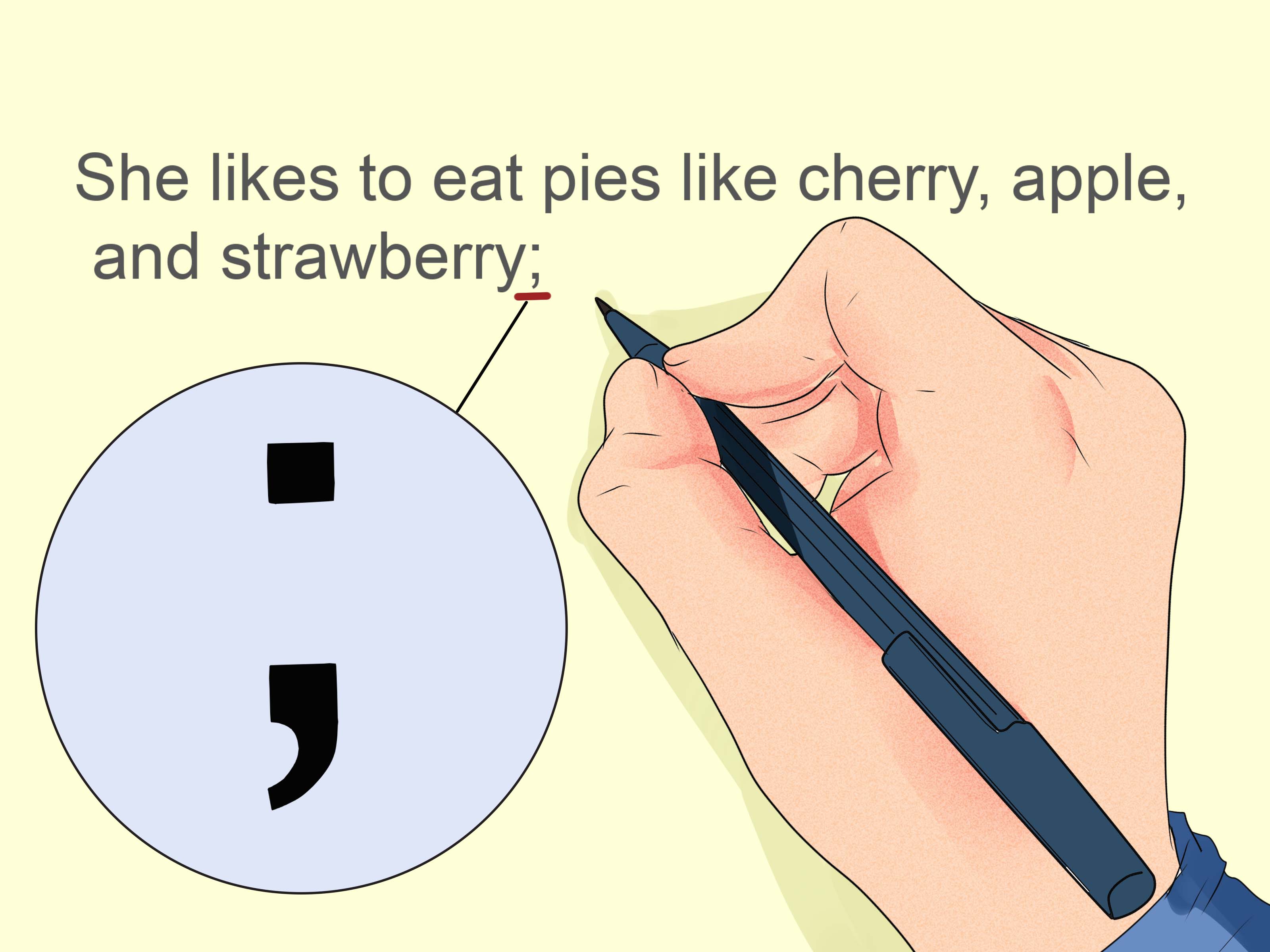
Sometimes list items already contain commas. When that happens, using only commas between items can confuse readers. Semicolons help separate the larger list items so the sentence does not turn into punctuation soup.
Confusing: “The conference featured speakers from Austin, Texas, Portland, Oregon, and Madison, Wisconsin.”
Clear: “The conference featured speakers from Austin, Texas; Portland, Oregon; and Madison, Wisconsin.”
In the clear version, each semicolon separates one city-and-state pair. Without semicolons, readers may have to slow down and decode which words belong together. That is not the kind of puzzle most people want while reading a sentence about conference speakers.
Use Semicolons for Long Phrases
Semicolons also work well when list items are long, detailed, or internally complicated. They give each item breathing room.
Example: “The editing plan included reviewing the introduction for clarity and tone; checking each paragraph for transitions, evidence, and flow; and proofreading the final draft for punctuation errors.”
Each item in that sentence contains multiple words and ideas. Semicolons keep the structure organized. The result is still one sentence, but it does not feel like a runaway train carrying commas in every boxcar.
Do Not Use Semicolons for Every List
Semicolons are not fancy commas. They are useful tools for specific situations. If the list is simple, commas are usually better.
Too formal: “I ordered coffee; toast; and orange juice.”
Better: “I ordered coffee, toast, and orange juice.”
The semicolon version is not smoother or smarter. It sounds like breakfast is being documented by a nervous lawyer. Save semicolons for lists that need them.
How to Choose the Best Method
Ask Three Quick Questions
Before turning a list into a sentence, ask yourself three questions:
- Are the items short and simple?
- Does the sentence need an introduction before the list?
- Do any list items already contain commas or long details?
If the items are short and simple, use commas. If the list needs a clear setup, use a colon after a complete sentence. If the items are complex or contain commas, use semicolons. That three-part decision will solve most list-to-sentence problems faster than you can say “parallel structure,” which is good, because nobody wants to say “parallel structure” too many times at lunch.
Before-and-After Examples
Original list:
- Research the topic
- Outline the article
- Write the first draft
- Edit for clarity
Comma sentence: “To write the article, research the topic, outline the article, write the first draft, and edit for clarity.”
Colon sentence: “A strong writing process includes four steps: researching the topic, outlining the article, writing the first draft, and editing for clarity.”
Semicolon sentence: “A strong writing process includes researching the topic with reliable sources; outlining the article so each section has a purpose; writing the first draft without obsessing over perfection; and editing for clarity, flow, and accuracy.”
Each version works, but each has a different style. The comma sentence is quick. The colon sentence is organized. The semicolon sentence is detailed. The best choice depends on what your reader needs.
Common Mistakes When Turning Lists Into Sentences
Mistake 1: Adding a Colon After an Incomplete Phrase
Avoid placing a colon after a phrase that cannot stand alone.
Incorrect: “My favorite writing tools are: a notebook, a timer, and coffee.”
Correct: “My favorite writing tools are a notebook, a timer, and coffee.”
Also correct: “I rely on three favorite writing tools: a notebook, a timer, and coffee.”
Mistake 2: Mixing Grammatical Forms
Keep list items consistent.
Awkward: “The app helps users track expenses, budgeting, and to save receipts.”
Better: “The app helps users track expenses, create budgets, and save receipts.”
Mistake 3: Using Commas When Semicolons Are Needed
If list items contain internal commas, upgrade the separators.
Confusing: “The tour stops in Albany, New York, Boise, Idaho, and Tampa, Florida.”
Clear: “The tour stops in Albany, New York; Boise, Idaho; and Tampa, Florida.”
Mistake 4: Making the Sentence Too Long
Not every list should become one sentence. If the list is long, technical, or step-by-step, keep it vertical. Readability matters more than showing off that you can juggle twelve items in one sentence without dropping a comma.
SEO Writing Tip: Sentence Lists Can Improve Readability
For web writing, list-to-sentence decisions affect user experience. Search engines do not reward confusing writing, and readers certainly do not either. A clean sentence can make a paragraph feel more natural, while a bullet list can improve scanning. The goal is not to choose one forever. The goal is to use both wisely.
In SEO content, use sentence lists when the information is brief and supports a larger point. Use bullet lists when readers need to compare, remember, or act. For example, a paragraph about healthy pantry staples may work better as a sentence: “Keep oats, beans, rice, olive oil, and canned tomatoes on hand for quick meals.” But a recipe method should probably remain numbered because order matters, and nobody wants to discover step five should have happened before step two. That is how pancakes become regret.
Natural keyword use also matters. If your main keyword is “make a list into a sentence,” place it where it fits naturally, such as in the introduction, a heading, and one or two body paragraphs. Related phrases like “comma-separated list,” “sentence structure,” “colon before a list,” “semicolon in a list,” and “parallel structure” can support the topic without making the article sound like it was written by a keyword blender.
of Experience: What I Learned From Turning Lists Into Sentences
After working with countless drafts, essays, emails, captions, product descriptions, and blog posts, I have learned that the humble list is one of the most underestimated parts of writing. People think lists are easy because they are short. That is adorable. Lists can cause chaos faster than a toddler with permanent markers. The trouble usually begins when a writer tries to move a list into a paragraph without changing the structure.
One common experience is seeing a bullet list copied directly into a sentence. The writer starts with clean items like “fast shipping,” “friendly support,” and “easy returns,” then produces something like, “Our store offers fast shipping, friendly support, easy returns.” That is not terrible, but it feels unfinished because the final item needs a conjunction. Add “and,” and suddenly the sentence behaves: “Our store offers fast shipping, friendly support, and easy returns.” Small change, big improvement.
Another lesson is that punctuation cannot rescue poor planning. I once reviewed a paragraph that tried to list product benefits, customer emotions, technical features, and pricing details in one heroic sentence. It had commas, dashes, semicolons, parentheses, and possibly a cry for help. The fix was not more punctuation. The fix was deciding which items belonged together. Once the writer grouped similar ideas, one long list became two clean sentences and one short bullet list. The paragraph instantly became easier to read.
I have also noticed that students often overuse colons because colons look official. A colon can make a sentence feel organized, but only when the setup is complete. “The reasons are: cost, time, and quality” is a classic example of a colon trying too hard. The smoother version is “The reasons are cost, time, and quality,” or “The decision came down to three reasons: cost, time, and quality.” The second version works because the words before the colon form a complete sentence. Once students understand that pattern, their writing usually becomes more confident.
Semicolons, meanwhile, make people nervous. Some writers treat them like decorative antiques: beautiful, mysterious, and probably not safe to touch. But semicolons are practical when list items contain commas. If I write, “The team visited Denver, Colorado, Reno, Nevada, and Phoenix, Arizona,” readers can figure it out, but they have to work. If I write, “The team visited Denver, Colorado; Reno, Nevada; and Phoenix, Arizona,” the structure is immediately clear. That is the real purpose of punctuation: not to impress readers, but to guide them.
The biggest experience-based advice is this: read the sentence aloud. If you run out of breath, get lost halfway through, or forget what the sentence was about before reaching the final item, the list may need to stay vertical. Good writing is not about squeezing everything into one sentence. It is about choosing the shape that helps readers understand the idea with the least friction. Sometimes that shape is a comma-separated sentence. Sometimes it is a colon-led explanation. Sometimes it is a semicolon-supported series. And sometimes, dear writer, it is still a bullet listand that is perfectly fine.
Conclusion: Make the List Serve the Sentence
Learning how to make a list into a sentence is not about memorizing obscure grammar rules for the thrill of sounding like a retired copy editor at a dinner party. It is about making information clear. Use commas for simple lists, colons for introduced lists, and semicolons for complex lists. Keep your items parallel, avoid unnecessary punctuation, and choose the format that helps your reader move smoothly from one idea to the next.
A list can be practical, but a sentence can be elegant. When you know how to move between the two, your writing becomes more flexible, polished, and reader-friendly. Whether you are writing an essay, a blog post, an email, or a product page, the same principle applies: clarity first, style second, and punctuation only where it earns its keep.