Note: This article is written from real APA 7 guidance synthesized from authoritative academic writing resources, including official APA Style materials and U.S. university writing-center guidance. Source links are intentionally not inserted in the article body.
Citing a source in APA format can feel, at first, like trying to fold a fitted sheet while someone grades you on punctuation. There are names, years, commas, italics, page numbers, DOIs, URLs, and the mysterious little creature known as “et al.” But once you understand the basic system, APA citation becomes much less frightening. In fact, it is wonderfully logical: tell readers who said the thing, when they said it, and where they can find the full source.
APA format, officially known as American Psychological Association style, is widely used in psychology, education, nursing, business, communication, and the social sciences. Its main goal is not to make students sweat into their keyboards. It exists to help writers give credit, avoid plagiarism, support claims, and guide readers back to original research. In other words, APA citations are academic breadcrumbsexcept instead of leading to a gingerbread house, they lead to journal articles, books, reports, and credible websites.
This guide explains three practical ways to cite a source in APA format: using parenthetical citations, using narrative citations, and creating full reference list entries. Along the way, you will see clear examples, common mistakes, and simple rules that make APA 7th edition much easier to handle.
What Is APA Format?
APA format is a standardized writing and citation style used to document sources in academic and professional writing. The current standard is APA 7th edition, which simplified several older rules and updated guidance for online sources, group authors, social media, DOIs, and student papers.
The most important thing to understand is that APA uses an author-date citation system. That means a brief citation appears inside the text of your paper, usually showing the author’s last name and the year of publication. Then, at the end of the paper, a full entry appears on the References page. These two parts work as a pair. Think of the in-text citation as the name tag and the reference entry as the full résumé.
The Two-Part APA Citation System
APA citations usually include two connected pieces:
- In-text citation: A short citation in the paragraph where you use the source.
- Reference list entry: A full citation at the end of the paper with complete publication details.
For example, if you write a sentence using information from a book by James Carter published in 2021, your in-text citation might look like this: (Carter, 2021). The matching reference entry would appear on the References page with the author, year, title, publisher, and other required details.
Way 1: Cite a Source With a Parenthetical Citation
A parenthetical citation places the source information inside parentheses, usually at the end of a sentence. This is one of the most common ways to cite a source in APA format because it is clean, quick, and easy to use when the author’s name is not part of your sentence.
Basic Parenthetical Citation Format
The basic format is:
(Author Last Name, Year)
Example:
Regular exercise can improve mood and reduce stress in many adults (Miller, 2020).
In this example, the citation tells readers that the idea came from a source written by Miller and published in 2020. The period comes after the closing parenthesis, not before it. Yes, punctuation has opinions in APA style.
Parenthetical Citation With a Direct Quote
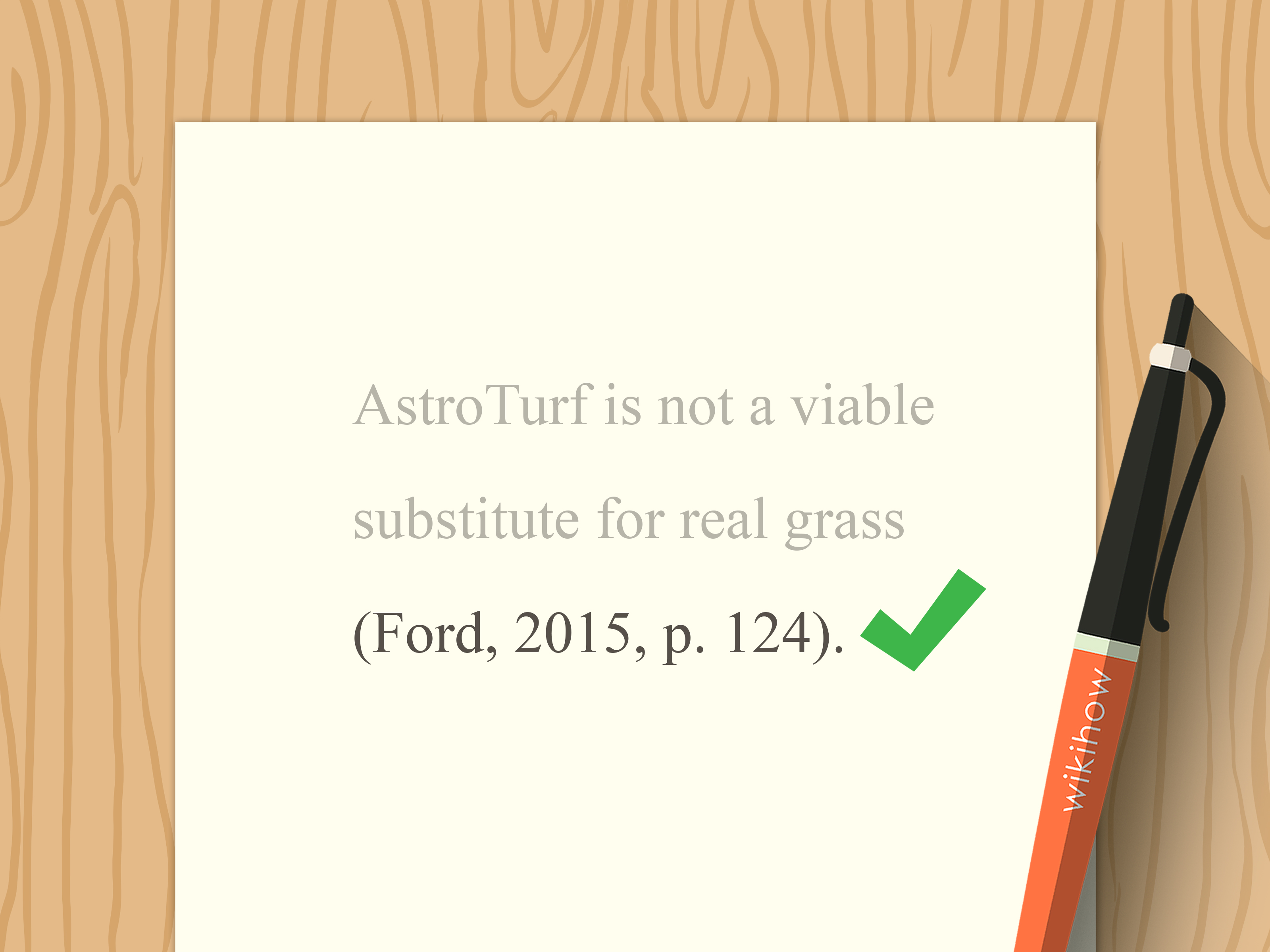
When you quote exact words from a source, APA style asks you to include a locator, such as a page number, paragraph number, timestamp, table number, or section heading. For most print sources, use a page number.
Format:
(Author Last Name, Year, p. Page Number)
Example:
Academic writing improves when students “treat revision as a process, not a punishment” (Johnson, 2022, p. 47).
If the source has no page numbers, such as a webpage, you can use a paragraph number or section heading when available:
(Centers for Learning Research, 2023, para. 4)
Direct quotes should be used carefully. A good rule is to quote only when the original wording is especially clear, memorable, technical, or important. Otherwise, paraphrase the idea in your own words and cite the source.
Parenthetical Citations With Two or More Authors
For two authors, include both last names and use an ampersand inside the parentheses:
(Rivera & Chen, 2021)
For three or more authors, use the first author’s last name followed by et al.:
(Nguyen et al., 2022)
Remember that et al. means “and others.” It is not a typo, a wizard spell, or the name of a very productive coauthor.
When to Use Parenthetical Citations
Use parenthetical citations when the source supports the whole sentence and you do not need to emphasize the author. This style keeps the focus on the idea rather than the researcher. It is especially useful in literature reviews, background sections, and paragraphs that compare several studies.
Example:
Students often remember citation rules better when they practice with real examples rather than memorizing abstract formulas (Harris, 2021).
Way 2: Cite a Source With a Narrative Citation
A narrative citation includes the author’s name as part of the sentence. The year appears in parentheses right after the author’s name. This method is useful when you want to highlight the author, introduce a study, or discuss what a particular researcher argued, found, explained, or discovered.
Basic Narrative Citation Format
The basic format is:
Author Last Name (Year)
Example:
Miller (2020) found that regular exercise can improve mood and reduce stress in many adults.
The information is the same as a parenthetical citation, but the sentence structure changes. Instead of putting the author and year at the end, you introduce the source directly in the sentence.
Narrative Citation With a Direct Quote
When using a direct quote in a narrative citation, include the year after the author and the page number after the quote.
Example:
Johnson (2022) argued that academic writing improves when students “treat revision as a process, not a punishment” (p. 47).
This format keeps the author visible and still gives the reader the exact location of the quoted material.
Narrative Citations With Multiple Authors
For two authors in a narrative citation, spell out the word “and”:
Rivera and Chen (2021) described citation as a form of academic conversation.
For three or more authors, use the first author’s last name followed by et al.:
Nguyen et al. (2022) examined how students use citation tools in first-year writing courses.
The difference between parenthetical and narrative citations is small but important. In parentheses, use an ampersand for two authors: (Rivera & Chen, 2021). In the sentence itself, use “and”: Rivera and Chen (2021).
When to Use Narrative Citations
Use narrative citations when the author matters to the flow of your discussion. This is common when comparing researchers, introducing an expert, or showing how one study builds on another.
Example:
Garcia (2023) emphasized that citation is not just a formatting rule but a way to show intellectual honesty.
Narrative citations can also make your writing feel more natural. Instead of stacking citations like luggage at the end of every sentence, you can weave sources into your prose.
Way 3: Cite a Source in the APA Reference List
The reference list is where APA format becomes more detailed. Every source cited in the text usually needs a matching full reference entry at the end of the paper. The References page allows readers to identify and retrieve the sources you used.
Basic APA Reference List Rules
In APA 7 format, the reference list should generally:
- Begin on a new page titled References.
- List entries alphabetically by the first author’s last name.
- Use a hanging indent for each entry.
- Double-space entries if following full APA manuscript formatting.
- Include only sources cited in the paper, with limited exceptions.
A hanging indent means the first line of a reference starts at the left margin, and the following lines are indented. It looks fancy, but really it is just APA’s way of making your reference list easier to scan.
The Four Main Parts of an APA Reference
Most APA reference entries include four major elements:
- Author: Who created the work?
- Date: When was it published?
- Title: What is the work called?
- Source: Where can readers find it?
This four-part structure works for books, journal articles, webpages, reports, videos, and many other source types. The exact punctuation and order may change depending on the source, but the basic logic remains the same.
APA Reference Example for a Book
Basic format:
Author, A. A. (Year). Title of book in sentence case. Publisher.
Example:
Brown, T. L. (2021). Writing with clarity in college. Academic Press.
In APA style, book titles are italicized and written in sentence case. That means you capitalize the first word of the title, the first word after a colon, and proper nouns. You do not capitalize every major word unless the title is a journal name or other source title that requires title case.
APA Reference Example for a Journal Article
Basic format:
Author, A. A., & Author, B. B. (Year). Title of article in sentence case. Title of Journal in Title Case, volume number(issue number), page range. DOI
Example:
Lee, M. R., & Patel, S. K. (2022). Student confidence and source use in first-year composition. Journal of Academic Writing, 14(2), 115–132. https://doi.org/10.xxxx/example
Journal titles and volume numbers are italicized. Article titles are not italicized. If the article has a DOI, include it as a hyperlink beginning with https://doi.org/. If there is no DOI, the next step depends on where the article came from and whether a stable URL is available.
APA Reference Example for a Website
Basic format:
Author, A. A. or Organization Name. (Year, Month Day). Title of webpage in sentence case. Site Name. URL
Example:
National Institute of Learning. (2023, May 10). How students evaluate online information. National Institute of Learning. https://www.example.org/student-evaluation
If the author and site name are the same, APA style usually omits the site name to avoid repetition. If no publication date is available, use (n.d.), which stands for “no date.” If a webpage is designed to change over time, such as a profile page, map, dictionary entry, or constantly updated database, a retrieval date may be appropriate.
How to Choose the Right APA Citation Method
The three citation methods work together rather than competing with one another. Parenthetical citations and narrative citations are both in-text citations. The reference list entry is the full source record. Most academic papers use all three.
Use Parenthetical Citations When the Idea Matters Most
If your sentence focuses on a finding, fact, or concept, a parenthetical citation is often best. It lets the idea take center stage while still giving credit.
Example:
Clear source attribution helps readers evaluate the strength of an argument (Allen, 2021).
Use Narrative Citations When the Author Matters Most
If your sentence introduces a researcher, compares studies, or discusses what a specific author said, a narrative citation is smoother.
Example:
Allen (2021) explained that clear source attribution helps readers evaluate the strength of an argument.
Use the Reference List for Complete Source Details
The reference list gives readers everything they need to find the original source. Without it, an in-text citation is like a street sign pointing to a road that does not exist. Helpful? Not really. Slightly rude? Maybe.
Common APA Citation Mistakes to Avoid
Mistake 1: Forgetting the Matching Reference Entry
Every in-text citation should normally match a full reference entry. If you cite (Miller, 2020) in your paragraph, readers should be able to find Miller in the References list. If they cannot, your citation trail breaks.
Mistake 2: Adding Sources You Did Not Cite
The References page is not a “books I vaguely glanced at while drinking coffee” list. It should include sources you actually cited in your paper. Background reading may help you understand a topic, but if you do not cite it in the text, it usually should not appear in the reference list.
Mistake 3: Misusing “et al.”
In APA 7, sources with three or more authors use the first author’s last name followed by et al. in the in-text citation. Do not use “et. al,” “et all,” or “and friends,” even if “and friends” feels emotionally accurate.
Mistake 4: Forgetting Page Numbers for Direct Quotes
When quoting exact words, include a page number or another locator. For paraphrases, page numbers are not required, but they can be helpful when pointing to a specific section of a long or complex source.
Mistake 5: Formatting Titles Incorrectly
APA uses sentence case for article titles, book titles, and webpage titles in reference entries. Journal titles use title case. This distinction is easy to miss, but it matters for polished APA formatting.
APA Citation Examples for Everyday Sources
One Author
Parenthetical: (Smith, 2020)
Narrative: Smith (2020)
Two Authors
Parenthetical: (Smith & Lopez, 2020)
Narrative: Smith and Lopez (2020)
Three or More Authors
Parenthetical: (Smith et al., 2020)
Narrative: Smith et al. (2020)
Group Author
Parenthetical: (American Psychological Association, 2020)
Narrative: American Psychological Association (2020)
No Date
Parenthetical: (Taylor, n.d.)
Narrative: Taylor (n.d.)
No Author
If a source has no author, use the title or a shortened title in the in-text citation.
Example: (“Student Writing Habits,” 2022)
On the reference list, the title moves into the author position.
How APA Citations Help SEO and Web Writing
Although APA format is mainly used in academic writing, its habits are useful for web content too. Strong citation practices make articles more trustworthy, easier to verify, and more helpful for readers. Search engines reward content that demonstrates expertise, experience, authority, and trustworthiness. While you do not need APA formatting for every blog post, the mindset behind APAcredit the source, identify the evidence, and make claims traceableis excellent for high-quality online publishing.
For students, APA citation builds credibility with instructors. For researchers, it connects new work to existing scholarship. For bloggers, editors, and content creators, it encourages responsible information use. In a digital world where anyone can publish anything before finishing a sandwich, careful citation is one way to separate reliable writing from confident nonsense.
Practical Experience: What Learning APA Citations Really Feels Like
Learning how to cite a source in APA format is rarely love at first sight. Most people do not wake up one morning and say, “Ah, what a beautiful day to master hanging indents.” More often, APA enters your life through an assignment deadline, a blinking cursor, and a professor who has written “Please cite your sources properly” with the calm menace of someone who means business.
The first experience many students have with APA citation is confusion. They know they need to cite a website, but they are not sure whether the organization is the author, whether the date at the bottom of the page counts, or why the title is italicized in one example but not in another. This is normal. APA is not difficult because the ideas are impossible; it is difficult because the details change depending on the type of source.
One helpful strategy is to stop thinking of citation as decoration and start thinking of it as source mapping. When you take notes, write down the author, date, title, and source information immediately. Do not tell yourself, “I’ll find it later.” Later is where citations go to hide. A source that seemed obvious at 9:00 p.m. can become completely invisible at 1:00 a.m., especially after eight browser tabs, two PDFs, and one emotional support snack.
Another practical lesson is that citation generators are useful but not perfect. Tools can save time, especially for books, articles, and websites, but they often misread titles, dates, authors, capitalization, or missing information. A citation generator should be treated like a helpful intern: fast, enthusiastic, and absolutely in need of supervision. Always compare generated citations with reliable APA examples before submitting your work.
Students also learn that paraphrasing does not remove the need for citation. This is one of the most common misunderstandings. If the idea came from someone else, cite iteven if you rewrote the sentence completely. Changing the outfit does not change the owner of the idea. Paraphrasing shows that you understand the source; citing shows that you respect it.
Direct quotes require even more care. If you copy exact wording, use quotation marks and include a page number or locator. Many writers overuse quotes at first because quoting feels safer than paraphrasing. However, strong academic writing usually depends more on paraphrase, summary, analysis, and synthesis. Use quotes when the original language is especially powerful or precise. Otherwise, explain the idea in your own words and connect it to your argument.
Over time, APA citation becomes less mechanical. You begin to recognize patterns. Books need authors, dates, titles, and publishers. Journal articles need article titles, journal titles, volume and issue numbers, pages, and DOI information when available. Webpages need authors, dates, titles, site names, and URLs. In-text citations usually need the author and year. The system starts to feel less like a maze and more like a checklist.
The biggest personal breakthrough for many writers is realizing that citation is not just about avoiding plagiarism. It is also about joining a conversation. Every citation says, “Here is the evidence behind my point,” or “Here is where this idea comes from,” or “Here is the scholar I am responding to.” Once you see citations as conversation markers, APA format becomes more meaningful. It is not just commas and parentheses. It is intellectual manners.
A smart workflow is simple: collect source details while researching, insert rough in-text citations while drafting, build the reference list as you go, and check formatting during revision. Do not save all citations for the end unless you enjoy academic treasure hunts under deadline pressure. Future-you deserves kindness. Give future-you complete source notes.
Finally, remember that nobody becomes fluent in APA citation by memorizing every rule. Even experienced writers check examples. The goal is not to become a walking citation manual. The goal is to understand the main structure well enough to use reliable guidance correctly. With practice, citing sources in APA format becomes just another part of writinglike proofreading, revising, and wondering why the word “References” suddenly looks misspelled after staring at it too long.
Conclusion
Citing a source in APA format becomes much easier when you understand the three main moves: use parenthetical citations when the idea is the focus, use narrative citations when the author is part of the sentence, and create full reference list entries so readers can find the original source. APA 7th edition may look picky at first, but its purpose is practical. It helps writers give credit, avoid plagiarism, support claims, and build trust with readers.
The best way to master APA citation is not to memorize every tiny rule in one sitting. Start with the author-date system. Learn how to cite one author, two authors, and three or more authors. Practice with books, journal articles, and webpages. Then check special cases as they come up. APA format is a skill, not a personality test. With a little practiceand perhaps a healthy relationship with examplesyou can cite sources clearly, correctly, and confidently.