Note: This article treats 1940s slang as historical vocabulary. Some words, especially gendered terms, may sound dated or awkward today, so enjoy them as cultural artifacts rather than modern etiquette tips.
Introduction: When Everyday Talk Had Swing, Sass, and a Side of Jive
The 1940s did not whisper. It snapped its suspenders, tilted its hat, turned up the big band, and walked into history with a vocabulary all its own. American life in the decade was shaped by World War II, ration books, radio broadcasts, Hollywood glamour, swing music, returning GIs, and a booming youth culture that was learning how to make noise. Out of that wild mix came 1940s slang: colorful, punchy, funny, and sometimes wonderfully dramatic.
Some 1940s slang terms came from jazz clubs and dance halls. Others grew out of military life, school corridors, movie dialogue, and the fast-talking language of newspapers and radio. A few words were already older but became closely associated with the decade because people used them constantly in popular culture. That is how slang works: it does not always wait politely for a birth certificate. It barges in, gets repeated, and suddenly everyone is saying it.
Today, 1940s slang gives us more than cute vintage expressions. It opens a window into how Americans joked, flirted, complained, danced, and coped during a decade of enormous pressure and change. These words carry the rhythm of swing music, the tension of wartime life, and the optimism of people trying to keep their spirits up when the world was not exactly handing out cupcakes.
Below are 10 unique and iconic 1940s slang terms explained with meanings, cultural context, and examples. So polish your saddle shoes, grab your ration-friendly cup of coffee, and let us take a swell little stroll through the language of the 1940s.
Why 1940s Slang Still Feels So Memorable
The best 1940s slang has a musical quality. Words like hepcat, jive, and jitterbug sound like they are already tapping their feet. That is no accident. Swing music and jazz culture influenced everyday speech, especially among young people who wanted to sound stylish, sharp, and socially tuned in. If you were “hep,” you understood what was happening. If you could “cut a rug,” you were not just dancing; you were making the floor nervous.
World War II also changed American slang. Soldiers used short, practical, humorous phrases to describe military life, danger, boredom, food, equipment, and officers. Some of that language returned home with them. Meanwhile, teenagers, especially bobby-soxers, helped shape a new youth marketplace. Their clothes, music preferences, celebrity crushes, and slang made adults realize that teens were not merely small adults with homework. They were a cultural force wearing ankle socks.
That is why 1940s slang remains popular in vintage writing, period films, retro fashion blogs, historical fiction, and social media nostalgia. It instantly creates atmosphere. Say “That party was nice,” and nothing much happens. Say “That shindig was swell, and the hepcats really cut a rug,” and suddenly there is a trumpet solo in the room.
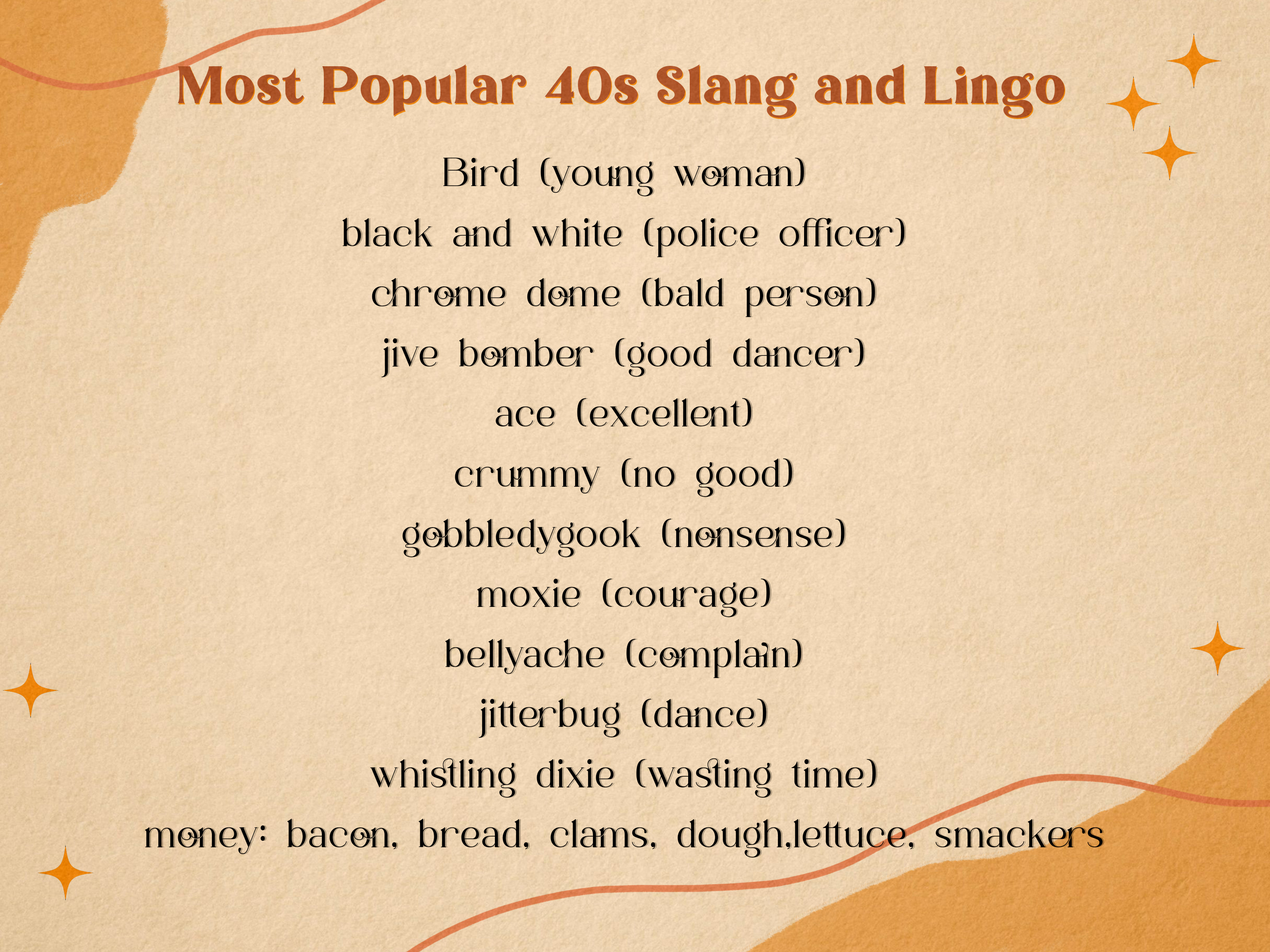
Quick Reference Table: 10 Iconic 1940s Slang Terms
| Slang Term | Meaning | Example |
|---|---|---|
| Swell | Excellent, great, first-rate | “That movie was swell.” |
| Hepcat | A stylish person who knows jazz or current trends | “Eddie is a real hepcat at the dance hall.” |
| Jive | Swing music, hip talk, or nonsense talk | “Quit giving me that jive.” |
| Cut a Rug | To dance energetically | “They cut a rug until midnight.” |
| Bobby-Soxer | A teenage girl associated with 1940s pop culture and fashion | “The bobby-soxers screamed for the singer.” |
| Dreamboat | A very attractive or desirable person | “Her date was a real dreamboat.” |
| Clams | Dollars; money | “That radio cost twenty clams.” |
| Dame | A woman; often used in old-fashioned American slang | “She was one smart dame.” |
| Gams | Legs, usually shapely legs | “The actress was famous for her gams.” |
| Ack-Ack | Antiaircraft fire or an antiaircraft gun | “The pilots flew through heavy ack-ack.” |
1. Swell
Meaning: Excellent, Great, or First-Rate
If the 1940s had a five-star review system, “swell” would be the glowing comment left by someone in a sharp suit. The word means excellent, very good, or admirable. People used it to describe dates, movies, meals, dances, plans, and almost anything that made life feel less like a chore and more like a musical number.
“Swell” was not invented in the 1940s, but it carried a strong old-fashioned charm during the era and stayed attached to mid-century American speech. It sounds cheerful without being overexcited. A swell evening might involve a soda fountain, a big band record, and somebody’s dad asking when you plan to be home.
Example: “Thanks for helping me fix the tire. That was swell of you.”
In modern speech, “swell” is often used humorously or nostalgically. If someone says, “Well, that’s just swell,” they may actually mean the opposite. Language, like a suspicious pie at a church picnic, should always be judged by context.
2. Hepcat
Meaning: A Cool, Trend-Aware Jazz Fan
A hepcat was someone who understood the scene. The term is deeply connected to jazz and swing culture. To be “hep” meant to be in the know, and “cat” was a familiar jazz-age word for a person, especially a musician or fan. Put them together and you get “hepcat”: the kind of person who knew the band, knew the steps, knew the slang, and probably knew where the best late-night food was hiding.
In the 1940s, calling someone a hepcat suggested style, confidence, and cultural awareness. It was not merely about clothing. A hepcat had rhythm. A hepcat had vocabulary. A hepcat could hear three seconds of horn section and know whether the night was about to become legendary.
Example: “Don’t worry about the music; Tommy’s a hepcat, and he always brings the good records.”
Today, “hepcat” sounds playful and vintage. You probably would not use it in a serious business meeting unless your quarterly report includes a saxophone solo. But for retro writing, character dialogue, or a 1940s-themed party, it is pure gold.
3. Jive
Meaning: Swing Music, Hip Talk, or Foolish Talk
“Jive” is one of those glorious slang words with several meanings packed into one small suitcase. In 1940s culture, it could refer to swing music, dance, jazz-influenced talk, or slick nonsense. A person might dance to jive, speak in jive, or accuse someone of talking jive when the story smelled fishier than a lunch counter on Friday.
The word carries the energy of African American musical innovation and jazz culture, which heavily influenced American popular language. As swing moved through ballrooms, radio shows, records, and films, its vocabulary traveled with it. “Jive” became part of the soundtrack of youth culture and entertainment.
Example: “I like the music, but don’t give me any jive about finishing your homework.”
The fascinating thing about “jive” is its flexibility. It can be stylish, musical, comic, or critical. That makes it extremely useful in period writing. A smooth talker might use jive to charm a crowd, while a skeptical mother might cut through it with one raised eyebrow.
4. Cut a Rug
Meaning: To Dance Energetically
To “cut a rug” means to dance with energy, usually in a lively social setting. The phrase is strongly associated with swing dancing, jitterbugging, and the kind of movement that makes furniture nervous. Nobody cuts a rug by gently swaying near the punch bowl. Cutting a rug requires commitment. Possibly perspiration. Definitely shoes that can survive impact.
The phrase likely comes from the image of dancers moving so vigorously that they seem to wear down, mark, or “cut” the floor covering. Whether or not anyone actually damaged a rug is less important than the phrase’s charm. It turns dancing into action. You are not simply moving; you are carving joy into the room.
Example: “The band started playing, and every couple in the hall got up to cut a rug.”
For SEO writers, historical fiction authors, and retro lifestyle bloggers, “cut a rug” is one of the most recognizable 1940s slang expressions. It instantly brings to mind big bands, dance halls, and couples spinning faster than common sense recommends.
5. Bobby-Soxer
Meaning: A Teenage Girl in 1940s Youth Culture
A bobby-soxer was typically an adolescent girl associated with 1940s teen fashion, pop music fandom, and youthful trends. The term comes from “bobby socks,” the ankle socks worn with loafers or saddle shoes. In the 1940s, bobby-soxers became linked to the rise of teen culture, especially the intense fan enthusiasm surrounding popular singers and movie stars.
This term matters because it shows how teenagers were becoming a visible cultural group. Before the modern teen marketplace fully took shape, bobby-soxers helped define what youth identity could look like: fashion-conscious, music-loving, socially active, and very capable of screaming at a celebrity appearance with Olympic-level dedication.
Example: “The theater was packed with bobby-soxers waiting to see their favorite singer.”
Today, “bobby-soxer” is mostly historical, but it remains useful when discussing 1940s fashion, music fandom, Frank Sinatra-era pop culture, or the early development of American teenage consumer culture. It is not just slang; it is a snapshot of a generation finding its voice.
6. Dreamboat
Meaning: A Very Attractive or Desirable Person
“Dreamboat” is one of the softer, sweeter 1940s slang terms. It describes someone highly attractive or desirable, often in a romantic sense. Imagine a movie star with perfect hair, a confident smile, and lighting so flattering it should receive its own paycheck. That person is a dreamboat.
The word became popular in the early-to-mid 20th century and fits perfectly with the glamour of 1940s cinema. Hollywood helped shape romantic ideals, and fans borrowed dreamy language to describe the people they admired. A dreamboat could be an actor, a singer, a date, or the mysterious person across the dance floor who somehow knew how to wear a suit without looking like a nervous envelope.
Example: “Did you see her brother in his Navy uniform? What a dreamboat.”
Modern speakers may use “dreamboat” jokingly, affectionately, or nostalgically. It is less blunt than modern slang for attractiveness and much more charming. Calling someone a dreamboat today might get a laugh, but it might also work. Confidence, after all, never goes out of style.
7. Clams
Meaning: Dollars or Money
“Clams” means money, especially dollars. It belongs to a long tradition of American money slang that includes bucks, dough, smackers, bones, and greenbacks. If someone said a jacket cost “fifteen clams,” they meant fifteen dollars, not a seafood-based barter arrangement. Though, in a true emergency, who knows what a stylish clam could buy?
The term was older than the 1940s, but it still fits comfortably into old-time American speech. It gives dialogue a streetwise, casual flavor. “That’ll be ten dollars” sounds ordinary. “That’ll be ten clams” sounds like it was said by a guy leaning against a diner counter who knows everybody’s business.
Example: “I’d buy that record, but I’m short a few clams this week.”
Money slang often becomes popular because people enjoy making financial pain sound less painful. “I spent all my clams” feels lighter than “I have made several irresponsible economic decisions.” The clams are gone either way, but at least the sentence has personality.
8. Dame
Meaning: A Woman, in Old-Fashioned American Slang
“Dame” was a common old-fashioned slang term for a woman. In 1940s films, detective stories, and popular speech, it could sound admiring, neutral, dismissive, or dramatic depending on tone. A private eye might say, “She was one classy dame,” and suddenly the room fills with cigarette smoke and suspicious piano music.
Modern readers should understand that “dame” is dated and can sound disrespectful today. In its historical setting, however, it was part of the fast-talking language of noir, comedy, and urban slang. It often appeared alongside words like “fella,” “pal,” and “joint.”
Example: “She was a sharp dame who knew better than to trust a cheap excuse.”
For writers, “dame” can quickly establish period atmosphere, but it should be used carefully. A character saying it tells us something about the era, the speaker, and possibly the speaker’s manners. In other words, it is useful vocabulary, not necessarily a recommendation.
9. Gams
Meaning: Legs, Usually Attractive Legs
“Gams” is slang for legs, especially attractive legs. Like “dame,” it belongs to a style of speech often heard in old movies, magazines, and nightclub chatter. The word is playful, but it is also very much a product of its era’s gendered language.
In 1940s entertainment culture, where movie stars were described through glamour photography and publicity copy, a term like “gams” fit the language of visual appeal. It was short, punchy, and easy to drop into a wisecrack. Today, it sounds unmistakably vintage, which is exactly why it works in retro-themed writing.
Example: “The dancer had great timing and famous gams.”
Because the word can sound objectifying, modern writers should treat it as historical slang rather than everyday vocabulary. It is best used when recreating period dialogue or analyzing old pop culture. You can appreciate the linguistic flavor without bringing every old social attitude along for the ride.
10. Ack-Ack
Meaning: Antiaircraft Fire or an Antiaircraft Gun
“Ack-ack” is military slang for antiaircraft fire or an antiaircraft gun. Although the term dates back earlier, it became strongly associated with wartime language because World War II put aviation, air raids, and antiaircraft defense into daily news reports and soldier vocabulary.
The term comes from the repeated sound of “A-A,” short for antiaircraft. It is a perfect example of how military language often values speed, clarity, and memorability. “Antiaircraft artillery fire” is accurate, but in a crisis, nobody wants to spend precious seconds sounding like a manual. “Ack-ack” gets the job done.
Example: “The bomber crew reported heavy ack-ack over the target.”
Unlike the dance-hall slang on this list, “ack-ack” reminds us that 1940s language was shaped by war as much as entertainment. The decade’s vocabulary could be cheerful, romantic, silly, or deadly serious. That contrast is part of what makes 1940s slang so historically rich.
How 1940s Slang Reflected the Decade’s Culture
Looking at these 10 terms together, we can see three major forces shaping 1940s American slang: music, youth culture, and war. Words like “hepcat,” “jive,” and “cut a rug” came from a world of rhythm, dance, and social performance. They suggest movement and confidence. They belong to crowded rooms where music was loud and everyone wanted to look like they knew the steps.
Terms like “bobby-soxer” and “dreamboat” point to the rise of teen culture and celebrity fandom. Young people were becoming trendsetters, and entertainment industries were learning how powerful youth attention could be. The bobby-soxer was not merely a girl in socks; she was a sign that teenagers were becoming an audience worth courting.
Then there is “ack-ack,” a reminder that no discussion of 1940s slang is complete without World War II. Military slang helped soldiers cope with fear, boredom, confusion, and danger. It made extreme experiences easier to name. Some terms stayed within military settings, while others moved into civilian awareness through newspapers, radio, veterans, and films.
The slang of the 1940s also shows how language can turn stress into style. People living through uncertain times often create vivid expressions. Humor becomes armor. Music becomes relief. A good phrase becomes a tiny survival tool. That may be why these words still feel alive. They are not just old words; they are little time capsules of attitude.
How to Use 1940s Slang in Writing Without Sounding Corny
If you are writing historical fiction, a retro blog post, a screenplay, or a themed social media caption, 1940s slang can add instant flavor. The trick is moderation. A sentence stuffed with vintage slang can sound less like authentic dialogue and more like a dictionary fell down the stairs.
Use one or two slang terms where they naturally fit. For example, “That band is swell” feels easy. “That hepcat dreamboat spent twenty clams so we could cut a rug while talking jive with a dame in bobby socks” is too much. At that point, the sentence needs a nap.
Also pay attention to character and context. A teenage music fan might say “dreamboat.” A soldier might say “ack-ack.” A nightclub regular might say “cut a rug.” A hard-boiled detective might say “dame.” Matching slang to the speaker makes the language believable.
Finally, remember that some terms are dated because social attitudes have changed. Words like “dame” and “gams” can work in historical dialogue, but they may sound inappropriate in modern conversation. Use them with awareness, especially if your content will be published online for a broad audience.
Experience Section: Spending a Day Talking Like It’s the 1940s
Trying 1940s slang in real life is a little like wearing a vintage hat to the grocery store: fun, noticeable, and likely to confuse someone near the cereal aisle. Still, it is one of the best ways to understand why these terms were memorable. Reading definitions is useful, but actually saying the words reveals their rhythm. They are short, expressive, and surprisingly good at adding personality to ordinary moments.
Imagine starting the morning by calling your coffee “swell.” Not excellent, not amazing, not life-changing. Just swell. The word immediately changes the mood. It makes your kitchen feel slightly more optimistic, as if a radio announcer might appear and remind everyone to buy war bonds. Then you check your wallet and realize you are low on “clams.” Suddenly, being broke sounds less tragic and more like a scene from a black-and-white comedy.
At lunch, you tell a friend not to give you any “jive” about being late. The phrase lands differently than “excuses.” It is playful but direct. It suggests you are willing to hear the story, but only if the story does not arrive wearing tap shoes and a fake mustache. That is the magic of slang: it compresses attitude into a few syllables.
Later, you hear music and announce that someone should “cut a rug.” This is where modern life may resist you. People might laugh. Someone may ask whether rugs are expensive to repair. But the phrase still works because it is visual. It makes dancing sound physical, joyful, and slightly reckless. Compared with “let’s dance,” “let’s cut a rug” has more electricity.
Using “hepcat” is trickier. You cannot simply call every stylish person a hepcat or the word loses its sparkle. A true hepcat should seem culturally tuned in: the friend who knows the best jazz playlist, the best late-night diner, and exactly which old movie deserves a rewatch. Used correctly, the term feels like a compliment with a wink.
Some 1940s slang, however, feels better observed than revived. “Dame” and “gams” can be useful when watching noir films or writing period dialogue, but they sound dated in everyday conversation. That experience teaches an important lesson: slang carries culture with it. When culture changes, words change too. A term can be historically fascinating and socially awkward at the same time.
By the end of a day experimenting with 1940s slang, you start noticing how modern slang does the same job. We still need words for cool people, attractive people, nonsense, money, dancing, and good times. We just update the packaging. Yesterday’s “swell” becomes today’s “awesome.” Yesterday’s “clams” become today’s “cash.” Yesterday’s “hepcat” becomes today’s person who somehow knows about every good band before anyone else does.
The biggest takeaway is that 1940s slang makes conversation feel theatrical in the best way. It adds bounce. It adds humor. It reminds us that language is not only a tool for information; it is a tool for style. And honestly, that is pretty swell.
Conclusion: Why These 1940s Slang Terms Still Have Swing
1940s slang remains iconic because it captures a decade of contrast. America was living through wartime sacrifice and cultural transformation, yet its everyday language still found room for music, jokes, romance, and attitude. Words like “swell,” “hepcat,” “jive,” and “cut a rug” show the influence of swing and jazz. Terms like “bobby-soxer” and “dreamboat” reveal the rise of teen culture and celebrity obsession. Slang like “ack-ack” reflects the hard reality of World War II and the military language that shaped public awareness.
These expressions are more than quirky old words. They are cultural clues. They tell us what people valued, feared, admired, mocked, and celebrated. Some terms are still charming. Some are best left in historical settings. All of them help us hear the 1940s more clearly.
So the next time you watch a classic film, listen to swing music, read wartime letters, or write a vintage-inspired story, keep an ear out for the slang. It may sound playful, but it carries history. And if that is not swell, what is?