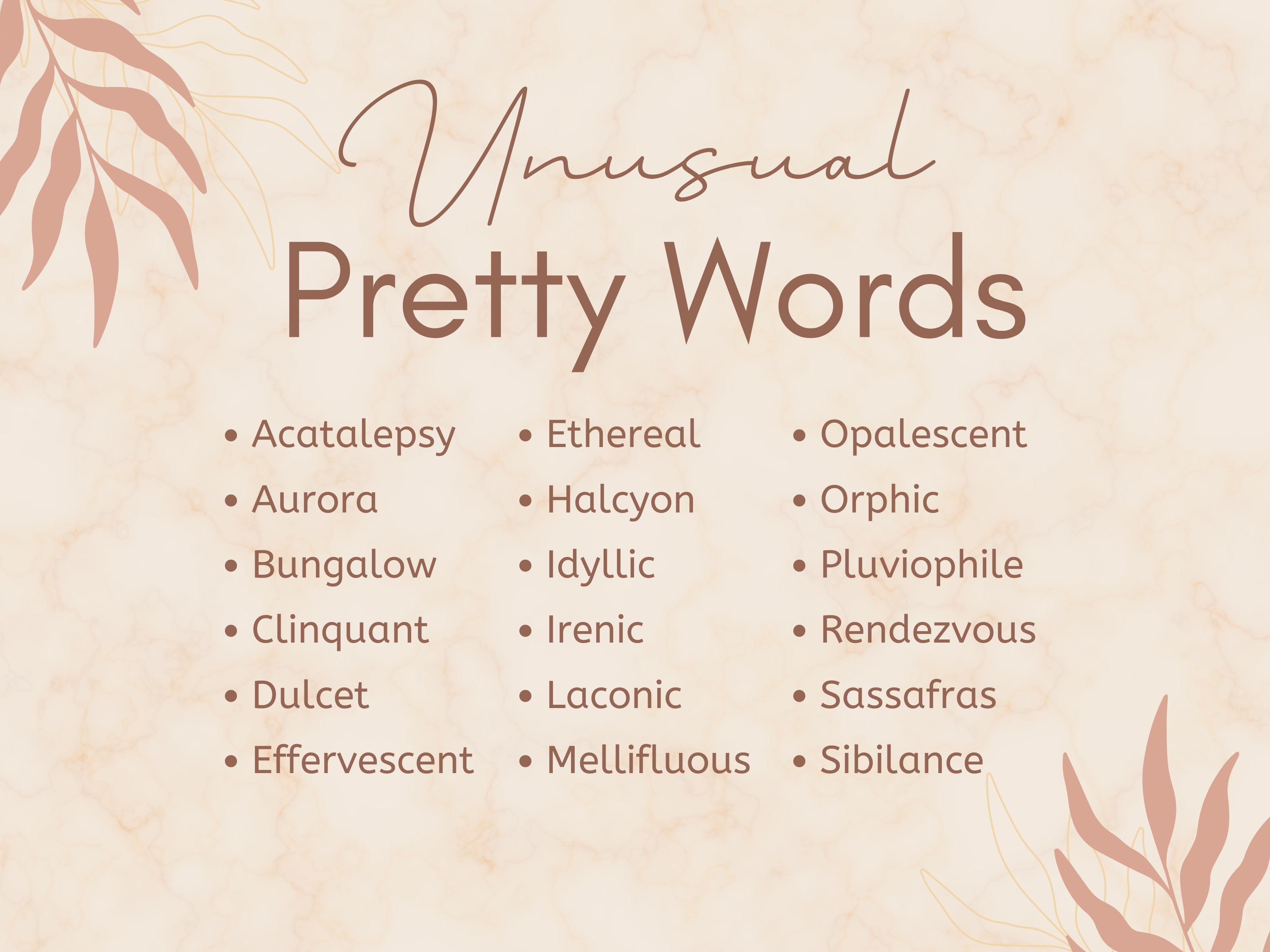
Some words walk into a sentence wearing sneakers. Others arrive in velvet, carrying a candle, a thunderstorm, and possibly a tiny orchestra. This collection of 190+ unusual words with beautiful meanings is for readers, writers, students, poets, brand builders, journal keepers, and anyone who has ever stared at a common word like “nice” and thought, “Surely English owns a better outfit than that.”
Unusual words are not just decorative vocabulary confetti. They help us name specific feelings, describe tiny moments, and give shape to experiences that ordinary language sometimes leaves sitting awkwardly in the hallway. A word like apricity can capture the warmth of winter sunlight. Sonder gives a name to the sudden awareness that every stranger has a full, complicated life. Susurrus sounds like what it means: a whispering, rustling murmur. That is not vocabulary; that is language doing ballet in socks.
Why Beautiful Unusual Words Matter
Language becomes more powerful when it becomes more precise. Saying “I felt sad” is useful. Saying “I felt saudade” suggests longing, memory, distance, and affection all tangled together like earbuds in a backpack. The right word can sharpen a sentence, deepen a poem, brighten a caption, or rescue a paragraph from sounding like it was assembled during a lunch break by a tired printer.
These words come from many places: old English roots, Latin, Greek, French, Italian, Japanese, Portuguese, scientific vocabulary, literary usage, and modern creative culture. Some are common enough to use in essays. Others are best saved for fiction, journaling, poetry, naming projects, or impressing your friend who still thinks “moist” is the most powerful word in English. Spoiler: it is not invited to this party.
190+ Unusual Words with Beautiful & Compelling Meanings
A–C: Words That Feel Like Dawn, Dreams, and Secret Libraries
- Abditory a hiding place; a secret spot for precious things.
- Absquatulate to leave suddenly or flee in a comic, dramatic way.
- Acclivity an upward slope; a climb toward something higher.
- Adoxography elegant writing about a trivial subject.
- Aeonian lasting for ages; eternal or almost timeless.
- Aeriform having the form of air; light and vaporlike.
- Aesthete a person deeply sensitive to beauty and art.
- Agelast someone who rarely laughs; the sworn enemy of puns.
- Alpenglow rosy light on mountains near sunrise or sunset.
- Amaranthine unfading, eternal, or richly beautiful.
- Ambrosial wonderfully fragrant or delicious; fit for the gods.
- Anagnorisis the moment a character discovers a crucial truth.
- Anamnesis remembrance; the act of recalling what was forgotten.
- Apricity the warmth of the sun in winter.
- Aquiver trembling with excitement, emotion, or movement.
- Ardor passionate enthusiasm, warmth, or devotion.
- Astrophile a person who loves stars and astronomy.
- Aurora the dawn; also the glowing natural lights near polar skies.
- Balter to dance clumsily but joyfully.
- Becoming flattering, suitable, or gracefully appropriate.
- Beguile to charm, enchant, or pleasantly distract.
- Bellwether a leading sign of a trend or future change.
- Bibliopole a seller of rare or valuable books.
- Bibliosmia the smell of books, especially old ones.
- Brontide a low rumbling sound like distant thunder.
- Brume mist, fog, or atmospheric haze.
- Cafuné the tender act of running fingers through someone’s hair.
- Callipygian having beautifully shaped buttocks; classical, oddly specific praise.
- Celadon a pale gray-green color, soft and elegant.
- Chiaroscuro the artistic contrast of light and dark.
- Cicatrize to heal by forming a scar.
- Clinquant glittering with gold or tinsel-like brightness.
- Coddiwomple to travel purposefully toward an unknown destination.
- Comely pleasant to look at; attractive in a graceful way.
- Concinnity harmony, elegance, or skillful arrangement.
- Coruscate to sparkle, flash, or glitter brilliantly.
- Crepuscular relating to twilight; active or appearing at dusk.
- Crystalline clear, transparent, or brilliantly structured.
D–H: Words for Light, Emotion, Silence, and Strange Little Miracles
- Defenestration the act of throwing something or someone out a window.
- Demesne a domain, territory, or privately held land.
- Desuetude a state of disuse or neglect.
- Diaphanous light, delicate, and translucent.
- Dulcet sweet and soothing to hear.
- Ebullience cheerful energy; bubbling enthusiasm.
- Efflorescence flowering, blooming, or reaching full expression.
- Effulgence radiant brightness or splendor.
- Elision omission of a sound or syllable in speech.
- Emollient soothing, softening, or calming.
- Empyrean the highest heaven; the pure upper sky.
- Ennui elegant boredom; weariness from lack of excitement.
- Ephemeral lasting for a very short time.
- Epiphany a sudden realization or illuminating insight.
- Erstwhile former; belonging to a previous time.
- Ethereal delicate, heavenly, or almost too perfect for this world.
- Eunoia beautiful thinking; goodwill toward others.
- Evanescent quickly fading or vanishing.
- Exulansis the frustration of not being understood when sharing an experience.
- Felicity intense happiness or the perfect expression of thought.
- Fernweh a longing for faraway places.
- Fika a Swedish-style pause for coffee, comfort, and connection.
- Flaneur a leisurely city wanderer and observer.
- Florilegium a collection of literary passages or flowers.
- Frisson a sudden thrill or shiver of emotion.
- Fugacious fleeting; disappearing quickly.
- Galvanize to energize or stir into action.
- Gambol to leap or skip playfully.
- Gloaming twilight; the dusky part of evening.
- Halcyon calm, peaceful, and happy; often nostalgic.
- Hiraeth deep homesickness for a place or time one cannot return to.
- Hodophile a person who loves travel.
- Hyacinthine blue, purple, or flowerlike in beauty.
- Hygge cozy contentment and warm togetherness.
I–M: Words for Wonder, Mystery, and the Mind’s Hidden Weather
- Icaria a dreamlike idea of flight or soaring freedom.
- Idyllic peaceful, picturesque, and charmingly simple.
- Ineffable too great or beautiful to be expressed in words.
- Inglenook a cozy corner beside a fireplace.
- Insouciance calm, carefree confidence.
- Iridescent showing shifting rainbowlike colors.
- Jocund cheerful and lighthearted.
- Kalopsia the illusion that things are more beautiful than they are.
- Kilig the fluttery thrill of romantic or exciting delight.
- Kismet fate or destiny.
- Lacuna a gap, missing part, or blank space.
- Lambent softly glowing or flickering over a surface.
- Languor dreamy, pleasant laziness or weakness.
- Latibule a hiding place; a place of safety and comfort.
- Leitmotif a recurring theme, image, or musical phrase.
- Limerence intense romantic infatuation.
- Lissome graceful, flexible, and light in movement.
- Logophile a lover of words.
- Lucent glowing or giving off light.
- Luminescence soft light produced without heat.
- Mellifluous sweet and smooth-sounding.
- Meraki putting soul, creativity, and love into what you do.
- Metanoia a deep change of mind, heart, or spiritual direction.
- Minutiae tiny details, often overlooked but meaningful.
- Monachopsis the subtle feeling of being out of place.
- Moonglade the bright path of moonlight reflected on water.
- Munificent extremely generous.
- Murmerous filled with low, soft, continuous sound.
N–S: Words That Sound Like Moonlight, Rain, and Half-Finished Poems
- Nadir the lowest point of something.
- Nefelibata a cloud-walker; someone who lives in imagination.
- Nemophilist a lover of forests and woodland beauty.
- Nepenthe something that makes one forget sorrow.
- Noctilucent shining at night.
- Numinous mysterious, spiritual, or filled with awe.
- Obambulate to wander about.
- Oblivion the state of being forgotten.
- Occhiolism awareness of the smallness of one’s perspective.
- Oleander a beautiful flowering shrub with a lyrical name.
- Onism frustration from being stuck in one body and one place.
- Opaline resembling opal; softly iridescent.
- Orenda a powerful spiritual force believed to exist in all things.
- Palimpsest something reused but still marked by its past.
- Panacea a remedy for all problems.
- Panoply a magnificent display or complete collection.
- Paracosm an elaborate imaginary world.
- Parapraxis a slip of the tongue that may reveal hidden thought.
- Peregrinate to travel or wander from place to place.
- Petrichor the earthy smell after rain.
- Phosphenes the lights and colors seen when the eyes are closed.
- Pluviophile a lover of rain.
- Psithurism the sound of wind in trees.
- Querencia a place where one feels safe, strong, and at home.
- Quiescent still, quiet, or peacefully inactive.
- Quixotic idealistic in a romantic, impractical way.
- Radiant shining brightly or expressing joy.
- Raconteur a skilled storyteller.
- Rame a word associated with chaos and joy at once.
- Redamancy the act of loving someone who loves you back.
- Resplendent dazzlingly beautiful or impressive.
- Reverie a dreamy state of pleasant thought.
- Ripple a small wave or spreading effect.
- Saudade deep emotional longing for someone or something absent.
- Scintilla a tiny spark or trace.
- Selcouth strange, rare, and wonderfully unfamiliar.
- Seraglio a secluded palace or private chamber.
- Seraphic angelic, pure, or blissfully radiant.
- Serendipity a happy accidental discovery.
- Sillage the lingering scent left behind in the air.
- Sonder the realization that every passerby has a vivid inner life.
- Sonorous deep, rich, and full in sound.
- Sophrosyne balanced self-control, wisdom, and moderation.
- Susurrus a soft whispering or rustling sound.
T–Z: Words for Time, Beauty, Travel, and the Last Page of the Sky
- Tacenda things better left unsaid.
- Tenebrous dark, shadowy, or obscure.
- Tintinnabulation the ringing or tinkling of bells.
- Toska a deep ache of the soul; vague spiritual anguish.
- Transpicuous transparent, clear, or easy to understand.
- Ubuntu humanity and shared compassion: “I am because we are.”
- Ukiyo the floating world; living in the moment.
- Umbrage offense, resentment, or shade.
- Vellichor the strange nostalgia of old bookstores.
- Vernal relating to spring.
- Vesper evening; also an evening prayer or star.
- Viridescent becoming green or greenish.
- Vorfreude joyful anticipation before something good happens.
- Wabi-sabi beauty found in imperfection and impermanence.
- Wanderlust a strong desire to travel.
- Welkin the sky or heavens.
- Wherewithal the resources, means, or ability to do something.
- Winsome charming in a sweet, innocent way.
- Wonderstruck filled with amazement.
- Yugen mysterious beauty too deep for words.
- Zephyr a soft, gentle breeze.
- Zibaldone a notebook filled with varied thoughts and scraps.
- Zenith the highest point or peak.
- Zenosyne the sense that time keeps moving faster.
- Ablaze burning brightly or filled with intense feeling.
- Amity friendship and peaceful goodwill.
- Anodyne something that soothes pain or distress.
- Arcadian simple, rustic, and peacefully pastoral.
- Aureate golden, grand, or richly expressive.
- Benison a blessing.
- Bucolic pleasantly rural or countryside-like.
- Cynosure the center of attention or admiration.
- Daedal skillfully crafted, intricate, or inventive.
- Elan style, flair, or spirited confidence.
- Foudroyant sudden and dazzling like lightning.
- Gossamer thin, delicate, and light as a spiderweb.
- Imbroglio a complicated, confusing situation.
- Jubilant full of joy and celebration.
- Labyrinthine complicated like a maze.
- Mirific wonderful or marvelous.
- Nacreous pearly or lustrous.
- Orphic mysterious, poetic, and enchanting.
- Penumbra a partial shadow; the edge between light and dark.
- Quietude calmness, stillness, and peace.
- Rutilant glowing with reddish or golden light.
- Sempiternal everlasting; eternal.
- Thalassic relating to the sea.
- Ultramarine a vivid deep blue.
- Verdant green with growing plants.
- Winsomeness the quality of being sweetly charming.
- Xenial hospitable, especially to guests or strangers.
- Yare quick, agile, and ready.
- Zaftig full-figured in a pleasing way.
How to Use Unusual Words Without Sounding Like a Walking Thesaurus
Unusual words are seasoning, not the entire soup. A sentence packed with rare vocabulary can sound impressive for three seconds and exhausting for the next three paragraphs. The trick is to use beautiful words where they create precision, rhythm, or emotional texture. For example, “the room was quiet” is clear. “The room held a soft quietude” adds mood. But “the quiescent chamber possessed a tenebrous quietude of empyrean ineffability” sounds like a haunted dictionary sneezed.
Use rare words when they do real work
A beautiful word should earn its place. Use petrichor when the smell after rain matters. Use hiraeth when ordinary homesickness is not deep enough. Use lambent when light is not simply shining but flickering softly, as if it has read poetry and now has opinions.
Pair unusual words with context
If your reader may not know the word, give them a small clue. “The old shop had vellichor, that dusty nostalgia unique to used bookstores.” This keeps the prose elegant without making the reader open five dictionary tabs and question their life choices.
Best Places to Use Beautiful Rare Words
Writers can use unusual words in fiction, poetry, essays, personal blogs, captions, newsletters, brand names, product descriptions, and journaling prompts. Students can use them to strengthen vocabulary and improve reading comprehension. Content creators can use them to make headlines more memorable, as long as clarity comes first. Even business writing can benefit from precise words, though perhaps do not begin a quarterly sales report with “Our revenue entered a fugacious brume of despair.” Finance departments have suffered enough.
These words are especially useful when writing about travel, nature, books, relationships, art, memory, personal growth, interior design, lifestyle, and emotional storytelling. A travel blog can describe fernweh. A home decor brand can borrow the spirit of hygge. A poetry collection may live comfortably among apricity, susurrus, and moonglade. In the right sentence, a rare word does not show off; it opens a door.
Personal Experience: Living With a Pocket Full of Beautiful Words
Learning unusual words can change the way you notice ordinary life. At first, collecting rare vocabulary feels a bit like gathering shiny stones: pretty, satisfying, and not always practical. You write down petrichor because it sounds magical. You save apricity because it makes winter feel less rude. You repeat mellifluous because the word itself practically hums. Then, slowly, these words start attaching themselves to real moments.
One day you step outside after rain and realize the sidewalk has a smell you can name. That is petrichor. Another day, sunlight slips through a cold window and rests on your hands. That is apricity. In a bookstore, surrounded by old paper and quiet shelves, you recognize vellichor. The word does not create the feeling, but it gives the feeling a handle. Suddenly, the world has more drawers, and each drawer contains a more exact kind of wonder.
Unusual words also make writing feel less flat. Before discovering words like sonder, hiraeth, and yugen, many emotions seem too large or too slippery to describe. You know what it feels like to miss a place that no longer exists in the same way. You know what it feels like to be moved by something beautiful without fully understanding why. You know what it feels like to look at a stranger and suddenly imagine their hidden life. When you find words for those moments, you feel less alone. Language becomes a small bridge between private experience and shared understanding.
There is also joy in using rare words playfully. A bad Monday becomes an imbroglio. A clumsy dance in the kitchen becomes baltering. Your messy notebook becomes a zibaldone, which sounds much better than “paper chaos with coffee damage.” A person who loves forests becomes a nemophilist, instantly upgrading a weekend walk into a personality trait. This is one of the best things about beautiful vocabulary: it adds dignity to tiny human oddities.
Of course, the goal is not to replace simple language. Simple words are strong. “Home,” “love,” “rain,” “light,” and “hope” do not need fancy cousins to be meaningful. The real magic happens when common words and unusual words work together. Plain language gives writing strength; rare language gives it shimmer. Too much shimmer and the sentence looks like it fell into a glitter factory. Too little, and it may not catch the light.
Keeping a personal word list is a practical way to build this skill. Write down unfamiliar words, add short meanings, and include one original sentence for each. Better yet, group them by mood: words for light, words for sadness, words for travel, words for beauty, words for strange social situations, and words for “I need to sound smarter than my coffee cup.” Over time, the list becomes more than vocabulary practice. It becomes a map of what you notice, value, and want to describe more honestly.
The most compelling words are not always the longest or rarest. They are the ones that help you say what you actually mean. A beautiful word earns its beauty by being useful, memorable, and emotionally exact. When you learn more of them, you are not just decorating your writing. You are expanding the number of ways you can pay attention.
Conclusion
Unusual words remind us that English is not a dull storage closet; it is a mansion with secret staircases, velvet curtains, creaky doors, and at least one room labeled “Words for Feelings You Thought Only You Had.” Whether you are writing a poem, naming a project, improving your vocabulary, or simply enjoying the music of language, these 190+ unusual words with beautiful and compelling meanings can help you express ideas with more color, precision, and charm.
Use them wisely. Use them clearly. And when in doubt, choose the word that makes the sentence more alivenot the one that makes the reader feel like they accidentally enrolled in a graduate seminar taught by a thundercloud.
Note: Meanings in this article were cross-checked and synthesized from reputable dictionary, etymology, vocabulary, and language-reference resources. Definitions are intentionally concise and rewritten in original language for web readability.