Getting hired by Saturday Night Live is the comedy equivalent of being handed a golden ticket, a live microphone, and a week with no sleep. But staying there? That is a different sport entirely. The show is famous for creating stars, but it is also famous for breaking hearts, reshuffling casts, and quietly deciding that someone who was funny enough to get through the door is suddenly not the right fit for Studio 8H.
Over the decades, several Saturday Night Live cast members fired, dropped, not renewed, or “not asked back” have gone on to become Oscar winners, sitcom legends, stand-up icons, cult-comedy heroes, and box-office monsters. In other words, being fired from SNL is not exactly a career death sentence. Sometimes it is more like comedy’s weirdest graduation ceremony: no cap, no gown, just Lorne Michaels, a contract call, and the haunting sound of a sketch that never made it past table read.
Here are 15 real SNL firing stories that prove the show’s exit door can lead somewhere surprisingly bright.
Why SNL Firings Become Comedy Lore
Saturday Night Live is a live sketch machine built on pressure. Cast members compete for airtime, writers fight to get sketches on the show, celebrity hosts arrive with their own timing and anxieties, and the whole thing resets every week. That environment can turn brilliant performers into household names, but it can also expose when someone’s style simply does not fit the format.
Some cast members were fired for going rogue. Some were swept away by budget cuts. Others were caught in major creative resets. A few were told, in gentler language, that they should probably build their own thing somewhere else. And many did exactly that.
15 SNL Cast Members’ Stories Of Being Fired
1. Damon Wayans: Fired After Going Off-Script
Damon Wayans had one of the most dramatic SNL exits because it happened almost in real time. During a 1986 sketch called “Mr. Monopoly,” Wayans intentionally changed how he played his police officer character, going against the rehearsed version that had been approved for air. The move broke one of SNL’s biggest unwritten rules: no surprises during the live broadcast.
Wayans later explained that he felt boxed in creatively and frustrated by material he did not want to perform. In his view, he wanted to write and play characters that reflected his own voice. Instead, he felt pushed into sketches that did not fit him. The result was a live-TV protest with consequences. Lorne Michaels fired him almost immediately after he left the stage.
The twist? Wayans later returned to perform stand-up on the season finale, and his career exploded after SNL. He became a major force on In Living Color, starred in films and sitcoms, and proved that one firing can be a detour, not a dead end.
2. Adam Sandler: Fired Before Becoming a Box-Office Giant
Adam Sandler’s firing is still one of the most surprising SNL stories because he was already one of the show’s most recognizable performers. His songs, goofy characters, and oddball charm had made him a fan favorite. Then, in 1995, during a turbulent period for the show, Sandler was let go alongside Chris Farley.
Sandler later described it as a strange blend of quitting and being fired. He did not claim to fully understand the decision, but he acknowledged that it hurt at the time. He was young, successful, and suddenly pushed out of the place that had made him famous.
Of course, the universe had other plans. Sandler went on to build one of the most commercially successful comedy careers in Hollywood. When he finally hosted SNL in 2019, he turned the firing into a musical joke. That is the most Adam Sandler response possible: process the pain, add guitar, make America laugh.
3. Chris Farley: Fired During the Same 1995 Shake-Up
Chris Farley was also part of the 1995 cast overhaul. Like Sandler, he was not some invisible background player. He was a volcanic physical comedian whose Matt Foley motivational speaker character became one of the most quoted sketches in SNL history.
Farley’s exit came during a season when the show faced criticism, ratings concerns, and pressure to refresh the cast. It remains shocking because Farley’s energy was so central to that era of SNL. He could enter a scene and change the temperature of the room by sheer force of commitment.
After leaving the show, Farley continued his film career with movies like Tommy Boy and Black Sheep. His story is bittersweet, but his firing did not erase his impact. If anything, it made fans more protective of his legacy.
4. Norm Macdonald: Removed From Weekend Update After O.J. Simpson Jokes
Norm Macdonald’s SNL exit is legendary because it sits at the intersection of comedy, corporate pressure, and stubborn artistic nerve. As the anchor of “Weekend Update,” Macdonald built a dry, fearless style. He was especially relentless with jokes about O.J. Simpson during and after the murder trial.
According to longtime SNL writer James Downey, NBC executive Don Ohlmeyer, who was friends with Simpson, had enough of those jokes. Macdonald was removed from “Weekend Update” and later left the show altogether. Downey was also fired around the same period.
For comedy fans, the firing only strengthened Macdonald’s reputation. He became a symbol of the comic who would rather tell the joke his way than keep the safer chair. That stubbornness became central to his legend.
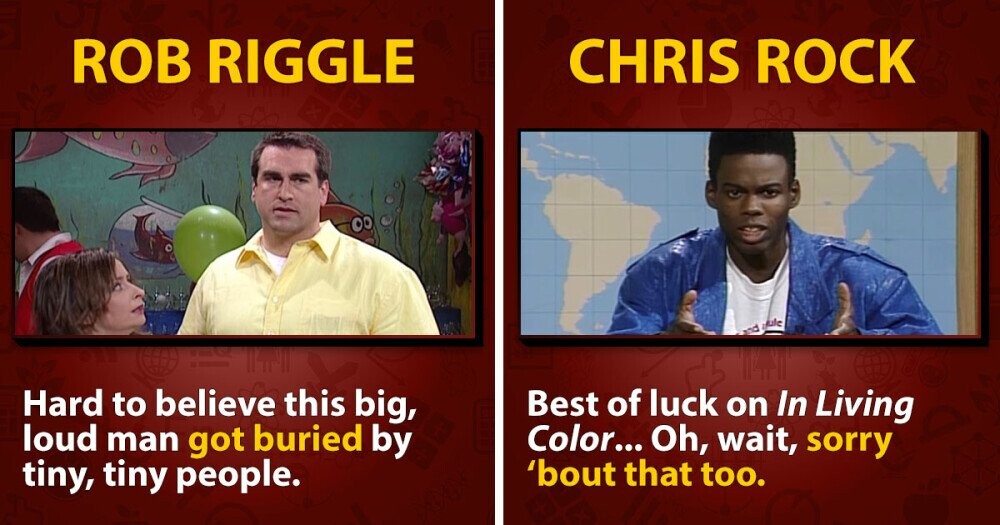
5. Chris Rock: Fired After Looking Toward In Living Color
Chris Rock’s time at SNL was creatively complicated. He was a sharp stand-up with a distinctive point of view, but the show did not always know how to use him. Rock later discussed feeling uncomfortable with some of the stereotypical material offered to him and wanting to work in a space where his comedy did not need constant translation.
He became interested in joining In Living Color, a sketch show with a different cultural energy and a more diverse cast. That move reportedly helped bring his SNL run to an end. The timing was not ideal, since In Living Color did not last much longer, but Rock’s career did just fine. Actually, “fine” is an understatement.
He became one of the most influential stand-up comedians of his generation, hosted SNL multiple times, won major awards, and built a career that turned his early frustration into artistic fuel.
6. Robert Downey Jr.: The Wrong Forum for the Future Iron Man
Robert Downey Jr. joined SNL in the 1985-1986 season, one of the show’s most famously chaotic years. He was only 20 years old, already talented, and absolutely not the polished sketch performer people might have expected from a future global superstar.
Downey later said the experience taught him what he was not. He realized he was not a catchphrase guy, not an impressions guy, and not naturally suited to the rapid-fire demands of weekly sketch comedy. That is not a failure of talent. It is a mismatch of format.
After one season, he was among several cast members replaced as the show retooled. Decades later, he became Iron Man, won an Oscar, and transformed into one of Hollywood’s most celebrated actors. SNL may not have known what to do with him, but the movies certainly figured it out.
7. Joan Cusack: Miserable in the 1985-1986 Season
Joan Cusack was also part of that difficult 1985-1986 cast. Like Downey, she entered a season packed with talent but lacking chemistry. SNL depends on fit, rhythm, and a strange kind of weekly survival instinct. Even excellent performers can disappear if the machine does not know where to place them.
Cusack later described the experience as miserable and admitted the show was not working for her either. That honesty matters. Not every firing is a villain story. Sometimes the job is simply wrong for the performer, the performer is wrong for the job, and everyone is relieved when the elevator doors finally open.
After SNL, Cusack built an acclaimed film and television career, earning Oscar nominations and becoming one of the most reliable scene-stealers in American comedy.
8. Julia Louis-Dreyfus: A Brutal Early Lesson
Julia Louis-Dreyfus joined SNL in the early 1980s and later spoke candidly about how difficult that era was for her. She described the environment as brutal and sexist, saying the experience taught her to prioritize whether future jobs were actually fun and fulfilling.
Her SNL run ended before the world saw what she would become. And what she became was one of the greatest sitcom performers in television history. Seinfeld, The New Adventures of Old Christine, and Veep turned her into an Emmy powerhouse.
Her story is a perfect reminder that SNL is not the final test of comedic greatness. Sometimes the performer is brilliant, but the room is not ready for her brilliance yet.
9. Jay Pharoah: Underused and Put in a Box
Jay Pharoah spent six seasons on SNL and became known for sharp impressions, especially Barack Obama. But after his contract was not renewed in 2016, he spoke openly about feeling underused. He said the show put people into boxes and expected them to stay there.
Pharoah’s frustration was not simply about airtime. It was about creative range. He felt he had more to offer than impressions, and other cast members reportedly noticed that he was not being used to his full ability. He also discussed speaking up about diversity behind the scenes.
His exit showed how even a technically gifted performer can struggle in a system that prefers clear labels. Pharoah could do impressions, so the show often treated that as his lane. He wanted more lanes. Honestly, who can blame him? Comedy is not a parking garage.
10. Taran Killam: Not Renewed With One Year Left
Taran Killam’s 2016 departure surprised fans because he had become one of the show’s most versatile performers. He could do impressions, physical comedy, musical sketches, and straight-man roles. Then his contract was not renewed even though he reportedly had one year left.
Killam later said he was not given a clear reason. He speculated that outside projects, including directing a film, may have complicated scheduling. But publicly, the decision remained vague.
That ambiguity is common in SNL exits. The show rarely gives a dramatic explanation. It simply changes shape, and the performer has to make sense of it afterward. Killam continued acting, directing, and writing, proving that leaving SNL does not mean leaving comedy.
11. Michaela Watkins: Told She Should Have Her Own Show
Michaela Watkins lasted one season, but many viewers still remember her as someone who seemed ready to break through. She later said the explanation she received from Lorne Michaels was that he felt she should have her own show. That is either a compliment, a firing, or the most confusing motivational poster ever.
Watkins handled the exit with grace, saying SNL had been a dream and that she had no regrets. Still, being told you are talented but not right for the ensemble has to sting. It is like being told your cake is delicious but does not belong at this birthday party.
She went on to build a strong career in television and film, appearing in projects such as Casual, Search Party, The Unicorn, and Abbott Elementary. Her post-SNL work proved that “not right for this show” is not the same as “not right for the business.”
12. Jenny Slate: Not Fired for the F-Bomb
For years, people believed Jenny Slate was fired because she accidentally said an expletive during her first SNL episode. Slate later clarified that this was not the real reason. In her own assessment, she simply did not click with the show and did not feel she did a good job there.
That kind of honesty is rare and refreshing. It is also deeply human. Sometimes talented people walk into a dream job and discover that the dream has fluorescent lighting, no sleep, and a sketch about biker ladies that follows them for a decade.
Slate’s career after SNL became wonderfully distinctive. She co-created Marcel the Shell with Shoes On, appeared in Parks and Recreation, starred in Obvious Child, and became one of the most original comic voices of her generation.
13. Sarah Silverman: Fired After One Season
Sarah Silverman was hired as a writer and featured player in the early 1990s, then fired after one season. She later joked that she had not written a single funny sketch, which may be the most brutally efficient self-review in comedy history.
Her firing came during a transition period for the show, and Silverman has described the experience as painful but not necessarily personal. SNL did not define her voice. It may have clarified it.
After leaving, she became a major stand-up, actor, writer, and creator. Her comedy has always thrived on discomfort, honesty, and sharp turns. SNL’s structure may not have been the best home for that voice, but the larger comedy world certainly had room for it.
14. Chris Parnell: Fired Twice, Rehired Once
Chris Parnell has one of the strangest SNL firing records: he was fired, rehired, and later let go again. His first firing in 2001 shocked him. He later said he never fully knew why it happened, and that it hit hard because a performer’s identity can become wrapped up in being part of SNL.
Support from cast members and writers reportedly helped bring him back. Lorne Michaels eventually admitted he had made a mistake, and Parnell returned after a gap. He stayed until 2006, when budget cuts led to another departure.
Parnell’s calm, precise style made him a valuable ensemble player. After SNL, he became a familiar voice and face in 30 Rock, Archer, Rick and Morty, and many other projects. Getting fired twice sounds rough, but being beloved anyway is a pretty good punchline.
15. Horatio Sanz: Cut During 2006 Budget Reductions
Horatio Sanz was a long-running cast member, known for big energy, musical sketches, and frequently breaking with Jimmy Fallon. In 2006, SNL cut Sanz, Chris Parnell, and Finesse Mitchell as the show reduced its cast size because of budget pressures.
Unlike the fiery exits involving creative conflict or live-TV rebellion, Sanz’s departure was more about economics and restructuring. Lorne Michaels compared the cast to a garden that needed pruning, which is a poetic way to describe people losing jobs on national television.
Sanz had spent eight years on the show, which is longer than many performers ever get. His firing shows that even established cast members are not immune when the show decides it needs to shrink.
What These SNL Firing Stories Reveal About Comedy Careers
The biggest lesson from these fired SNL cast members is that SNL is not a universal measurement of talent. It is a very specific machine. It rewards speed, collaboration, impressions, character work, political timing, live performance instincts, and the ability to survive on the kind of sleep schedule that would make a raccoon file a labor complaint.
That means a performer can be brilliant and still not fit. Robert Downey Jr. was not built for weekly sketch comedy, but he was built for film. Jenny Slate did not click at SNL, but she became a singular writer, actor, and voice performer. Sarah Silverman did not thrive in the SNL writers’ room, but she became one of the most recognizable stand-ups in America. Julia Louis-Dreyfus had a miserable early experience, then became a sitcom legend.
Another lesson: firings often reflect timing as much as talent. Sandler and Farley were casualties of a major cast reset. Parnell, Sanz, and Mitchell were affected by budget cuts. Killam and Pharoah left during another reshaping of the show’s future. When SNL changes direction, someone gets left standing outside 30 Rock wondering whether they should laugh, cry, or call their agent.
Extra Perspective: The Experience of Being Fired From a Dream Job
There is a reason these stories continue to fascinate people. Being fired from SNL is not like being let go from a normal office job. Most people do not get dismissed from work and then have strangers debate the decision for 30 years. SNL is public, emotional, and mythic. It turns a career setback into a pop-culture chapter.
For performers, the experience can be identity-shaking. Many comedians spend years dreaming of SNL. They study the sketches, memorize the cast histories, audition with characters they have polished for years, and imagine hearing their name in the opening credits. Then they arrive and discover that getting hired was only the first impossible thing. The second impossible thing is getting on the air.
The weekly process is famously intense. A cast member may pitch ideas on Monday, write all night on Tuesday, read sketches on Wednesday, rehearse Thursday, rewrite Friday, perform dress rehearsal Saturday, and still watch their best work get cut before airtime. Even talented people can feel invisible. If a performer does not quickly establish a recurring character, a killer impression, or a relationship with the right writers, the season can slip away fast.
That is why many SNL firings feel less like simple judgments and more like complicated weather events. A performer might be funny, but the cast may be too crowded. A writer might love them, but the host may not. A sketch might crush at the table but die at dress. A new producer priority, election cycle, budget concern, or network note can change someone’s future. Comedy may look spontaneous on Saturday night, but behind the scenes it is a delicate ecosystem with fluorescent lighting and cold pizza.
The emotional impact can also be strange because SNL is both a workplace and a symbol. When someone is fired from it, they are not only losing a job; they are losing a childhood fantasy, a creative home, and a public badge of approval. Chris Parnell described how deeply a person’s sense of worth can become tied to being an SNL cast member. That honesty applies far beyond comedy. Many people understand the pain of realizing that a dream job has become the source of anxiety, confusion, or self-doubt.
But the hopeful part is obvious: almost every performer on this list found another path. Some became bigger than they ever were on SNL. Some created shows better suited to their voice. Some found freedom in stand-up, film, voice acting, sitcoms, or writing. Their stories show that rejection from one room can push a person toward the room where they actually belong.
In that sense, SNL firings are not just gossip. They are creative case studies. They remind writers, actors, comedians, and anyone chasing a difficult career that being misunderstood by one institution does not mean you are untalented. It may mean your best work needs a different format, a different team, or a different stage. Sometimes the door closing at Studio 8H is not the end of the joke. It is the setup.
Conclusion
The stories of these Saturday Night Live cast members fired, dropped, or not renewed reveal the strange reality of show business: talent gets you in the room, but timing, chemistry, politics, stamina, and luck decide how long you stay. SNL has launched countless stars, but it has also let go of people who later became some of the most successful performers in entertainment.
Adam Sandler, Chris Farley, Robert Downey Jr., Julia Louis-Dreyfus, Sarah Silverman, Jenny Slate, Chris Rock, and others prove that a firing can be painful without being final. In comedy, the flop is often just part of the rhythm. The sketch gets cut, the contract ends, the phone call hurts, and then the next stage appears.
So if there is a grand lesson in these SNL firing stories, it is this: losing one dream job does not mean losing the dream. Sometimes it means the dream needed better writers.