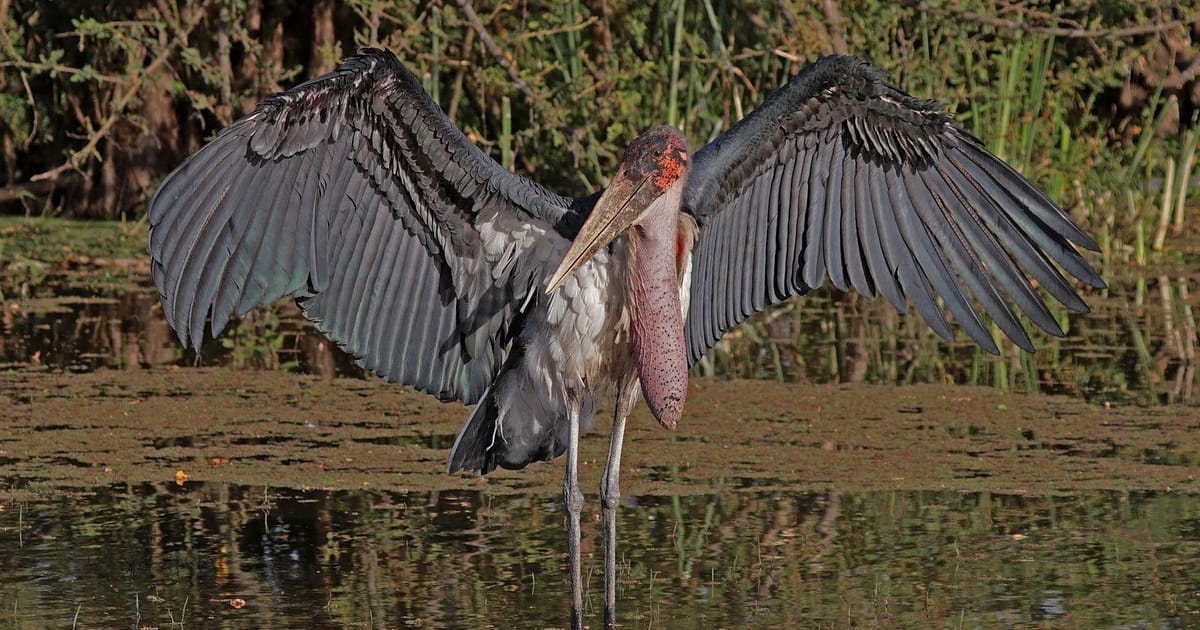
The marabou stork is not the bird most people would choose for a greeting card. It does not have the delicate charm of a hummingbird, the glossy glamour of a peacock, or the cozy reputation of the storybook stork delivering babies. Instead, the marabou stork looks like it walked out of an ancient wildlife documentary, paused dramatically in a dust cloud, and said, “Yes, I clean up the savanna. Somebody has to.”
Native to sub-Saharan Africa, the marabou stork is one of the largest and most unforgettable birds on Earth. With its long legs, huge bill, bare head, dark wings, white underside, and famous throat pouch, it is both strange and strangely impressive. This bird is a scavenger, a hunter, a soaring giant, a colonial nester, and an important member of its ecosystem. It may not win a beauty contest judged by parrots, but in the wild, usefulness beats prettiness every time.
Below are 10 fascinating facts about marabou storks that reveal why this unusual bird deserves far more respect than its gloomy nickname suggests.
1. Marabou Storks Are Among the Largest Flying Birds
The marabou stork is a giant in the stork family. Adults can stand around five feet tall and weigh close to 20 pounds. Their wingspan is even more impressive, often reaching seven to nine feet, with some sources reporting larger individuals. When a marabou stork opens its wings, it does not simply “take off.” It unfolds like a living aircraft with feathers.
This size gives the bird a commanding presence on the ground and in the air. In flight, marabou storks use broad wings to soar on warm air currents. Instead of flapping constantly like a small backyard bird in a hurry, they glide with patience and efficiency. It is the avian version of using cruise control.
Why Their Size Matters
A large body helps marabou storks compete at feeding sites with other scavengers, including vultures. Their big bill and long reach allow them to grab food quickly, while their height gives them a better view across open habitats such as savannas, riverbanks, and grasslands.
2. They Are Nicknamed the “Undertaker Bird”
The marabou stork is often called the “undertaker bird,” and once you see one from behind, the nickname makes sense. Its dark wings look a bit like a long black coat, its thin pale legs appear almost formal, and the white feathers around the neck can resemble a slightly chaotic collar. Add the bird’s habit of visiting carcasses, and the name practically writes itself.
But this nickname is more theatrical than fair. The marabou stork is not gloomy; it is practical. As a scavenger, it performs a service that keeps ecosystems cleaner. By feeding on carrion and animal scraps, marabou storks help remove organic waste that could otherwise attract disease and pests.
A Bird With a Job Nobody Else Wants
In nature, cleanup crews are essential. Marabou storks may not look cuddly, but they are part of the system that keeps the savanna running. Think of them as wildlife sanitation workers with wings and no interest in office politics.
3. Their Bare Head Is a Brilliant Adaptation
A featherless head may not sound glamorous, but for a scavenging bird, it is extremely useful. Marabou storks often feed on carrion, and a bare head and neck are easier to keep clean than feathers. Vultures have a similar adaptation for the same reason.
This is a good reminder that animal features do not exist to please human fashion sense. The marabou stork’s appearance is shaped by survival. Every odd-looking detail has a purpose, even if that purpose makes the bird look like it woke up after sleeping in a wind tunnel.
Function Over Fluff
Feathers are wonderful for insulation and flight, but they can become messy during scavenging. A bare head reduces that problem. In the wild, cleanliness is not about looking polished for a photo shoot; it is about avoiding bacteria, parasites, and unnecessary trouble.
4. The Famous Throat Pouch Is Used for Display
One of the marabou stork’s most recognizable features is the large, fleshy throat pouch known as a gular sac. This pouch hangs from the neck and can become especially noticeable during social and breeding behavior. It may look like the bird is carrying a deflated balloon, but it plays a real role in communication.
During displays, marabou storks can inflate or emphasize the pouch, using it as part of their body language. The scientific name, Leptoptilos crumenifer, is often associated with the idea of carrying a pouch or purse. Nature apparently gave this bird a built-in accessory and decided subtlety was unnecessary.
More Than Just a Strange Decoration
The gular sac helps marabou storks communicate visual signals. In a colonial nesting environment where many large birds gather together, bold signals matter. When everyone is tall, hungry, and slightly cranky-looking, a dramatic throat pouch can help make a point.
5. Marabou Storks Eat an Extremely Varied Diet
Marabou storks are opportunistic feeders, which means their menu is flexible. Their diet can include carrion, fish, insects, frogs, lizards, snakes, rodents, small birds, eggs, and scraps near human settlements. They are not picky eaters. If a restaurant had a marabou stork menu, it would simply say: “Whatever is available.”
This flexibility helps them survive in changing environments. In natural habitats, they may visit drying pools where fish are concentrated. Around large predators, they may feed near kills. Near people, they may gather at rubbish piles, stockyards, and fishing areas.
Helpful but Vulnerable Around Human Waste
Their ability to use human-altered environments can be an advantage, but it also brings risks. Landfills and garbage sites may provide food, yet they can expose birds to plastic, metal, toxins, and unhealthy scraps. A bird that can swallow almost anything is impressive, but “almost anything” is not always safe.
6. They Help Reduce Disease by Cleaning Up Carcasses
The marabou stork’s scavenging role is one of its most important ecological contributions. By feeding on dead animals and organic waste, it helps remove material that could otherwise spread bacteria or attract pests. It is not the prettiest job in the animal kingdom, but it is one of the most necessary.
Many people overlook scavengers because their behavior can seem unpleasant. However, ecosystems need recyclers. Vultures, hyenas, beetles, bacteria, and marabou storks all help break down and remove remains. Without scavengers, landscapes would become much messier and less healthy.
The Unsung Cleanup Crew
A marabou stork standing near a carcass may not look heroic in the usual sense, but ecology has a different definition of heroism. Sometimes saving the day means preventing yesterday’s leftovers from becoming tomorrow’s public health problem.
7. They Use an Unusual Cooling Trick
Marabou storks live in hot environments, so staying cool matters. One unusual behavior involves depositing urates on their legs. As the moisture evaporates, it helps cool blood vessels near the skin. To humans, this may sound like a terrible spa treatment, but in bird biology, it is clever temperature control.
This behavior can make their legs appear pale or whitish. It is not dirt in the ordinary sense; it is part of a cooling strategy. Birds have developed many remarkable methods for managing heat, and marabou storks are no exception.
Nature’s Air Conditioning Is Not Always Pretty
Animals do not need their adaptations to look elegant. They need them to work. For marabou storks, evaporative cooling through the legs is a useful way to handle high temperatures while standing in open habitats under the African sun.
8. Marabou Storks Are Social Nesters
Marabou storks often breed in colonies, sometimes sharing nesting areas with other large waterbirds. They usually build stick nests in trees, and breeding often lines up with food availability. In parts of Africa, dry-season breeding can be useful because shrinking water sources concentrate fish and other food.
Their nests are practical structures rather than luxury apartments. Still, for a large bird, a sturdy platform of sticks does the job. Chicks remain dependent on their parents for weeks, growing slowly into the oversized bill and long-legged shape that makes adult marabou storks so recognizable.
Family Life in a Crowded Neighborhood
A nesting colony can be noisy, busy, and competitive. Marabou storks may use bill clattering, body postures, and gular sac displays to communicate. It is not exactly a peaceful suburban cul-de-sac, but for the birds, it is home.
9. They Can Thrive Near People, but That Comes With Problems
Marabou storks are often seen near human settlements, especially where food waste is easy to find. In some African cities and towns, they gather around dumps, markets, fishing areas, and slaughter sites. Their intelligence and adaptability allow them to take advantage of human activity.
However, dependence on human garbage can create serious problems. Birds may eat harmful materials, become more aggressive around food, or face injury from vehicles, wires, and pollution. Human environments can offer easy meals, but easy meals sometimes come with hidden costs.
A Wild Bird in a Human World
The marabou stork’s urban presence shows how wildlife adapts to changing landscapes. It also reminds us that waste management affects animals. Cleaner cities and safer disposal practices help both people and wildlife, which is a rare situation where everyone wins.
10. Their Conservation Story Is More Complicated Than It Looks
Globally, marabou storks are often listed as a species of Least Concern, meaning they are not currently considered at high risk of extinction worldwide. Their broad range across sub-Saharan Africa and their ability to use many habitats help explain this status.
But the full picture is more complex. In some regions, especially parts of West Africa, researchers have raised concerns about population declines, loss of nesting colonies, and shrinking regional range. A species can be common in one area and struggling in another. Conservation is rarely a simple headline.
Why Local Populations Matter
Protecting marabou storks means paying attention not only to global status but also to regional changes. Habitat loss, poisoning, pollution, hunting, and disturbance at nesting sites can all affect local populations. A bird that seems tough still depends on healthy ecosystems.
What Makes the Marabou Stork So Fascinating?
The marabou stork is fascinating because it challenges our idea of what a “beautiful” animal should be. It is not delicate, colorful, or conventionally charming. Yet it is powerful, useful, intelligent, and perfectly adapted to its role. It soars like a glider, feeds like a survivor, nests like a social strategist, and cleans up landscapes with the dedication of a bird that knows the world does not run on cuteness alone.
In many ways, the marabou stork is a lesson in ecological honesty. Nature is not always polished. Sometimes it is awkward, wrinkled, practical, and slightly alarming. But it is also balanced. Every creature has a job, and the marabou stork performs one of the most valuable jobs in the wild.
Experience-Based Reflections: Observing Marabou Storks in the Real World
Seeing a marabou stork in a photo is interesting. Seeing one in person, whether at a zoo, wildlife center, wetland, or African lakeshore, is a completely different experience. The first thing most people notice is scale. A marabou stork is not a small bird that politely fits into the background. It stands there like a feathered monument with a bill large enough to make you reconsider your position in the food chain.
Visitors often describe the bird as prehistoric, and that reaction makes sense. The long legs, bare head, hunched posture, and heavy bill create an impression of something ancient. It looks less like a modern bird and more like a creature that remembers when mammals were still trying to organize themselves. Yet after the first surprise fades, the marabou stork becomes strangely graceful. When it walks, each step is slow and deliberate. When it spreads its wings, the awkward-looking ground bird suddenly becomes an elegant glider.
In a zoo setting, watching a marabou stork can be surprisingly educational. It may stand quietly for long periods, then suddenly shift posture, stretch its wings, clatter its bill, or interact with another bird. The gular sac, which seems odd at first glance, becomes easier to understand when you see it as part of the bird’s communication system. It is not random weirdness; it is visual language.
In wild habitats, the experience can be even more memorable. Imagine standing near a lake in East Africa and seeing several marabou storks gathered along the shore. Some may be waiting near fishermen, others may be pacing through shallow water, and a few may be soaring high above on thermals. Their presence changes the mood of a landscape. They are not background decoration. They are participants in the daily business of survival.
What makes the marabou stork especially interesting for travelers, birdwatchers, and wildlife photographers is the contrast between appearance and movement. On the ground, it can look stern, rumpled, and almost comic. In flight, it becomes majestic. The same bird that looked like an annoyed old professor five minutes ago can rise into the sky with the calm confidence of a master pilot.
Observing marabou storks also encourages a deeper appreciation for scavengers. Many people arrive with the idea that scavenging is unpleasant or somehow lesser than hunting. But after watching these birds work within their environment, that view changes. Scavengers are not lazy. They are efficient. They read the landscape, follow opportunities, compete with other animals, and help recycle nutrients. The marabou stork’s lifestyle is not glamorous, but it is essential.
For writers, educators, and nature lovers, the marabou stork is a perfect example of why wildlife deserves careful attention. A quick glance might produce a joke about its looks. A longer look reveals adaptation, ecological value, social behavior, and survival intelligence. That is the reward of paying attention to nature: the strange becomes meaningful, and the “ugly” becomes extraordinary.
The next time someone calls the marabou stork unattractive, it may be worth smiling and saying, “Maybe. But can you soar for hours, clean an ecosystem, cool your legs with built-in biology, and carry a throat pouch like a formal accessory?” Probably not. The marabou stork may never become the mascot of elegance, but it absolutely deserves a place among the most fascinating birds in the world.
Conclusion
Marabou storks prove that nature has a sense of humor and a serious plan at the same time. They are huge, strange-looking, highly adaptable birds with an important ecological role. Their bare heads, massive bills, long legs, gular sacs, and scavenging habits may seem odd, but each feature helps them survive in demanding environments.
From cleaning up carcasses to soaring across African skies, the marabou stork is far more than an unusual face. It is a living reminder that every ecosystem needs workers behind the scenes. Some animals dazzle with color. Others sing beautifully. The marabou stork shows up, handles the messy work, and keeps the wild world moving.