Note: This article is prepared in clean HTML for web publishing. Source-link markers, citation tags, and unnecessary publishing artifacts have been intentionally left out of the article body.
Francisco Goya’s mysterious Dark Paintings are the kind of artworks that make a museum room feel slightly colder. One moment you are admiring Spanish art history like a civilized person; the next, you are staring at Saturn Devouring His Son and wondering whether you should have brought a flashlight, a therapist, or both.
Known more formally as Goya’s Black Paintings, these haunting works were created near the end of the artist’s life, around 1819 to 1823, inside his country house outside Madrid. They are not cheerful wall décor. There are no charming fruit bowls, no smiling aristocrats, and absolutely no “Live, Laugh, Love” energy. Instead, Goya painted witches, old age, violence, fear, isolation, madness, superstition, and mythological horror directly onto the walls of his home.
What makes the Black Paintings so fascinating is not simply that they are dark. Plenty of artists have painted spooky things. Goya’s genius was that he made darkness feel intelligent. These works seem to ask questions rather than provide answers: What happens when reason collapses? What does war do to the human spirit? Why do people gather in crowds to believe terrifying things? And why, exactly, is Saturn eating like he missed breakfast?
Below are 10 facts about Francisco Goya’s mysterious Dark Paintings, including their strange origins, unsettling symbolism, and lasting impact on modern art.
1. The Dark Paintings Were Originally Private Wall Paintings
The Black Paintings were not created for a church, palace, royal patron, or public exhibition. Goya painted them inside his own home, the Quinta del Sordo, a country house near Madrid. This fact changes everything. These were not polished works designed to impress wealthy collectors over wine and awkward compliments. They were private images, made in the rooms where Goya lived.
That private setting gives the series its disturbing intimacy. When we look at the Black Paintings today in the Prado Museum, we see them as masterpieces. But originally, they were part of Goya’s domestic environment. Imagine inviting guests over for dinner and casually seating them near Saturn Devouring His Son. The conversation might begin with soup and end with everyone reconsidering existence.
The paintings covered walls in two rooms of the house. Because they were made for a specific architectural space, their original placement mattered. Some works were positioned on the ground floor, while others were upstairs. This means the paintings once surrounded viewers physically, not just visually. Goya did not merely paint darkness; he built an atmosphere out of it.
2. The House’s Name Was a Strange Coincidence
The name Quinta del Sordo means “House of the Deaf Man.” At first, this sounds like an obvious reference to Goya, who became deaf after a serious illness in the 1790s. But the house already had that name before he bought it. The previous owner was also reportedly deaf, making the title a historical coincidence with almost too much gothic flavor.
Goya’s deafness, however, remains important to understanding the mood of his later art. After losing his hearing, he became increasingly inward-looking, more critical, and more psychologically daring. His prints, drawings, and paintings grew sharper in their attacks on superstition, cruelty, corruption, and social hypocrisy.
Still, it would be too simple to say, “Goya was deaf, therefore he painted nightmares.” That reduces a brilliant artist to a medical condition. The Black Paintings reflect many forces at once: personal illness, old age, political disappointment, the trauma of war, religious tension, and an imagination that had no interest in behaving politely.
3. There Are 14 Black Paintings
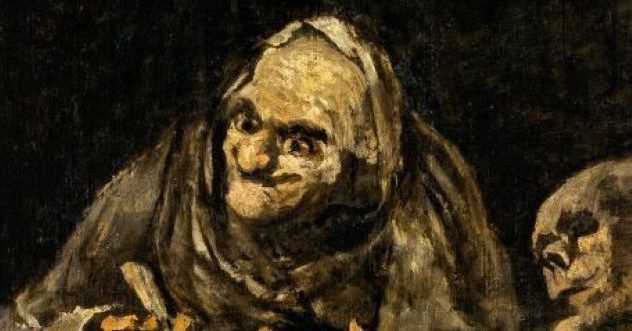
The Black Paintings are usually counted as a group of 14 works. Some of the best-known titles include Saturn Devouring His Son, The Dog, Witches’ Sabbath, Fight with Cudgels, Judith and Holofernes, Two Old Men Eating Soup, A Pilgrimage to San Isidro, Atropos, and Leocadia.
The series is not unified by a single storyline. There is no neat beginning, middle, and end. Instead, the paintings feel like fragments from a feverish moral universe. Some are mythological. Some seem political. Some look like nightmares. Some feel like memories curdled into symbols.
The number 14 also reminds us that the Black Paintings are not just a single shocking image. Saturn gets the most attention because, frankly, it is hard to compete with a wild-eyed god chewing on a body. But the quieter works are just as powerful. The Dog, for example, is almost empty compared with Saturn, yet it may be even more devastating.
4. Goya Painted Them After War, Illness, and Political Disillusionment
To understand Francisco Goya’s Dark Paintings, it helps to remember the world he had survived. Goya lived through the Peninsular War, Napoleon’s invasion of Spain, famine, executions, political repression, and the unstable rule of Ferdinand VII. He had seen enough human cruelty to know that monsters did not need horns. Sometimes they wore uniforms, crowns, or respectable shoes.
Before the Black Paintings, Goya had already created The Disasters of War, a print series that exposed the brutality of conflict without heroic decoration. He also painted The Third of May 1808, one of the most powerful anti-war images in Western art. By the time he worked on the walls of Quinta del Sordo, he had spent decades observing how quickly civilization can remove its nice jacket and reveal blood on its shirt cuffs.
The Black Paintings are often described as pessimistic, and that is fair. But they are not lazy pessimism. They are not “everything is terrible” in paint form. They are more like an autopsy of fear: precise, unsentimental, and uncomfortable because it keeps finding recognizable human organs.
5. Saturn Is the Most Famousand Most MisunderstoodPainting in the Series
Saturn Devouring His Son is the celebrity of the Black Paintings, although “celebrity” feels strange for an image that looks like a mythological crime scene. The painting shows the Titan Saturn consuming one of his children, a reference to the ancient story in which Saturn fears being overthrown by his offspring.
What makes Goya’s version unforgettable is its psychological intensity. Saturn is not a calm mythological figure performing a symbolic act. He looks terrified, frantic, and almost animal-like. His eyes are wide. His body is tense. The darkness presses around him like a cave made of panic.
Art historians have read the painting in many ways. It may represent time destroying life, tyranny devouring its subjects, old age attacking youth, or political power feeding on the innocent. The beauty of the imageif “beauty” is the right word for nightmare cannibalismis that it refuses to settle down into one meaning.
It is also important to note that Goya did not write a handy little label explaining, “Dear future viewers, here is exactly what I meant.” The painting’s mystery is part of its force. It stares back like it knows something, but it is not telling.
6. The Dog May Be the Quietest Horror in Western Art
If Saturn is the scream, The Dog is the silence afterward. The painting shows a small dog’s head peering upward from behind a vast slope of brownish space. That is almost all. No dramatic battle. No witches. No blood. Just a small living creature nearly swallowed by emptiness.
Modern viewers often find The Dog surprisingly contemporary. Its spare composition, emotional ambiguity, and large empty field feel closer to modern abstraction than to traditional 19th-century narrative painting. The dog may be drowning, trapped, waiting, hoping, or simply looking. The painting does not say.
That uncertainty is exactly why it works. Goya gives us just enough information to become emotionally involved, then removes the comfort of explanation. The result is a painting that feels lonely in a way words struggle to capture. It is not loud, but it follows you out of the room.
7. Goya Probably Did Not Give the Paintings Their Current Titles
One of the most interesting facts about Goya’s Black Paintings is that the familiar titles were likely assigned after his lifetime. This matters because titles shape interpretation. When a painting is called Witches’ Sabbath, viewers look for witchcraft. When it is called Fight with Cudgels, viewers focus on violence and conflict. When it is called The Dog, the small animal becomes the emotional center.
But Goya left no full explanation of the series. The titles we use today come from later inventories, scholars, and curators. That means every title is useful, but also slightly suspicious. The paintings are not simple illustrations of official captions; they are visual puzzles with later names attached.
This is one reason the Dark Paintings remain mysterious. We are not only unsure what Goya intended. We are also working through layers of later interpretation, restoration history, and changing cultural attitudes. The paintings are not locked boxes with missing keys. They are rooms with too many doors.
8. The Transfer from Wall to Canvas Changed Their Physical Life
In the 1870s, decades after Goya’s death, the Black Paintings were removed from the walls of Quinta del Sordo and transferred to canvas. This process saved them from disappearing with the house, but it also altered them. Wall paintings are fragile, and transferring them is never as simple as peeling a sticker from a laptop.
The operation was carried out under the direction of restorer Salvador Martínez Cubells. Later, the works entered the Prado Museum, where they are now among the museum’s most famous treasures. Their survival is a gift, but it came with complications. The surfaces, colors, and details we see today may not perfectly match what Goya painted on the walls.
This adds another layer to their mystery. We are looking at Goya, but also at preservation, loss, restoration, and time. The paintings have survived like ancient witnesses who have been through too much and no longer speak in complete sentences.
9. The Black Paintings Turn Myth, Folklore, and Daily Life into Psychological Drama
Goya’s Dark Paintings draw from many sources: mythology, Spanish folklore, religious imagery, political anxiety, and ordinary human behavior. Yet he transforms all of them into psychological drama. A pilgrimage becomes unsettling. A group of people reading becomes secretive. A mythological god becomes a portrait of panic. Old men eating soup become almost skeletal emblems of decay.
Take Witches’ Sabbath. On one level, it appears to show a supernatural gathering around a goat-like figure. But the painting also works as a study of crowd psychology. The faces are distorted, absorbed, and dependent on the central figure. It is about belief, fear, manipulation, and the strange comfort people sometimes find in terrifying systems.
Or consider Fight with Cudgels, in which two men appear locked in combat. The image is often interpreted as a symbol of civil conflict, with the fighters unable or unwilling to escape their destructive struggle. It is not just two men hitting each other. It is society punching itself in the face and refusing to stop.
10. The Dark Paintings Helped Point Art Toward Modernism
Goya is often described as a bridge between the Old Masters and modern art. The Black Paintings are a major reason why. Their loose brushwork, psychological intensity, distorted figures, political unease, and rejection of ideal beauty all feel startlingly modern.
These works do not flatter the viewer. They do not decorate power. They do not pretend that human beings are always noble, rational, or attractive under good lighting. Instead, they show anxiety, absurdity, violence, and inner life with a freedom that later artists would recognize as revolutionary.
Expressionism, Symbolism, Surrealism, and modern psychological painting all seem to find an ancestor in Goya. Artists such as Picasso and Dalí admired his darkness, his courage, and his ability to turn horror into form. The Black Paintings matter because they do not simply belong to the past. They still feel like they are waiting for us in the future.
Why Francisco Goya’s Dark Paintings Still Feel So Alive
The continued power of Francisco Goya’s mysterious Dark Paintings comes from their refusal to behave like historical objects. Yes, they belong to early 19th-century Spain. Yes, they were shaped by Goya’s age, illness, politics, and private circumstances. But they do not feel trapped in their century.
Modern viewers recognize their themes instantly. Fear of political violence? Still relevant. Distrust of crowds whipped into irrational belief? Painfully familiar. Anxiety about aging, death, and the body? Nobody needed Wi-Fi to invent that problem. The Black Paintings speak to human fears that have not retired.
They also challenge the common idea that great art must be pleasing. The Black Paintings are not “pretty” in the usual sense. They are rough, shadowy, and often grotesque. But they are visually magnetic. Goya understood that beauty can be unsettling, and that truth often arrives wearing terrible clothes.
That is why the Black Paintings remain essential. They are not famous because they are shocking. They are famous because their shock has depth. They do not merely frighten us; they make us think about why we are frightened.
Experience Section: How to Spend Time with Goya’s Dark Paintings
Experiencing Goya’s Black Paintings is different from simply looking at them. These works ask for patience. A quick glance will tell you they are dark and strange, but the real force arrives slowly. The best approach is to treat them less like illustrations and more like psychological weather.
Start with the room as a whole. Before focusing on individual paintings, notice the mood they create together. The palette is heavy with blacks, browns, grays, and dull yellows. Light feels scarce. Bodies seem unstable. Faces blur between human, animal, and mask. This overall atmosphere is important because Goya originally painted the works in his own living space. They were not isolated images; they were an environment.
Next, move toward one painting and give it time. With Saturn Devouring His Son, do not look only at the violence. Look at Saturn’s eyes. The horror is not just what he does, but the terror inside him while he does it. He seems both predator and prisoner, a figure trapped by his own fear of losing power. That is what makes the painting more than a gruesome myth. It becomes a study of paranoia.
Then turn to The Dog. After Saturn’s brutality, this painting may feel almost empty. Stay with it anyway. The small head, the tilted gaze, and the huge surrounding space create an emotional situation without explaining it. Is the dog sinking? Searching? Waiting for rescue? The uncertainty becomes the subject. Many viewers discover that this quiet painting lingers longer than the louder ones.
It also helps to compare the Black Paintings with Goya’s earlier career. He once painted tapestry designs, portraits, fashionable figures, and courtly scenes. Knowing that background makes the late works more startling. This was not an artist who lacked technical polish and therefore painted darkness by accident. Goya could paint elegance when he wanted to. In the Black Paintings, he chose something rawer because rawness had become necessary.
Finally, resist the temptation to reduce the series to one explanation. The Black Paintings are not only about madness, not only about politics, not only about old age, and not only about death. They are about the human mind under pressure. They show what happens when history, fear, memory, and imagination crowd into the same room and refuse to leave.
For anyone writing, studying, or simply thinking about art, Goya’s Dark Paintings offer a valuable lesson: mystery is not the absence of meaning. Sometimes mystery is meaning that has not been flattened. Goya gives us images that remain alive because they keep changing as we change. A teenager may see horror. A historian may see politics. A painter may see daring technique. An older viewer may see mortality. A modern viewer may see society still fighting itself with cudgels.
That is the strange gift of these paintings. They are uncomfortable, but they are not empty. They stare into the dark and bring something back. It may not be comforting, but it is unforgettableand in art, unforgettable usually wins.
Conclusion
Francisco Goya’s mysterious Dark Paintings are among the most powerful works in the history of Western art because they combine private fear with public meaning. Created on the walls of his own home, these 14 haunting images were never simple decorations. They were visions of human cruelty, superstition, loneliness, violence, aging, and survival.
From the savage intensity of Saturn Devouring His Son to the quiet despair of The Dog, the Black Paintings show Goya at his most fearless. He did not soften the world to make it easier to look at. He painted the nightmare and trusted viewers to understand that nightmares often tell the truth.
Their mystery remains part of their greatness. We do not know exactly why Goya painted them, what he called them, or how he expected them to be seen. But perhaps that is why they still feel alive. They do not close the conversation. They open a dark door and dare us to step closer.