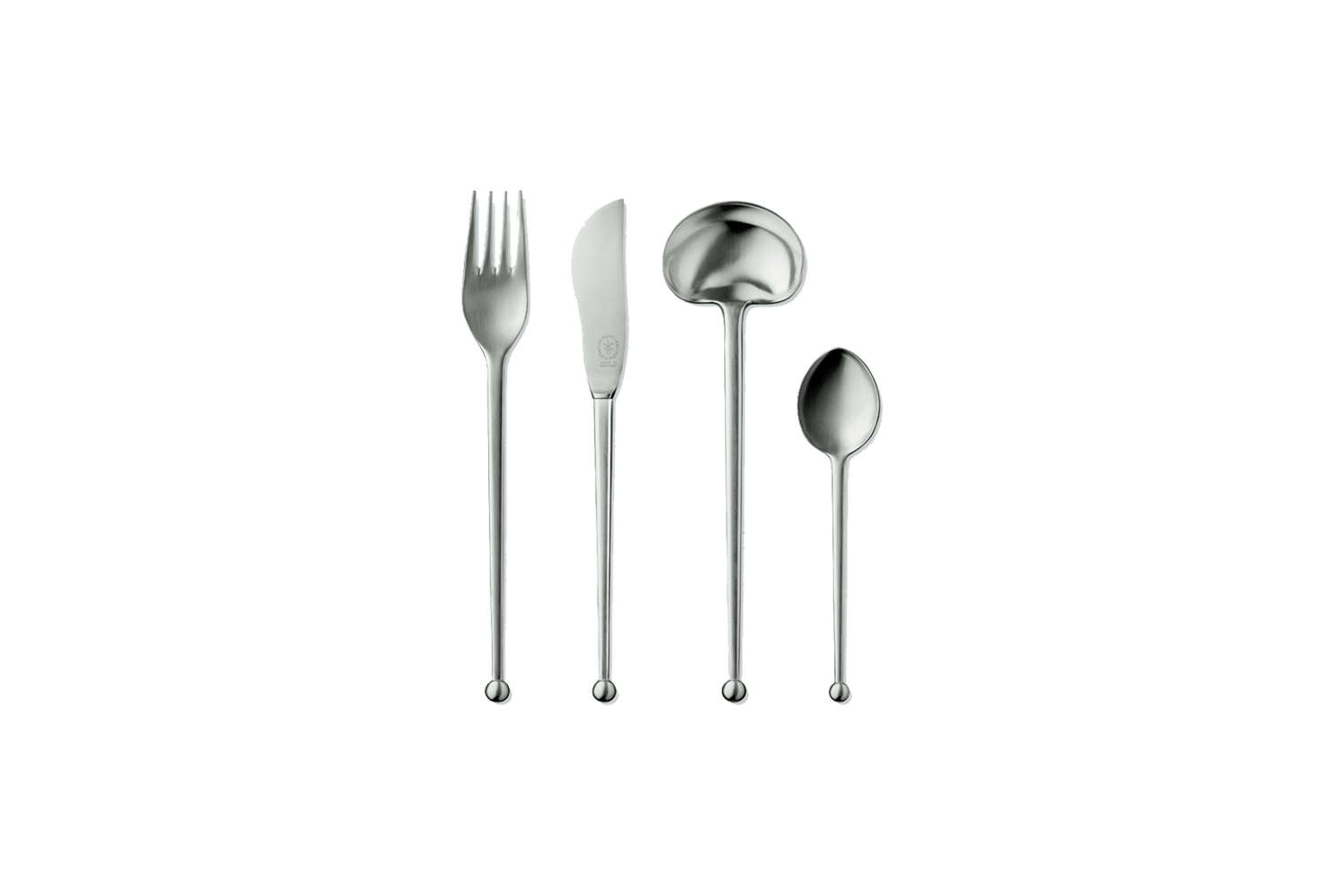
Sculptural flatware proves that the most interesting object on the dinner table does not have to be the centerpiece. Sometimes it is the fork quietly resembling a piece of modern art, the spoon with the weight of a miniature monument, or the knife that appears ready to slice dinner in a stylish science-fiction movie.
Remodelista’s editors have long treated cutlery as more than a collection of tools. Their selections draw from modernist architecture, traditional metalworking, experimental product design, and forms that look vaguely inspired by stones, branches, prehistoric implements, and objects found in a very sophisticated spaceship.
This guide revisits nine designs featured in Remodelista’s archived sculptural-flatware roundup and adds one complementary choice from the publication’s related editor-curated flatware coverage. Together, these ten selections show how designer silverware can be functional, expressive, and surprisingly capable of changing the mood of an entire meal.
Why Sculptural Flatware Deserves a Place at the Table
Most conventional flatware is designed to disappear. The shapes are familiar, the proportions are predictable, and nobody pauses halfway through soup to compliment the teaspoon. Sculptural flatware takes the opposite approach. It gives everyday utensils recognizable silhouettes, tactile surfaces, unexpected proportions, and enough personality to participate in the table setting.
The best examples are not merely unusual. A successful sculptural fork must still pick up food without requiring advanced engineering credentials. A spoon needs a comfortable bowl, and a knife must feel balanced rather than resembling a decorative letter opener. Great modern cutlery sits at the intersection of visual drama and ordinary usefulness.
What to Look for Before Buying
Begin with ergonomics. Consider the weight, handle thickness, balance point, tine length, spoon depth, and shape of the knife blade. Next, examine the material. Stainless steel is generally the easiest option for everyday dining, while sterling silver and hand-finished pieces demand more care but offer exceptional warmth and character.
Finally, think about compatibility. Dramatic designer flatware often looks best beside simple plates, plain linen, and unfussy glassware. When the utensils already resemble a sculpture garden, the dinnerware does not also need to arrive dressed for the Met Gala.
10 Best Sculptural Flatware Choices
1. Pott No. 86 by Josef Hoffmann
Pott No. 86 is the grand statement of the group. Designed by Austrian architect and designer Josef Hoffmann in 1955, the pattern combines slender stems, rounded ends, organic curves, and small knob-like details. The result is elegant but slightly eccentric, like formal silverware that has developed an interest in abstract sculpture.
The design is produced in sterling silver, which reinforces its ceremonial quality. Pott notes that the unusual form is so demanding that this particular pattern can only be manufactured in silver. That makes it less of a casual starter set and more of an heirloom purchase for collectors, design devotees, or anyone determined to make Tuesday-night pasta feel historically significant.
Best for: Collectors seeking investment-level modernist flatware.
2. David Mellor Minimal Cutlery
David Mellor’s Minimal collection demonstrates how quiet design can still have a powerful presence. Its thick, linear handles flow into gently shaped bowls and compact fork heads, creating a substantial silhouette without decorative flourishes. Every curve appears deliberate, and nothing seems to have been added merely because there was room.
The stainless steel construction makes Minimal more practical than many artistic utensils. Its generous weight also gives each piece a sense of permanence. This is flatware for people who admire minimalism but still want to feel as though they are holding something, not waving a shiny paper clip near their dinner. Heath Ceramics describes the range as a master metalworker’s design for modern living, an accurate summary of its restrained yet tactile appeal.
Best for: Minimalist kitchens and sophisticated everyday dining.
3. Cutt Flatware by Thomas Feichtner
Thomas Feichtner’s Cutt collection looks as though each utensil has been reduced to a continuous gesture. Handles bend, narrow, and transition into working ends with an experimental lightness. The forms feel hand-drawn rather than mechanically assembled, giving the set a lively quality despite the coolness of the metal.
The design was initially produced on a small scale by Wiener Silber Manufactur, a company whose craft heritage reaches back to the nineteenth century. Cutt is therefore an intriguing meeting of unconventional contemporary design and meticulous silverworking. It is polished, intelligent, and just peculiar enough to become the object guests pick up and examine before remembering that dinner is getting cold.
Best for: Design collectors who appreciate experimental European metalwork.
4. Field Forged Flatware by Farrah Sit
Farrah Sit’s Field Forged Flatware introduces the visible hand of the maker. Rather than hiding every mark beneath a flawless machine polish, the pieces celebrate hammering, subtle irregularity, and the small variations that distinguish crafted objects from mass-produced utensils.
The original Remodelista selection highlighted the collection’s hand-hammered solid-silver construction. That material and process give the pieces a jewelry-like presence, yet their elongated proportions keep them earthy rather than ornate. Imagine an archaeological tool redesigned by a contemporary New York artist, then invited to a beautifully lit dinner party. That is approximately the mood.
Best for: Handmade tablescapes, artisanal ceramics, and intimate gatherings.
5. Conca by Gio Ponti for Sambonet
Gio Ponti’s Conca flatware offers one of the most recognizable profiles in the roundup. The handles and working ends are intentionally offset, producing an asymmetrical shape that appears almost aerodynamic. Each utensil looks caught in motion, even while resting politely beside a plate.
Ponti designed Conca in 1955, and Sambonet continues to produce the collection in stainless steel and other finishes. The asymmetry may initially look theatrical, but the broad handles help keep the utensils visually and physically balanced. Conca is an excellent example of sculptural flatware that delivers drama without becoming a tabletop prank.
Best for: Italian-modern interiors and hosts who enjoy conversation-starting tableware.
6. AJ Cutlery by Arne Jacobsen for Georg Jensen
Arne Jacobsen’s AJ Cutlery may be the most famous futuristic flatware ever created. Launched in 1957, its narrow handles, flattened surfaces, and dramatically simplified profiles challenged traditional ideas about how knives, forks, and spoons should look.
The stainless steel design was sufficiently futuristic to appear in Stanley Kubrick’s 1968 film 2001: A Space Odyssey. More than half a century later, it still looks as though it belongs on a spacecraft where dinner is served by a calm computer with questionable intentions.
Despite its cinematic reputation, AJ Cutlery is not a novelty prop. Its organic lines resulted from Jacobsen’s attempt to remove unnecessary elements while retaining function. It works especially well with restrained Scandinavian dinnerware, monochromatic linens, and architectural glassware.
Best for: Midcentury-modern enthusiasts and committed science-fiction fans.
7. Famished Flatware by Tsé & Tsé
Famished Flatware from French design house Tsé & Tsé approaches stainless steel with a sense of play. The forms are slender and irregular, avoiding the stiff symmetry associated with conventional place settings. They look handmade, slightly stretched, and wonderfully unconcerned about standing in a perfectly straight line.
The collection’s polished surfaces keep the whimsical shapes from becoming rustic. That contrast makes Famished Flatware versatile: it can soften a highly modern table or add sparkle to handmade plates. Remodelista previously described the line as polished stainless steel, while Tsé & Tsé’s broader Famished tableware family remains known for irregular outlines and handcrafted character.
Best for: Eclectic homes and relaxed tables that avoid formal matching.
8. Merci for Serax Stone-Washed Flatware
This compact collection, designed by French concept store Merci for Serax, proves that sculptural flatware can also be casual and approachable. The assortment includes unconventional pieces such as a spork, a picking fork, and a broad, spatula-like knife. Rather than following the traditional five-piece place-setting formula, it treats dining as a flexible activity.
The stone-washed surface gives the metal a subdued, worn-in appearance that pairs well with pottery, wood, linen, and other tactile materials. Fingerprints are less visually dramatic than they would be on mirror-polished steel, which is excellent news for anyone who prefers eating dinner to polishing evidence from a tiny crime scene.
Best for: Casual entertaining, shared plates, and rustic-modern table settings.
9. Mono Zeug by Michael Schneider
The Remodelista archive refers to a Michael Schneider design as the Mono Tools Daily set. Mono’s current catalog identifies Schneider’s famously primitive-looking collection as Mono Zeug, introduced in 1995 for the German company’s centennial.
The pieces deliberately resemble prehistoric tools. Handles are thick, bowls are broad, and the fork has the blunt confidence of an object that expects dinner to put up a fight. Mono even describes it as “Neanderthal flatware,” although the manufacturing is anything but primitive: the company says its finished utensils can require roughly 30 production steps.
Mono Zeug is not visually timid, but its exaggerated shapes make sense in the hand. It is particularly appealing beside heavy stoneware, dark wood, and food served in generous portions. A delicate microgreen may feel nervous around it.
Best for: Bold contemporary dining rooms and fans of primitive-inspired design.
10. Citterio 98 by Antonio Citterio and Glen Oliver Löw
Because Remodelista’s archived sculptural-flatware feature promises ten designs but describes nine, Citterio 98 makes a fitting tenth selection from the publication’s related editor-curated flatware coverage. Designed in 1998 by architect Antonio Citterio and industrial designer Glen Oliver Löw for Iittala, it balances strong proportions with daily practicality.
The collection is made from stainless steel and distinguished by broad, subtly tapered handles. It feels substantial without becoming bulky, and its crisp surfaces coordinate easily with both modern porcelain and handmade ceramics. Unlike some artistic flatware, it does not demand that every meal become performance art. It is simply handsome, balanced, and confident.
Iittala calls Citterio 98 a modern classic, while the designer’s studio describes it as a union of Finnish manufacturing precision and Italian design sensibility. That combination makes it an ideal bridge between sculpture and utility.
Best for: Buyers seeking distinctive designer flatware for regular use.
Quick Comparison of the Sculptural Flatware Picks
| Collection | Design Character | Primary Material | Ideal Setting |
|---|---|---|---|
| Pott No. 86 | Organic, luxurious, historic | Sterling silver | Formal and collectible |
| David Mellor Minimal | Heavy, calm, minimalist | Stainless steel | Everyday modern dining |
| Cutt | Experimental and fluid | Silver | Design-focused occasions |
| Field Forged | Hand-hammered and artisanal | Solid silver | Craft-centered tables |
| Conca | Asymmetrical and dynamic | Stainless steel | Italian-modern interiors |
| AJ Cutlery | Futuristic and iconic | Stainless steel | Midcentury tables |
| Famished | Irregular and playful | Stainless steel | Eclectic dining |
| Merci for Serax | Compact and primitive | Stone-washed metal | Casual shared meals |
| Mono Zeug | Bold and prehistoric | Stainless steel | Statement tables |
| Citterio 98 | Architectural and balanced | Stainless steel | Daily designer tableware |
How to Choose the Right Designer Flatware
Match the Weight to Your Dining Habits
Heavy flatware can feel luxurious, but it is not automatically more comfortable. People with smaller hands may prefer a lighter set, while those who enjoy substantial utensils may appreciate the solidity of David Mellor Minimal, Citterio 98, or Mono Zeug. Before investing in a full service, purchase one place setting and use it for several meals.
Consider Replacement Pieces
Flatware has a mysterious habit of disappearing. Teaspoons leave home especially often, presumably to begin exciting lives behind office desks and inside takeout containers. Check whether individual pieces remain available before buying a large collection. Long-running stainless steel patterns are generally easier to expand than limited artisan editions.
Choose Finishes for Real Life
Mirror finishes look polished and formal but reveal fingerprints and water marks quickly. Matte and stone-washed finishes conceal minor evidence of daily use more successfully. Sterling silver develops tarnish and requires periodic polishing, although many collectors consider the changing patina part of its appeal.
Let the Flatware Be the Decoration
When using expressive modern cutlery, simplify the surrounding table. White plates, natural linen, clear glassware, and a restrained centerpiece allow unusual utensils to stand out. Pairing sculptural forks with elaborately patterned plates, metallic chargers, crystal tassels, and twelve napkin rings may cause the table to file a noise complaint.
What Living with Sculptural Flatware Is Actually Like
The most useful experience with sculptural flatware begins before the first dinner party. Set one place at the table and notice what happens when the utensils are aligned beside an ordinary plate. Conventional flatware behaves like punctuation. Sculptural flatware behaves more like a supporting character. It changes the proportions of the setting, draws attention to empty space, and can make inexpensive dinnerware look more intentional.
The next test is the hand. Pick up each piece naturally rather than holding it where the designer seems to suggest. A dramatic handle may look wonderful in a photograph yet place too much weight behind the palm. A shallow spoon can be elegant for dessert but frustrating for soup. An unusually wide fork can feel stable with roasted vegetables and clumsy with delicate noodles. These details rarely appear in product photos, but they determine whether the set becomes a daily favorite or expensive drawer decoration.
During a meal, the finish becomes important. Polished utensils reflect candlelight beautifully, although they also record every fingerprint with investigative enthusiasm. Matte and stone-washed pieces are visually quieter and often feel more relaxed. Hammered silver creates a different experience again: tiny surface variations catch light unevenly, making each utensil seem more individual.
Sculptural flatware also affects how guests interact with the table. Unusual pieces invite questions. Someone will turn over the fork, inspect the maker’s mark, or compare the knife with an object from a museum. This can be charming, particularly at a gathering where not everyone knows one another. A strange spoon is occasionally a better conversation starter than asking people what they do for work.
Cleaning reveals another practical truth. Complex shapes may not nest neatly in a dishwasher basket, and oversized handles can occupy more drawer space than expected. Hand-finished silver requires gentler treatment than standard stainless steel. Before committing to eight or twelve place settings, measure the flatware organizer and read the maker’s care instructions. Design enthusiasm is powerful, but it cannot make a 10-inch knife fit into a 9-inch compartment.
Over time, the best artistic flatware becomes less visually surprising and more personally familiar. The weight begins to feel normal. Small scratches record actual meals rather than damage a perfect showroom finish. A favorite spoon is repeatedly selected for breakfast, and one guest always asks for the futuristic fork. That is when sculptural tableware succeeds: not when it merely looks extraordinary, but when its unusual form becomes part of ordinary life.
Final Thoughts
The best sculptural flatware combines artistic ambition with physical comfort. Pott No. 86 and Field Forged demonstrate the expressive potential of silver. David Mellor Minimal and Citterio 98 offer substantial modern forms suited to frequent use. Conca and AJ Cutlery bring architectural history to the table, while Famished, Merci for Serax, and Mono Zeug prove that utensils can be playful without becoming useless.
There is no universally perfect set. The right choice depends on how the pieces feel in your hand, how much care you are willing to provide, and how loudly you want your forks to announce themselves. Choose thoughtfully, test a setting when possible, and remember that dinner already contains enough difficult decisions. The spoon should at least make you happy.